
The first orthodontic assessment is recommended around age 7 by the French National Authority for Health (HAS), the age when baby teeth and permanent teeth coexist. Treatment lasts on average 18 to 24 months with adjustment appointments every 6 to 8 weeks. Divonne-les-Bains has a high concentration of patients

Orthodontist specializing in children and adolescents in Divonne-les-Bains: indications and organization of follow-up care
Written by Nicolas Barrière : Orthodontist, Qualified Specialist in Dentofacial Orthopedics, founder of the practice at nicolasbarriere.fr. Updated on . Reading time: approximately 12 minutes.
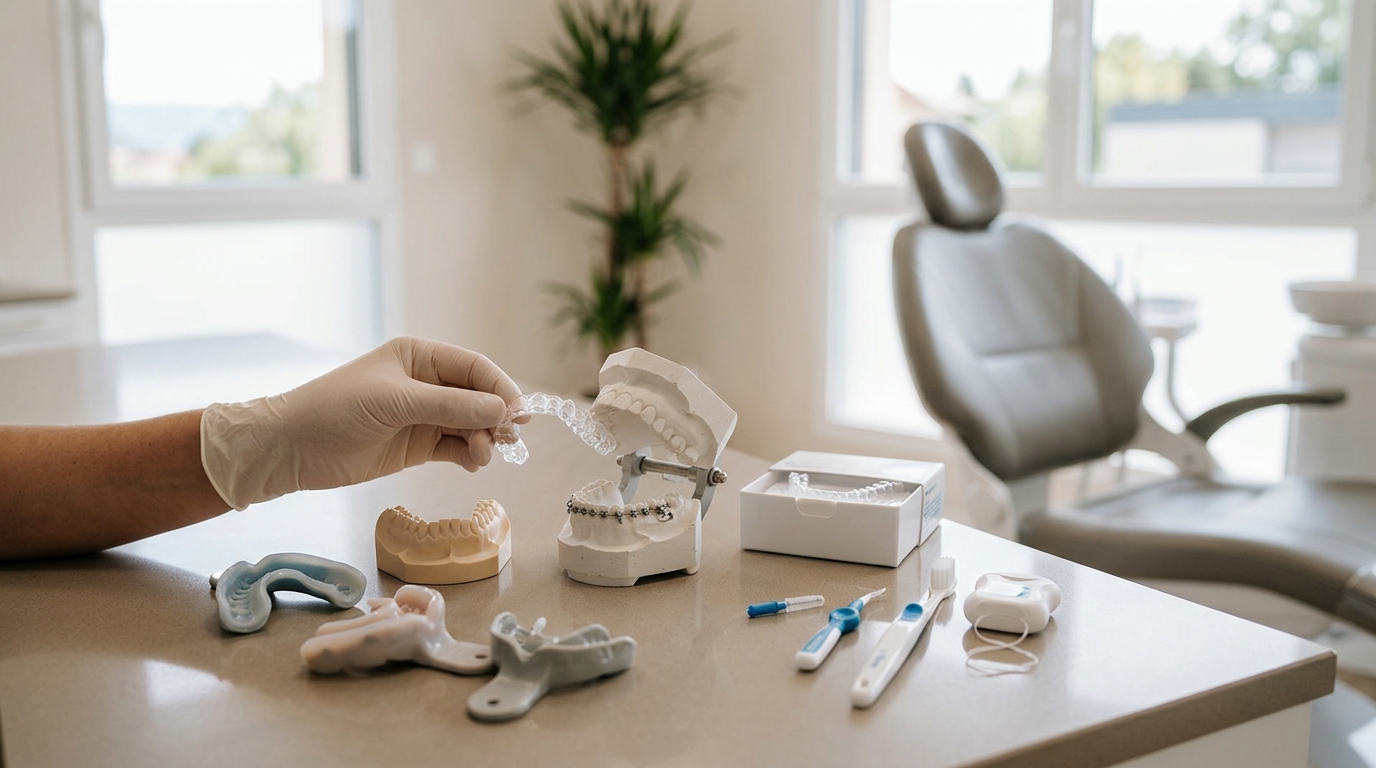
A child or adolescent presenting with malocclusion, jaw misalignment, or insufficient space for their permanent teeth is referred to a qualified specialist orthodontist. This article details the actual clinical indications and the practical organization of follow-up care at the practice in Divonne-les-Bains, which welcomes patients from the Pays de Gex region and neighboring Switzerland.
- The first orthodontic assessment is recommended around age 7 by the French National Authority for Health, the age when baby teeth and permanent teeth coexist.
- Treatment typically lasts 18 to 24 months with adjustment appointments every 6 to 8 weeks.
- The practice in Divonne-les-Bains welcomes a young and cross-border patient base, requiring logistical organization adapted to the school schedule.
A pediatric orthodontist in Divonne-les-Bains is a dental surgeon holding a Diploma of Specialized Studies in Dentofacial Orthopedics (DES ODF, representing three years of specialization after dental school). They intervene from the age of 7 to detect malocclusions, then provide regular follow-up (every 6 to 8 weeks) for an average of 18 to 24 months, with a retention phase essential for the stability of the result.
This dossier delves deeper into a specific aspect of the editorial cluster dedicated to the organization of orthodontic care in the municipalities of the Pays de Gex : it focuses specifically on pediatric clinical indications and the pace of follow-up, two topics that raise many questions among Franco-Swiss border parents in 2026.
Why consult a specialist orthodontist for your child in Divonne-les-Bains?
A specialist orthodontist is distinguished from a general dentist by three additional years of university training exclusively dedicated to dentofacial orthopedics. This qualification is officially recognized by the Health Insurance under the title "Code 36", which identifies practitioners registered with the Order as qualified specialists in orthodontics.
Code 36 Code 36 is the standard code assigned by the French National Health Insurance (Assurance Maladie) to qualified dental surgeons specializing in Dentofacial Orthopedics. It guarantees to the patient that the practitioner has completed the Diploma of Specialized Studies (DES ODF), a three-year program following six years of dental surgery training.
In practice, a general dentist can make the initial diagnosis of a misalignment, but then refers the family to a specialist orthodontist for active treatment. This referral ensures a treatment plan designed by a practitioner specifically trained in tooth movement, maxillofacial bone growth, and the biomechanics of braces.
Namely: according to the French Union of Orthodontists, Only a practitioner holding Code 36 can legally declare themselves a "qualified specialist in dentofacial orthopedics." A general dentist practicing orthodontics on an occasional basis cannot use this title.
What is the concrete difference between a dentist and an orthodontist?
The general dentist provides overall oral health care: treating cavities, scaling, restorative treatments, and preventative care. The orthodontist, on the other hand, focuses solely on repositioning teeth and guiding jaw growth. At the Divonne-les-Bains practice, this division of roles is particularly clear: families consult their general dentist for biannual checkups and are referred to a specialized orthodontic practice for any alignment treatment.
ODF
Code 36
Dentofacial orthopedics
Qualified Specialist
Treating dentist
Corresponding
«"The difference in training is not a mere administrative subtlety. Three additional years dedicated to dental biomechanics and facial growth change the accuracy of the diagnosis and the precision of the treatment plan, particularly in growing children."»
What are the clinical situations that require orthodontic treatment?
The main indications for pediatric orthodontic treatment are dental malocclusions, skeletal jaw misalignments, lack of space for permanent teeth, and orofacial dysfunctions. The French National Authority for Health (HAS) has published official recommendations detailing these indications and the optimal intervention ages.
At what age should a child have their first check-up?
The French National Authority for Health (HAS) recommends a first orthodontic assessment around age 7. At this age, the first permanent teeth (incisors and first molars) are usually present, while some baby teeth remain in place. This so-called "mixed" dentition allows the specialist to detect early growth abnormalities, early crowding, or skeletal discrepancies, and to intervene at the most opportune time.
Health alert point: An early assessment does not necessarily mean immediate treatment. In many cases, the specialist will simply schedule annual monitoring to intervene at the appropriate time. A personalized opinion requires a clinical consultation and a thorough examination.
The recommendations of the French National Authority for Health (HAS) guidelines on the use of dentofacial orthopedics in children They specify that some cases justify very early intervention, from 6 to 8 years old, particularly in the presence of a reversal of articulation (lower teeth covering the upper teeth) or an upper jaw that is too narrow requiring expansion.
What signs should alert parents of a teenager?
In adolescents, several clinical signs warrant a consultation with a specialist orthodontist in Divonne-les-Bains. Parents often notice these signs themselves on a daily basis.
🦷
Dental overlap
Teeth that overlap or bend due to lack of space on the dental arch.
↔️
Jaw misalignment
Receding or protruding chin, crossed jaw, difficulty closing the mouth properly.
👄
Mouth breathing
Open mouth at rest, snoring, signs of persistent non-nasal breathing.
👍
Persistent sucking
Thumb or pacifier sucking beyond 4-5 years of age, distorting growth.
Teenagers are also very keen on aesthetic and discreet solutions. Clear aligners are particularly appealing to this age group, who are conscious of their image, especially during middle and high school. However, the choice of appliance (visible braces, lingual braces, or clear aligners) depends on the clinical diagnosis made by the practitioner, who ensures the appropriate device is selected, and not on an isolated aesthetic preference: the patient does not choose a brand.
⚡ Class II (receding chin), Class III (protruding chin) and severe crowding are the three most frequent reasons for referral to a specialist orthodontist in adolescents aged 11 to 15 years.
The main clinical indications in pediatric orthodontics
-
Dental congestion
Insufficient space on the dental arch leading to overlapping and misaligned teeth.
-
Skeletal Class II
Receding lower jaw, often associated with mouth breathing.
-
Skeletal Class III
Mandibular prognathism, prominent chin, anterior reverse occlusion.
-
Anterior gap
Upper and lower teeth not touching, often related to sucking.
-
Cross-jointed
Lower teeth that cover the upper teeth, unilaterally or bilaterally.
-
Teeth included
Canines or premolars that do not erupt spontaneously.
How is orthodontic follow-up organized in Divonne-les-Bains?
A complete pediatric orthodontic treatment spans 18 to 24 months on average, punctuated by adjustment appointments every 6 to 8 weeks, followed by a retention phase of several years. At the practice in Divonne-les-Bains, which serves a cross-border patient base, this logistics requires precise family organization, often coordinated with school schedules and the professional constraints of cross-border parents.
The 6 stages of the orthodontic treatment process
-
Initial consultation
Interview, clinical examination, discussion of the reasons and expectations of the child and parents.
-
Diagnostic assessment
Panoramic and cephalometric radiographs, photos, digital impressions, casts.
-
Treatment plan
Presentation of the diagnosis, treatment options and timeline.
-
Active phase
Fitting of the appliance (braces, aligners or removable appliance), regular adjustments.
-
Deposit
Removal of the appliance once the occlusal objectives have been achieved.
-
Restraint
Wearing a retention device (bonded wire, night guard) to stabilize the result.
What is the actual pace of the adjustment appointments?
During the active phase, the child or adolescent returns on average every 6 to 8 weeks for an adjustment appointment, lasting 15 to 30 minutes depending on the type of treatment. For clear aligners, the interval can be extended to 10-12 weeks thanks to the simultaneous provision of several successive sets of aligners.
7years, age of the first assessment
21months on average
7weeks between appointments
12at 15 appointments for treatment
Over the course of a school year, this represents approximately 7 to 8 appointments. For a family living in Divonne-les-Bains or from the Pays de Gex region, the clinic's proximity becomes a major logistical consideration. Appointment times offered in the late afternoon or on Wednesdays help to minimize school absences.
Practical tip: Booking appointments well in advance of treatment, several months ahead of time, helps secure slots that fit with the school schedule. The practice often opens its schedules 3 to 4 months in advance.
Monitoring procedures according to the equipment
The choice of appliance depends on the clinical diagnosis made by the practitioner. Metal and ceramic braces require appointments every 6 to 8 weeks and specific dietary and hygiene restrictions, while clear aligners are removed before meals and require checkups every 8 to 12 weeks. The average treatment duration remains 18 to 24 months. The practitioner determines the technique best suited to each case; the patient does not choose a brand.
The particularity of the cross-border patient population
The Pays de Gex is a demographically very dynamic area, driven by its proximity to Geneva. According to data from the’INSEE on the population growth of Ain, This cross-border conurbation has a high concentration of young families. The demand for pediatric orthodontics is particularly strong there, which can lengthen waiting times for an initial assessment appointment.
18minimum month
24maximum months
8weeks between appointments
2years of restraint
For families living near the border, there's a specific point to consider: coverage for orthodontic treatment differs between the French system (French national health insurance + supplemental insurance) and the Swiss system (LAMal + additional supplemental insurance). Families covered by the Swiss system should anticipate the specific administrative procedures, which a practice experienced in treating this patient population can assist with.
An orthodontic assessment for your child?
For any questions regarding the indication for treatment or the organization of follow-up, please make an appointment for a clinical consultation at the office.
How to choose your orthodontic practice?
Choosing an orthodontic practice is based on three main criteria: the practitioner's qualifications (Code 36), the geographical proximity to home or school, and the technologies available at the practice.
Advantages of a specialist firm
- Practitioner holding Code 36 (DES ODF)
- Complete technical platform (digital impressions, 3D radiography)
- Exclusive orthodontic treatment
- Extensive experience with all types of malocclusions
- Easier coordination with the treating dentist
Points to be aware of
- Waiting times for an initial assessment can sometimes be long.
- Need to verify official qualification
- Check coverage for cross-border workers' schemes if applicable
- Ensure the availability of an emergency orthodontic service
Qualification criteria to be verified
- Is the practitioner listed in the directory of the National Order of Dental Surgeons with the mention "qualified specialist in dentofacial orthopedics"?
- Does the professional plaque explicitly mention this qualification?
- Does the practice exclusively practice orthodontics or is it a secondary activity?
- Are the diagnostic equipment (3D impressions, imaging) available on site?
- A service of’orthodontic emergency Is there a system in place to handle problems with the equipment?
What should you know about the retention phase after treatment?
Retention is an essential phase that begins as soon as the appliance is removed and aims to stabilize the result obtained. It usually relies on a wire bonded behind the teeth and/or a retainer worn at night. Without retention, the risk of relapse (the teeth returning to their original position) is significant.
Restraint Retention refers to all the devices used after active orthodontic treatment to maintain teeth in their new position. It can be fixed (bonded wire) or removable (night retainer), and often lasts for several years, sometimes for life.
Recidivism Orthodontic relapse is the partial or total return of teeth to their pre-treatment position, in the absence of or in the event of premature discontinuation of retention. It is favored by the tissue memory of periodontal fibers and the continuation of facial growth.
«"Restraint is not an option: it is the essential condition for the work done over 18 to 24 months to be maintained over time. We systematically emphasize this point during removal, because that is when families tend to let their guard down."»
Health alert point: Forgetting to remove or prematurely discontinuing retention is the leading cause of orthodontic relapse. Annual checkups of the retention wire and retainer are necessary for several years after the completion of active treatment.
How long does a complete treatment actually take?
A complete orthodontic treatment, from the initial consultation to the end of active retention, takes on average 4 to 6 years. It comprises three main phases, the respective durations of which vary according to the complexity of the case.
Months 0 to 3
Diagnosis and treatment plan
Initial assessment, further examinations, presentation of the plan.
Months 3 to 24
Active phase
Fitting of the device, adjustments every 6 to 8 weeks.
Months 24 to 30
Finishing touches and removal
Final corrections, removal of the equipment.
Months 24 to 60+
Restraint
Fitting of the retention wire, night guard, annual check-ups.
FAQ: Your frequently asked questions about pediatric orthodontics
How can I obtain an initial assessment for my child?
Your child's regular dentist is usually the first point of contact. They can write a referral letter explaining the reasons for the orthodontic consultation. You can also contact the orthodontic practice in Divonne-les-Bains directly to schedule an initial assessment appointment.
How to choose the best practitioner for your child?
Choosing an orthodontist is based on three objective criteria: verifying official qualifications (CPAM Code 36, registration with the Order as a qualified specialist), assessing proximity to home or school, and inquiring about the technologies used (digital impressions, transparent aligners, 3D radio).
At what age can a child consult an orthodontist?
The French National Authority for Health (HAS) recommends an initial assessment around age 7, when the first permanent teeth erupt. In certain specific cases (persistent sucking, mouth breathing, early skeletal discrepancies), a consultation as early as 4-5 years of age may be appropriate for interceptive orthodontics.
What is the average duration of orthodontic treatment in adolescents?
The active phase of orthodontic treatment in adolescents lasts on average 18 to 24 months. This is followed by a retention phase lasting several years, which is essential to prevent relapse. The exact duration depends on the complexity of the initial malocclusion and the patient's cooperation (hygiene, wearing elastics, keeping appointments).
Do you need a prescription to see an orthodontist?
No, orthodontists are direct-access specialists. You can make an appointment without a prescription or referral letter. However, a referral letter from your primary dentist is often helpful to share previously collected clinical information and facilitate care coordination.
Are orthodontic treatments covered by insurance for children?
Health insurance covers orthodontic treatments started before the age of 16, provided a prior authorization request is approved. The remaining cost varies depending on the supplementary health insurance and the type of appliance chosen. For cross-border families covered by the Swiss health insurance system (LAMal), reimbursement procedures are specific and must be assessed on a case-by-case basis.
What to do in case of an orthodontic emergency (bracket comes loose, wire is pricking)?
If there is a problem with the braces (a loose bracket, a wire rubbing against the cheek, a broken retainer), you should contact the orthodontist's office that treats your child as soon as possible. Most offices have a daily appointment slot dedicated to emergencies. While waiting for the appointment, a piece of orthodontic wax can temporarily relieve discomfort.
Are clear aligners suitable for all teenagers?
Clear aligners are suitable for many adolescent cases, provided the patient is disciplined enough to wear them 22 hours a day and adhere to the scheduled changes. Some complex malocclusions still require treatment with braces to achieve optimal results: the practitioner determines the appropriate technique on a case-by-case basis during the assessment; the patient does not choose a brand.
📌 Key points to remember
- A specialist orthodontist is a dental surgeon holding the DES ODF (Code 36), which is 3 years of specialized training after dental school.
- The French National Authority for Health (HAS) recommends a first orthodontic assessment from the age of 7, at the time of the appearance of the first permanent teeth.
- The main pediatric indications are malocclusions, jaw misalignments, crowding, open bites and impacted teeth.
- Active treatment lasts 18 to 24 months on average, with appointments every 6 to 8 weeks.
- The retention phase that follows removal is essential to prevent recurrence.
- At the Divonne-les-Bains office, proximity (home or school) is a major logistical criterion for families coming from the Pays de Gex.
- For Franco-Swiss border families, the arrangements for support differ between schemes and must be anticipated.
Need a personalized consultation for your child?
A personalized opinion requires a clinical consultation and a thorough examination. Dr. Nicolas Barrière's practice in Divonne-les-Bains welcomes families from the Pays de Gex region.

About the author: Nicolas Barrière
Dr. Nicolas Barrière is an orthodontist, a qualified specialist in dentofacial orthopedics, a former hospital intern, and the founder of his practice in Divonne-les-Bains. He treats children, adolescents, and adults with orthodontic treatments (clear aligners, lingual braces), paying particular attention to the care of patients living near the French-Swiss border.
Areas of expertise: Dentofacial orthopedics, preventive and interceptive orthodontics from age 4, adolescent and adult orthodontics, clear aligners, lingual orthodontics, aesthetic ceramic braces, orthognathic surgery, management of malocclusions and complex cases, functional disorders and TMJ, sleep apnea, retention and relapse management, orthodontic emergencies.
📚 Sources and references
Official and institutional sources:
- French National Authority for Health: Indications for dentofacial orthopedics in children and adolescents
- HAS: Report on the indications for orthodontics (PDF)
- HAS: Criteria for successful completion of dentofacial orthopedic treatment
- Health Insurance: Reimbursement for orthodontic treatments
- DREES: Children's Oral Health (PDF)
- INSEE: Population growth in the Ain department
Professional sources:
- French Union of Orthodontists: Code 36
- SFODF: Recommendations for good practice
- SFODF: Recommendations on restraint (PDF)
- CNP ODF-ODMF: Presentation of the specialty
📖 Also read:
 French
 English