
Adult lingual braces in Divonne-les-Bains are invisible at work because they are bonded behind the teeth. Clear aligners are removable and suitable for mild to moderate corrections. Average treatment duration for adults: 12 to 24 months depending on the complexity. Health Insurance

Discreet orthodontics for adults: lingual braces and clear aligners, two techniques with different indications
Written by Nicolas Barrière Orthodontist, Qualified Specialist in Dentofacial Orthopedics, founder of the practice. Updated on . Reading time: approximately 14 minutes.
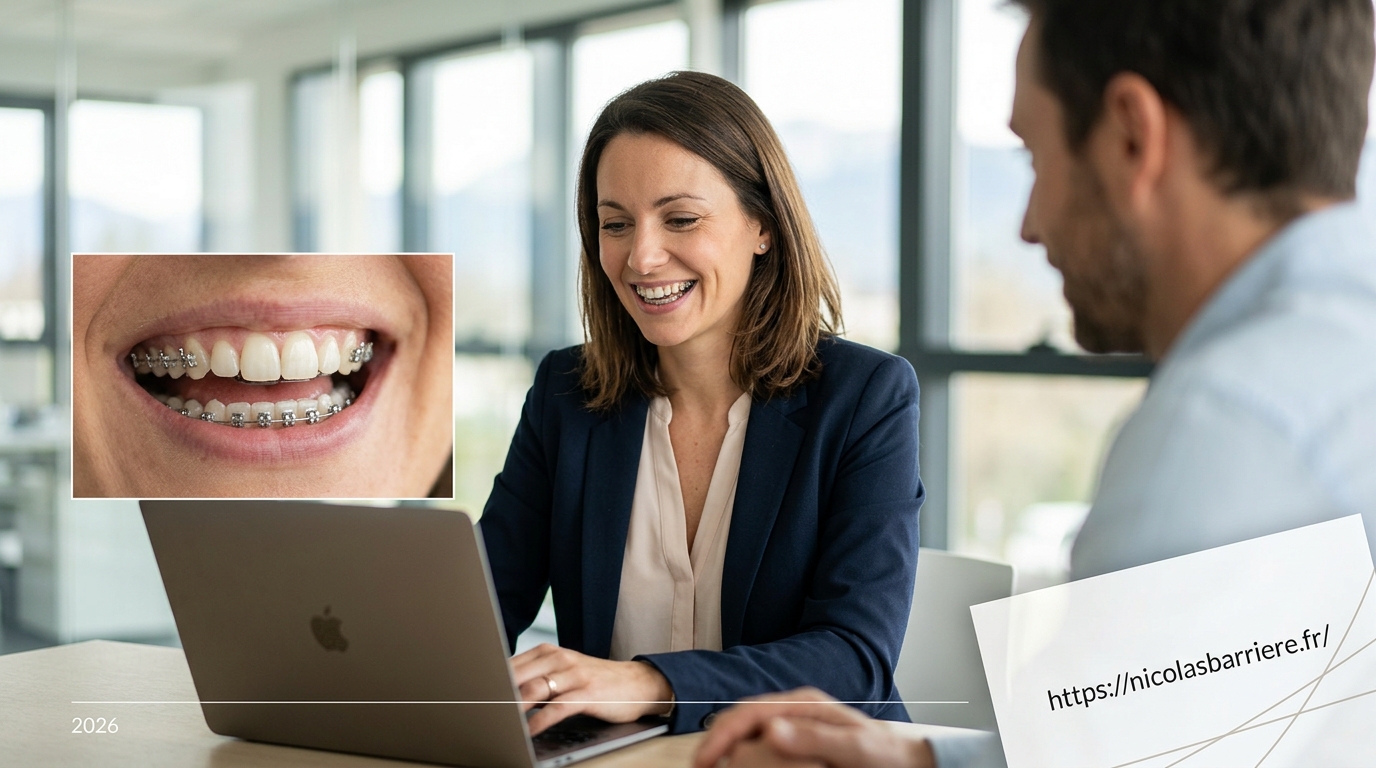
In Divonne-les-Bains, a growing number of working adults want to correct their teeth without their braces being visible in social settings. Two techniques meet this demand for invisibility: lingual braces and clear aligners.
- Adult lingual braces in Divonne-les-Bains are invisible at work because they are glued behind the teeth.
- Clear aligners are removable and suitable for mild to moderate corrections.
- Average duration of adult treatment: 12 to 24 months depending on the complexity.
- Health insurance will no longer reimburse orthodontics after age 16 in 2026.
For an adult working in Divonne-les-Bains, invisible orthodontics relies on two main solutions: lingual braces fixed behind the teeth and removable clear aligners. Lingual braces allow for the treatment of complex malocclusions in a completely invisible way, even in the office. Aligners offer optimal flexibility for cases requiring mild to moderate corrections.
In 2026, in Divonne-les-Bains, the demand for invisible orthodontic treatment for adults in the workplace continued to grow. The practice welcomed patients from the Pays de Gex region, the Ain department, and neighboring Switzerland. Cross-border workers, executives, and professionals: many wanted to straighten their teeth without compromising their professional image. Understanding the differences between lingual braces and clear aligners helps people approach their first consultation with their orthodontist with confidence.
Important point to note: This article is for informational purposes only. Only a clinical consultation with a qualified orthodontist can establish an accurate diagnosis and recommend the most suitable technique for your situation. Make an appointment at the office for a personalized assessment.
What are the fundamental differences between lingual braces and aligners?
Lingual braces are fixed brackets bonded to the inside (lingual) surface of the teeth, invisible from the outside. Clear aligners are removable plastic trays worn for 22 hours a day and changed regularly to guide tooth movement.
The demand from working adults in Divonne-les-Bains requires near-total invisibility. Both techniques meet this aesthetic requirement, but through very different mechanisms. One is fixed and hidden behind the teeth, the other is removable and transparent.
Lingual orthodontics : orthodontic technique using brackets and wires glued to the inside surface of the teeth (tongue side), making the device completely invisible from the outside.
How does the lingual orthodontics technique work?
Lingual braces rely on custom-made brackets bonded to the inside of the teeth, connected by a wire that exerts continuous tension to move the roots. This device is completely hidden by the teeth themselves: during a discussion or a meeting, no ring is perceptible, even at very close range.
Modern systems offer miniaturized brackets, custom-made from a digital impression of the patient's mouth. This personalization improves both comfort and the precision of tooth movement.
👁️
Total invisibility
The fasteners are concealed behind the teeth, invisible even in close-up.
🔧
Fixed device
Nothing to remove, no risk of forgetting or losing it on a daily basis.
🎯
Complex movements
Suitable for rotations, extractions and cases of severe malocclusion.
How do clear aligners affect teeth?
Clear aligners are rigid plastic trays worn for about 22 hours a day, replaced every 1 to 2 weeks according to the treatment plan. Each new aligner applies targeted pressure to specific teeth, gradually moving them into their final position.
The treatment is planned digitally in advance: the orthodontist models all the stages of the tooth movement, then has the complete set of aligners manufactured. The patient changes them themselves at home, according to the prescribed schedule.
Clear aligners : removable orthodontic trays made of thermoformed plastic, used in successive series to progressively correct the alignment of teeth in adults or adolescents.
What are the clinical indications for each orthodontic treatment?
Lingual braces are indicated for complex malocclusions requiring significant tooth movement, such as after extractions or severe rotations. Clear aligners are suitable for mild to moderate crowding and spacing. The choice is based primarily on an accurate clinical diagnosis, not solely on aesthetic preference.
Before making any decision, it is essential to understand that the choice of orthodontic technique does not depend solely on the desire for invisibility. The medical diagnosis, made after a clinical examination, X-rays, and analysis of the relationship between the jaws, determines what is technically possible and clinically desirable. The practitioner remains responsible for choosing the appliance—visible braces, lingual braces, or aligners—based on the clinical situation.
In what cases should lingual braces be preferred?
According to a systematic review published on PubMed Central (study on the effectiveness of lingual orthodontics), Lingual braces demonstrate comparable effectiveness to traditional vestibular braces for complex treatments. They are particularly well-suited to the following situations:
- Severe malocclusions requiring tooth extractions
- Significant rotations of incisor or canine teeth
- Anterior or lateral open bites
- Clinical situations requiring precise control of root movement
- Patients prioritizing absolute invisibility at work
When are clear aligners more suitable?
Clear aligners are particularly suitable for mild to moderate crowding, gaps between teeth, and post-orthodontic relapse. Before choosing, it is advisable to compare orthodontic treatments and dental veneers to correct the alignment of her smile, because some situations are more suited to prosthetics than orthodontics.
There The French National Authority for Health (HAS) reiterates in its report on the indications for dentofacial orthopedics The importance of an accurate diagnosis of malpositions before choosing a technique. This diagnosis involves a complete clinical examination, cephalometric analysis, and sometimes three-dimensional imaging.
Lingual braces: advantages
- Total invisibility at work and in public
- Fixed device, no possibility of forgetting
- Effective on complex cases
- Precise control by the practitioner
Aligners: advantages
- Removable for eating and brushing teeth
- Superior initial comfort
- Digital visualization of the result
- Follow-up appointments spaced out
Health alert point: No article can replace a clinical examination. The suitability of orthodontic technique to individual circumstances can only be verified after a complete assessment, including radiographs, impressions, and occlusal analysis. Assessing your orthodontic needs It could be an informative first step.
Why does digital impression taking facilitate diagnosis?
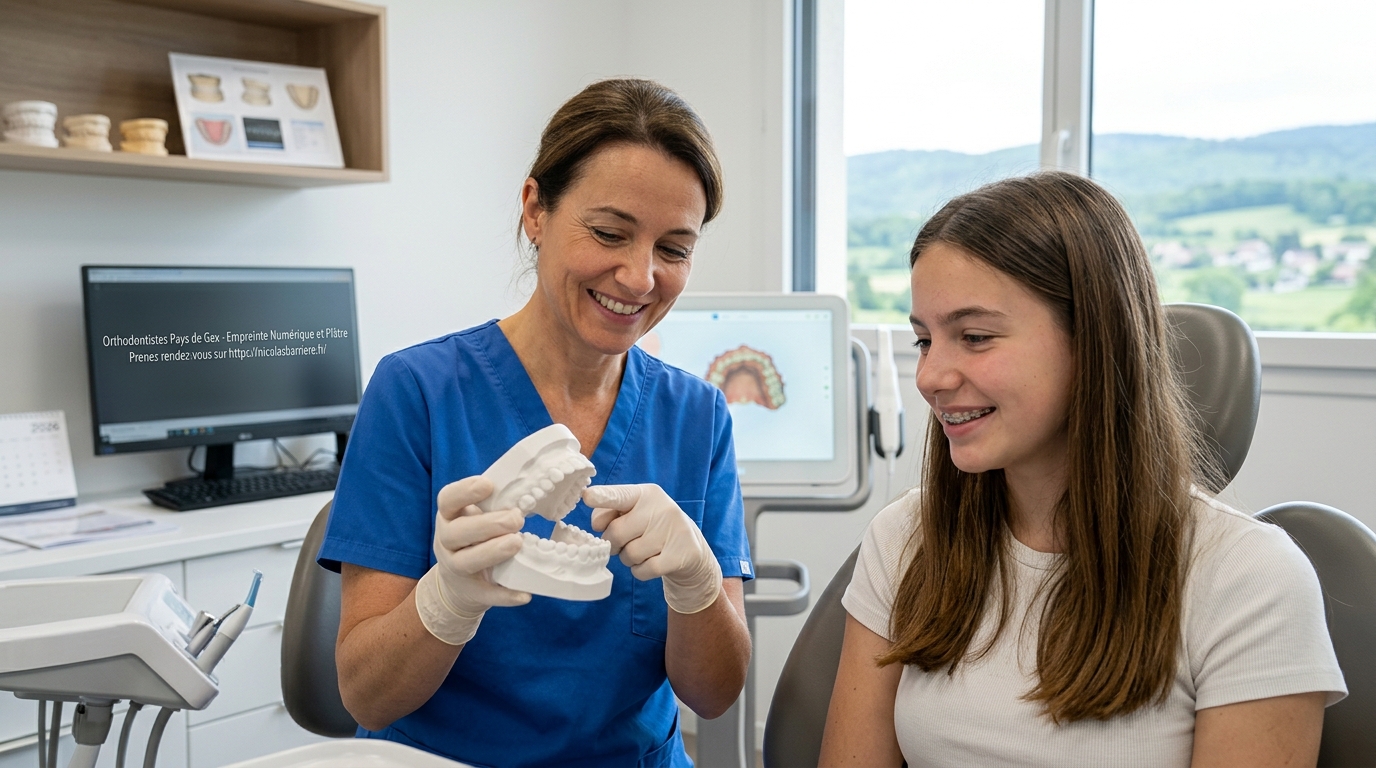
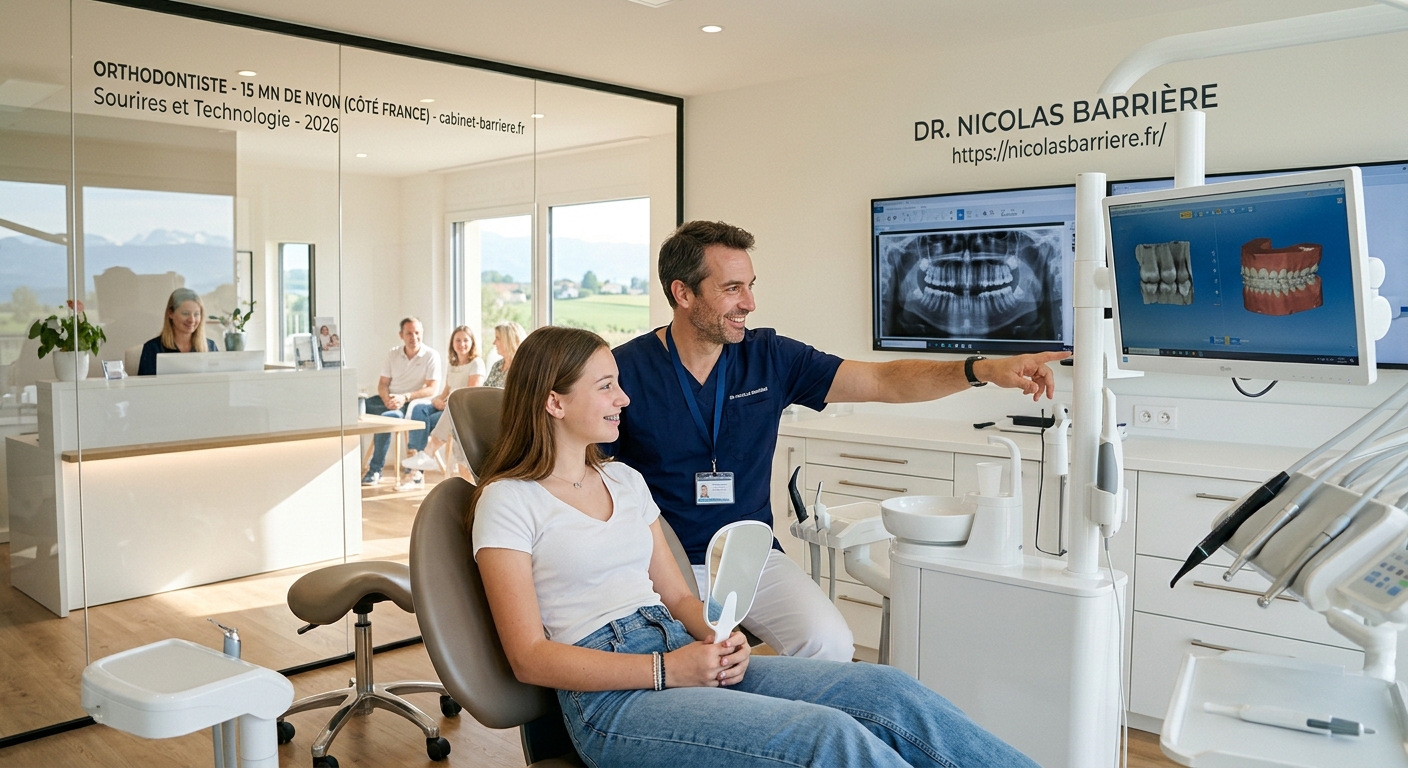
Digital impressions have replaced plaster impressions in many dental practices. They allow for immediate 3D modeling of the teeth, used for fabricating custom lingual braces as well as planning aligners. To learn more about this process, see our dedicated article on...’Digital impressions in orthodontics and their importance in adult treatment planning.
How to manage your invisible braces at work in Divonne-les-Bains?
At work, lingual braces require no special care as they are fixed and invisible. Clear aligners require daily discipline: remove them to eat, brush your teeth after each meal, and then put them back in immediately to achieve 22 hours of wear per day.
For an executive, salesperson, or cross-border worker in Geneva, integrating treatment into their professional life is a crucial factor. Business lunches, client meetings, presentations: each situation presents its own set of challenges.
What is the impact of lingual braces on speech?
Lingual braces induce a tongue adaptation period of 1 to 3 weeks, during which a slight lisp may be perceived. This temporary discomfort gradually disappears as the tongue adapts to the new intraoral configuration. Most patients regain normal speech within a month of placement.
Beyond this initial phase, the major advantage of lingual braces in a professional setting is their fixed nature: nothing to remove before an appointment, no visible manipulation in public, no time constraints.
Week 1Language adaptation, slight lisp possible
Week 2-3Gradual reduction of phonetic discomfort
Month 1Speech has returned to its natural state in most cases
Continuation of treatmentStable comfort until removal
What is the daily routine like when wearing clear aligners?
The aligners must be removed before each meal and each hot or colored drink, then put back in after careful brushing of the teeth. This discipline determines the effectiveness of the treatment: insufficient wearing prolongs the duration of the treatment, or even compromises the result.
For a professional working in Divonne-les-Bains, this means having a brushing kit at the office, discreetly managing the removal and replacement of the aligners during business lunches, and remaining vigilant about the cumulative wearing time each day.
-
Upon waking
Remove the trays, brush your teeth and aligners with warm water.
-
At breakfast
Eat your meal, then brush your teeth before putting your aligners back in.
-
Lunch at the office
Remove the trays into a dedicated case, eat, brush your teeth in the toilet, put the aligners back in.
-
Evening
Another removal for dinner, brushing, putting the aligners back in for the night.
-
Before bedtime
Gutter cleaning, continuous wear until the following morning.
For a complete description of how removable aligners work, see our dedicated article on Clear aligners for adults: how they work, indications, and follow-up care.
«"The success of aligner treatment in active adults depends primarily on the regularity of daily wear. Patients who establish a routine from the very first days achieve the best results, regardless of the initial complexity of their case."»
How long is the adaptation period to expect with lingual braces?
Adapting to lingual braces happens in several phases. The first few days may be accompanied by tooth sensitivity, minor tongue irritation, and a temporary change in chewing. Applying orthodontic wax to any uncomfortable brackets and being patient for a few weeks will allow you to get through this stage smoothly.
To understand in detail how it works, its indications, and how to adapt it to daily life, consult our guide on the Lingual braces in adults: principle, indications and daily use.
What is the cost and reimbursement for adult orthodontics?
In 2026, French national health insurance (Assurance Maladie) will no longer cover orthodontic treatment for those over 16. The chosen technique and the treatment duration, ranging from 12 to 24 months, are primarily determined by the clinical diagnosis and the practitioner's expertise. Supplemental health insurance plans and cross-border insurance providers offer specific coverage packages.
Understanding the treatment process is a legitimate expectation for adult patients. Before any consideration of cost, the clinical diagnosis and the practitioner's expertise determine the appropriate technique for each case. A personalized quote is always provided after the initial consultation.
Each orthodontic technique addresses specific clinical indications. The choice of appliance—lingual braces, clear aligners, or vestibular braces—is made by the practitioner based on each patient's individual situation and not on cost.
Good to know for cross-border workers: Patients working in Switzerland often have supplemental health insurance that includes coverage for adult orthodontics. The practice assists with the preparation of applications for Swiss LAMal (Swiss health insurance) and supplemental insurance, as well as those for French mutual insurance companies.
What does a quote for adult orthodontic treatment consist of?
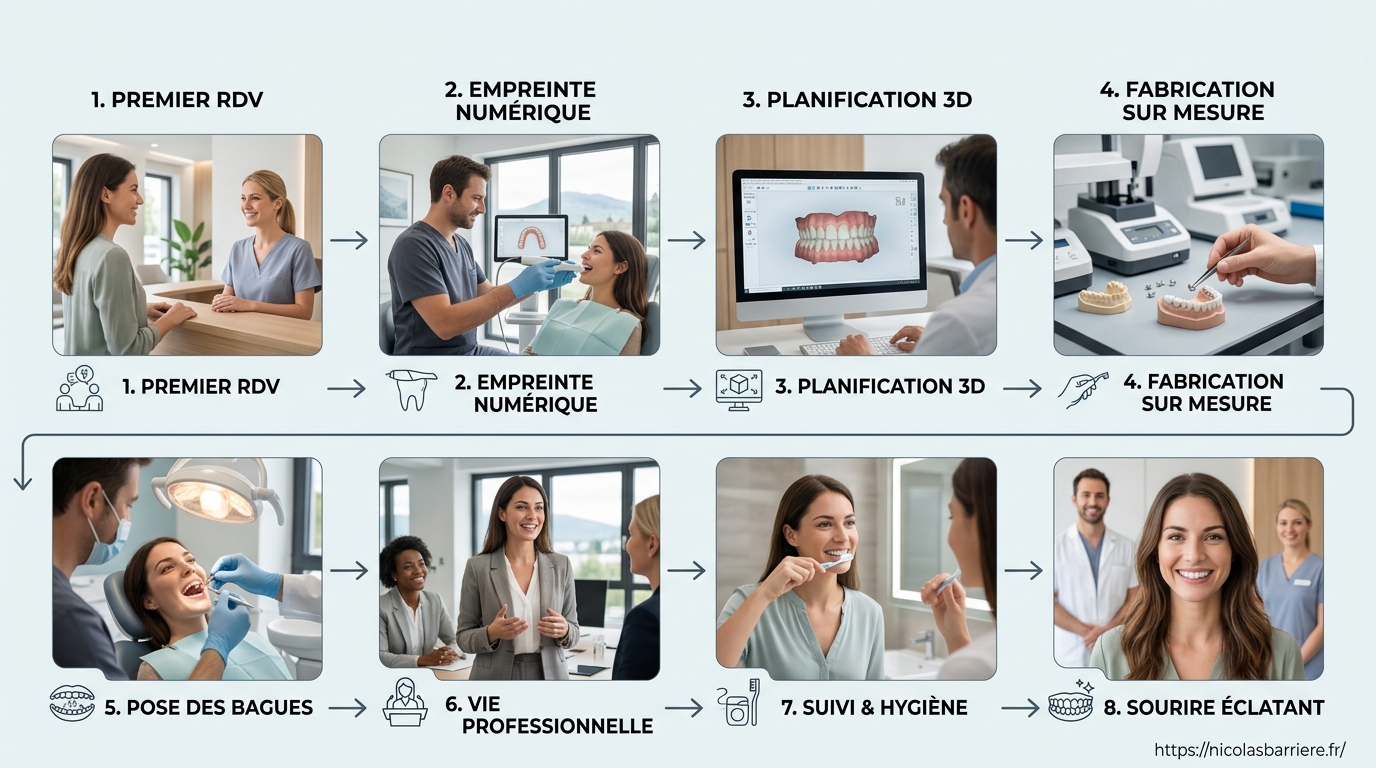
The orthodontic treatment plan typically covers the entire process: initial assessment, additional examinations, appliance placement, follow-up appointments, completion of treatment, and retention. The detailed plan is presented during the final consultation, after diagnosis.
-
Diagnostic assessment
Clinical examination, radiographs, impressions, cephalometric analysis.
-
Treatment plan
3D modeling, choice of technique, detailed quote.
-
Active phase
Device placement, monthly or spaced-out follow-up consultations.
-
End of processing
Removal of braces or discontinuation of aligners, verification of the result.
-
Restraint
Placement of a glued wire or wearing of a night guard to stabilize the result.
How to choose between lingual braces and aligners depending on your professional situation?
The choice depends on three main criteria: the complexity of the clinical case as diagnosed by the orthodontist, the patient's professional lifestyle, and their ability to maintain a daily routine. Lingual braces are suitable for professions with high exposure and no tolerance for forgetfulness, while aligners are better suited to disciplined patients seeking flexibility.
In Divonne-les-Bains, the profile of adult patients is varied: cross-border workers, professionals, teachers, and business owners. Each has specific constraints that influence their choice. The orthodontist guides this process during the initial assessment.
💼
High-risk professions
Managers, salespeople, teachers: lingual braces avoid any visible manipulation and any time constraints related to wearing a device.
✈️
Frequent travel
Aligners require a brushing kit to be kept on hand at all times.
🍽️
Business lunches
Lingual braces do not require removal before a business meal.
🎤
Speaking
Allow 2 to 3 weeks for phonetic adaptation with lingual braces.
A personalized diagnosis to choose the right technique
Each situation is unique: only a clinical examination can guide us towards the solution best suited to your mouth and your professional life.
How does the follow-up of adult orthodontic treatment proceed in Divonne-les-Bains?
Adult orthodontic treatment involves regular check-ups (every 4 to 8 weeks depending on the technique), adjustments to the appliance or aligners, and a final retention phase to stabilize the results. The average total duration is 12 to 24 months.
Regular appointments are essential for effective treatment. Missed or delayed appointments can lengthen the overall duration. The practice schedules appointments taking into account professional constraints, particularly for patients who live near the border.
Month 0
Initial assessment
Complete diagnosis, choice of technique, quote.
Month 1
Installation of the device
Fitting of the braces or handing over of the first set of aligners.
Months 2 to 18
Active phase
Regular follow-up consultations, adjustments to the device or change of aligners, verification of progress.
Months 18 to 24
End and restraint
Removal and placement of the wire or retainer.
For life
Restraint monitoring
Periodic check-ups to prevent recurrence.
Why is compression therapy essential after adult treatment?
After active treatment is completed, teeth retain a natural tendency to return to their original position. Retention, in the form of a bonded wire behind the incisors or a night guard, maintains the achieved result. In adults, it is often recommended long-term, even lifelong, because periodontal tissues are less malleable than in adolescence.
To delve deeper into the question of choosing between orthodontics and veneers, read our article on the...’Adult orthodontics: when veneers are considered and when orthodontics is indicated.
«"Retention is too often underestimated by adult patients. Yet, it is what guarantees the long-term success of orthodontic treatment. A properly placed and regularly checked retention wire prevents most relapses."»
What to do if you have a problem with your orthodontic appliance at work?
If a bracket comes loose, a wire is causing irritation, or you lose your aligner, you should contact your orthodontist's office immediately for an emergency appointment. In the meantime, orthodontic wax can soothe any irritation, and wearing your previous aligner can help maintain the treatment.
Everyday incidents are not uncommon and should not be a cause for undue concern, provided they are addressed promptly. The practice has dedicated slots for orthodontic emergencies to avoid any interruption of treatment.
In case of an orthodontic emergency: Contact your healthcare provider promptly. To learn more about situations requiring immediate attention, consult the dedicated page on orthodontic emergency.
📌 Key points to remember:
- Lingual braces are completely invisible because they are glued behind the teeth, ideal for professions with high exposure in Divonne-les-Bains.
- Clear aligners are removable and suitable for mild to moderate corrections, with a daily discipline of 22 hours of wear per day.
- The choice between the two techniques depends first and foremost on the clinical diagnosis, not solely on aesthetic preference.
- The average duration of adult treatment varies between 12 and 24 months depending on the complexity of the case.
- Health insurance does not reimburse orthodontics after age 16 in 2026, but mutual insurance companies offer specific packages.
- Final retention is essential to stabilize the result in the long term.
- Only an in-office consultation allows for the establishment of a personalized treatment plan adapted to each situation.

About the author: Dr. Nicolas Barrière
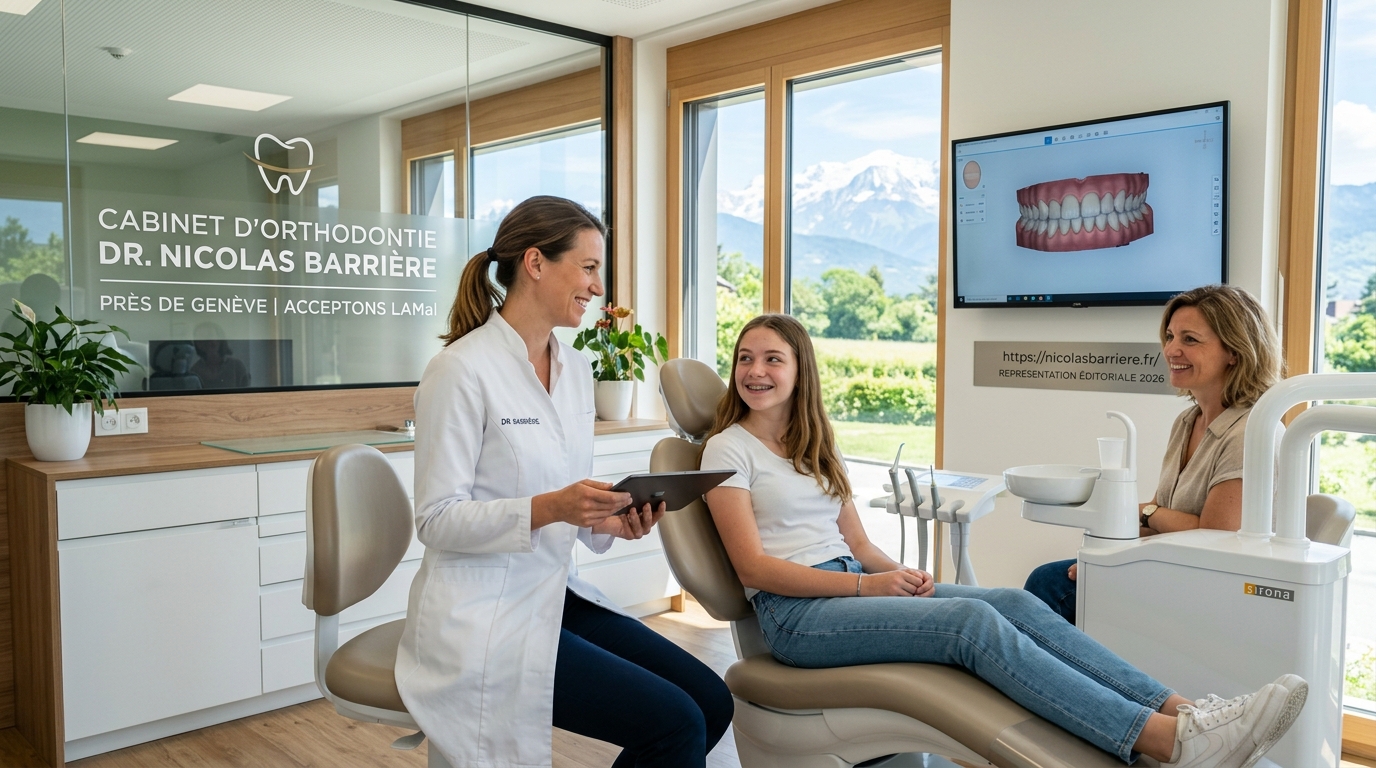
Dr. Nicolas Barrière is an orthodontist, a qualified specialist in dentofacial orthopedics, a former hospital intern, and the founder of his practice in Divonne-les-Bains. He treats children, adolescents, and adults with orthodontic treatments (invisible aligners, lingual orthodontics), paying particular attention to the care of patients living near the French-Swiss border.
Areas of expertise: Orthodontics, Dentofacial orthopedics, Invisible aligners, Lingual orthodontics, Children's orthodontics, Adult orthodontics.
Frequently asked questions about invisible orthodontics for adults
Do lingual braces hurt?
Lingual braces may cause temporary sensitivity during placement and each time the wires are adjusted, as well as slight tongue irritation during the first few days. These discomforts gradually decrease within 1 to 3 weeks, as the tongue adjusts to the appliance. Applying orthodontic wax can relieve any uncomfortable contact points.
Is it safe to smoke or drink coffee while wearing clear aligners?
The aligners must be removed before drinking hot or colored beverages such as coffee, tea, or wine to prevent heat from warping the plastic and causing the device to yellow. Smoking is also discouraged while wearing the aligners, as it permanently stains the material and can impair its transparency.
What is the average duration of lingual treatment for an adult?
The duration of lingual braces treatment varies depending on the initial malocclusion and the complexity of the case, generally ranging from 12 to 24 months to achieve stable dental alignment. Simple cases can resolve in less than a year, while complex malocclusions involving extractions may require up to 30 months.
Are lingual braces really invisible at work?
Yes, lingual braces are completely invisible from the outside because they are bonded to the inside surface of the teeth (tongue side). Even during close conversation or a presentation in a meeting, they remain hidden by the teeth themselves. This is their main advantage for professions with high visibility in Divonne-les-Bains.
Is it possible to switch from treatment with aligners to lingual braces?
Yes, a change of technique during treatment is possible if the clinical diagnosis warrants it, for example, if tooth movement cannot be achieved with aligners. This decision is made by the orthodontist after evaluating the progress and may require an adjustment to the initial treatment plan.
Are French-Swiss border residents reimbursed for adult orthodontics?
Cross-border workers affiliated with the Swiss health insurance system (LAMal) or with supplementary Swiss insurance can benefit from specific orthodontic packages for adults, depending on their contract. In France, supplementary health insurance companies also offer dedicated packages. The practice assists with the application process for both systems.
Is it necessary to wear a retainer after lingual braces or aligners?
Yes, a retention phase is always included after any orthodontic treatment for adults, regardless of the appliance used. It takes the form of a wire bonded behind the incisors or a night guard, to be worn long-term to stabilize the result and prevent relapse.
At what age can lingual braces be considered?
Lingual braces can be fitted as soon as the permanent teeth have erupted, generally from age 15-16, and in adults without an upper age limit. In adults, there is no maximum age for starting orthodontic treatment, provided that the periodontal and dental condition is compatible with the planned tooth movements.
Would you like a personalized opinion on your situation?
A clinical assessment in the office allows for a precise evaluation of the feasibility and relevance of each technique for your case.
📚 Sources and references
Official and institutional sources:
- French National Authority for Health: Indications for dentofacial and dentomaxillofacial orthopedics
- HAS: Criteria for successful completion of dentofacial orthopedic treatment
- Ameli: Orthodontic diagnosis of dental malpositions
Academic and scientific sources:
- PubMed Central: Evidence of Effectiveness of Lingual Orthodontics as an Alternative to Conventional Labial Orthodontics
- PubMed: Implications of Lingual Orthodontics Compared to Conventional Orthodontics
- PubMed: Orthodontic Retreatment of an Adult Bimaxillary Protrusion Patient With Lingual Appliances
- Wikipedia: Lingual braces
📖 Also read:
- Misaligned teeth in adults: orthodontics or veneers, two different approaches
- Digital impressions in orthodontics: procedure and benefits for adults
- Clear aligners for adults: how they work, indications and monitoring
- Lingual braces in adults: principle, indications and daily wear
- Adult orthodontics: when veneers are considered and when orthodontics is indicated



 French
 English