
The treating dentist detects the anomaly and refers the patient to a qualified orthodontist. The orthodontist undergoes 3 to 4 years of specialization after graduating as a dentist. A first assessment is recommended by the French National Health Insurance (Assurance Maladie) starting at age 7. Coverage by Social Security...

Orthodontics in the Ain department, Gex and Saint-Genis-Pouilly area: how does referral to a specialist work?
Written by Nicolas Barrière : Orthodontist, Qualified Specialist in Dentofacial Orthopedics, founder of the practice at nicolasbarriere.fr. Updated on . Reading time: approximately 12 minutes.
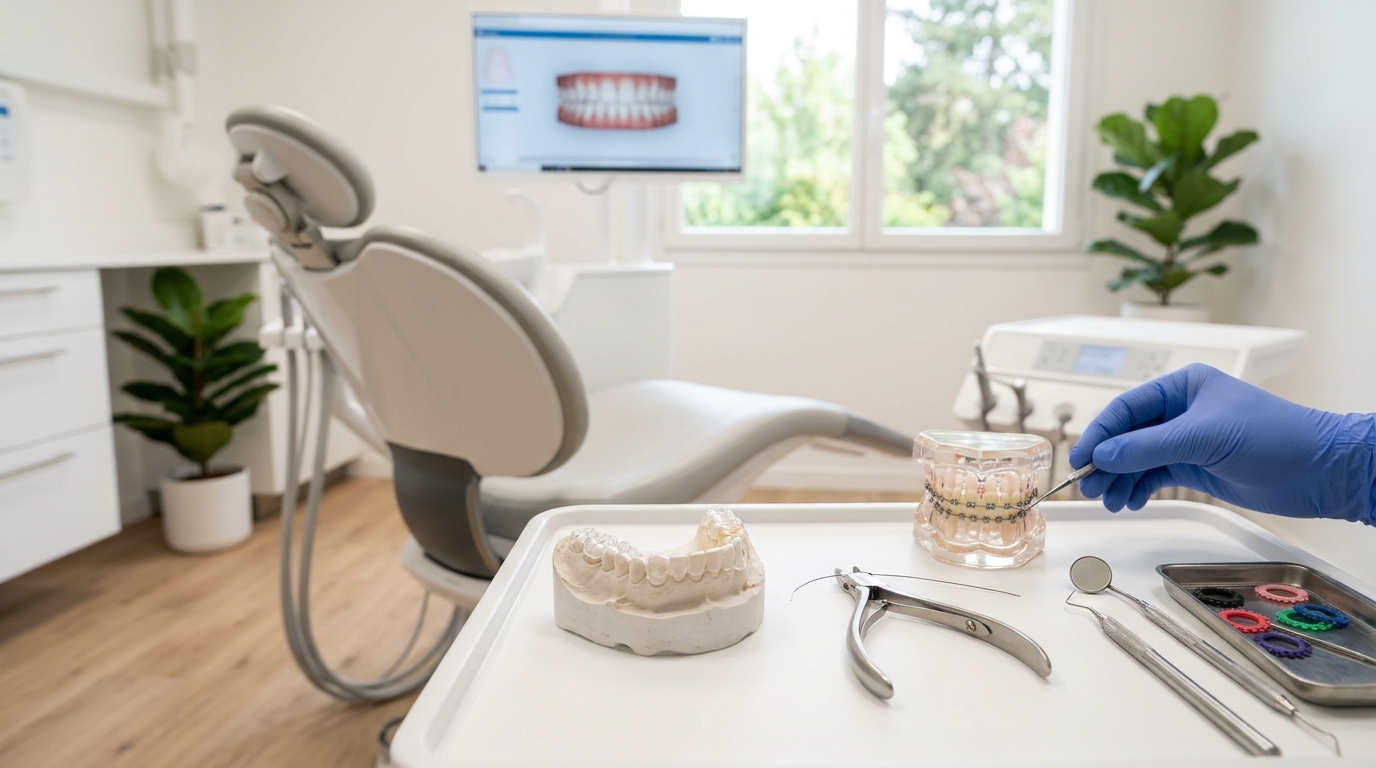
Finding an orthodontist near Saint-Genis-Pouilly or Thoiry requires a clear understanding of the care pathway between the treating dentist and the orthodontist. This medical coordination is the cornerstone of successful treatment in the Pays de Gex region.
- The treating dentist detects the anomaly and refers the patient to a qualified orthodontist.
- An orthodontist undergoes 3 to 4 years of specialization after graduating as a dental surgeon.
- A first assessment is recommended from the age of 7 by the Health Insurance.
- Coverage by Social Security is possible before age 16, upon request for prior agreement.
- The treating dentist continues routine care (cavities, scaling) during orthodontic treatment.
To begin treatment at a orthodontist near Saint-Genis-Pouilly or Thoiry, The patient first consults their general dentist. This dentist performs a comprehensive oral examination and then refers the patient to a qualified specialist in dentofacial orthopedics with a referral letter. This coordinated approach ensures a structured care pathway in the Pays de Gex region.
The Gex, Saint-Genis-Pouilly, and Thoiry area forms a dynamic living space in the Ain department, characterized by its close proximity to Geneva and a growing young population. To understand how a consulting firm...’organization of the orthodontic practice and accessibility for patients from the Pays de Gex and surrounding municipalities To coordinate with local dentists, it's essential to first understand the distinction between two professions that are often confused. In 2026, many families living in Thoiry, Prévessin-Moëns, Ferney-Voltaire, or Saint-Genis-Pouilly are wondering about this process: who to consult first, when, and how to organize the next steps?
Health alert point: This article is for informational purposes only. A personalized opinion on your situation or that of your child always requires a clinical consultation and a thorough examination in a doctor's office.
What is the difference between a dental surgeon and an orthodontist?
The dentist treats all aspects of oral health (cavities, gums, prevention). The orthodontist is a dentist who has completed 3 to 4 years of additional specialization in dentofacial orthopedics, dedicated exclusively to correcting misaligned teeth and jaws.
In everyday language, the two professionals are often confused. However, their training, skills, and scope of practice differ significantly. The dentist is the primary care practitioner for all things oral: they treat cavities, monitor periodontal health, place crowns, extract wisdom teeth, and provide preventative care through annual cleanings. They are your "family doctor" for your oral cavity.
L'’orthodontist, He, on the other hand, is necessarily a dental surgeon to begin with. After obtaining his state diploma as a Doctor of Dental Surgery (6 years of study), he chooses to pursue further specialized training. Two paths are recognized in France: the CECSMO or the OF THE d’dentofacial orthopedics. These courses last an additional 3 to 4 years full-time, in a university hospital center.
Dentofacial orthopedics : medical specialty that studies, prevents and corrects anomalies in the position of teeth and the shape of jaws. Dentofacial orthopedics acts on both dental alignment and the growth of facial bone structures, particularly in children and adolescents.
Their respective areas of intervention
Treating dentist
- Cavities and conservative treatments
- Descaling and prevention
- Periodontal (gum) care
- Prostheses (crowns, bridges)
- Typical Extractions
- Initial detection of malpositions
Qualified specialist orthodontist
- Correction of dental malpositions
- Jaw orthopedics in children
- Fitting of multi-bracket appliances (braces)
- Treatments using clear aligners
- Lingual orthodontics (inner surface)
- Coordination with orthognathic surgery
The French National Authority for Health (HAS) precisely defines the indications for dentofacial orthopedics. It has published guidelines. Official indications for dentofacial orthopedics in children and adolescents, which serve as a reference for practitioners to determine the indication for treatment.
The "Code 36": Only practitioners holding a recognized specialist diploma (CECSMO or DES) can use the title "orthodontist" and bill for procedures under the CCAM code for exclusive orthodontics. The French Union of Orthodontists regularly emphasizes the importance of this qualification for patient safety.
What is a qualified specialist?
Qualified specialist in dentofacial orthopedics : an official title recognized by the National Council of the Order of Dental Surgeons, awarded to practitioners who have validated the CECSMO or the DES in Orthodontics. This title attests to an exclusive practice of orthodontics, unlike a general dentist who practices orthodontics on an occasional basis.
This distinction has a concrete impact on care: a qualified specialist devotes 100% of their activity to orthodontics, which allows them to master complex cases (impacted teeth, severe dysmorphoses, pre-surgical preparations).
«"Many patients only discover the difference the day their dentist suggests an orthodontic assessment. Explaining our respective roles already reassures the family about the process that lies ahead."»
How does the dentist direct his patient in the Saint-Genis-Pouilly and Thoiry area?
The treating dentist detects the anomaly during a routine check-up, informs the family, and writes a referral letter to a local orthodontist. This letter includes the reason for the consultation, the patient's dental history, and facilitates the transfer of medical records for coordinated care.
In the Pays de Gex, this approach is embedded in a unique local network. The region encompasses several medium-sized towns (Saint-Genis-Pouilly has approximately 12,000 inhabitants, Thoiry nearly 6,000, and Gex over 13,000), with a young population and sustained demographic growth due to its proximity to Geneva. Families often reside across several towns and send their children to schools throughout the canton.
The concrete steps of career guidance
-
Detection during the annual dental check-up
The dentist observes a malocclusion, crowding, jaw misalignment or a disturbing oral habit (persistent thumb sucking, mouth breathing).
-
Family information
The practitioner explains the observed anomaly, its likely progression, and the benefits of a specialist opinion. He answers initial questions about the time frame, age, and type of treatment possible.
-
Drafting the address letter
A professional letter is given to the family or sent directly to the orthodontic practice, specifying the reason, the history and the examinations already carried out (recent panoramic x-rays, for example).
-
Making an appointment with the specialist
The family contacts the orthodontic practice of their choice in the area. Waiting times vary depending on the season (high demand after the start of the school year).
-
Initial consultation and treatment plan
The orthodontist carries out his own clinical and radiographic assessment, then proposes, if necessary, a treatment plan adapted to the age and situation.
Geographical proximity plays a crucial role. Orthodontic treatment lasts on average 18 to 24 months, with adjustment appointments every 4 to 8 weeks. For a family living in Thoiry, Prévessin, or Ornex, being able to reach the practice in less than 30 minutes, without crossing Geneva or making multiple trips, radically changes the feasibility of treatment; this is why the question of’organization of the orthodontic practice and accessibility for patients from the Pays de Gex and surrounding municipalities is central for parents.
A local network for a semi-rural area
The Pays de Gex region combines urban characteristics (business parks, high population density in Saint-Genis-Pouilly) and more rural areas (hilltop hamlets, forest communities).’INSEE highlights in its analysis of access to healthcare in Auvergne-Rhône-Alpes Access to a general practitioner remains difficult for one in three residents of rural areas. This reality underscores the importance of good coordination between dentists and orthodontists to avoid gaps in patient care.
≈ 12,000inhabitants of Saint-Genis-Pouilly
≈ 6,000inhabitants of Thoiry
> 100,000inhabitants in the Pays de Gex
30 minrecommended access radius
Sources: INSEE 2024 for municipal and metropolitan demographic data.
What does a letter of address contain?
The letter written by the treating dentist is not a mere formality. It structures the entry into the specialized care pathway and conveys essential clinical information.
📋
Reason for addressing
Crowding, anterior open bite, sagittal shift, functional aspect.
🦷
Dental history
Treatments performed, extractions, trauma, previous cavities.
🩺
Medical history
Relevant medical conditions, allergies, and current treatments.
📸
Exams available
Recent panoramic radiographs, photographs, and any plaster casts.
Unsure about the right time to consult?
A phone call with our team can help you understand if an appointment is appropriate for your child or for you.
What is the treatment process for dental braces in the Ain region?
The orthodontic treatment process comprises five stages: initial consultation and diagnosis, further examinations (impressions, X-rays), prior authorization request to the national health insurance (Sécurité sociale), fitting of the appliance (clear aligners or braces), and then retention. Between the approval of the treatment plan and the retention phase, an active phase includes regular follow-up appointments and adjustments to the appliance. The entire process takes between 18 and 36 months, depending on the complexity of the case.
After referral by the treating dentist, the patient enters a circuit structured by French regulations and the recommendations of the SFODF. Each step has its own medical and administrative logic.
Step 1: The diagnostic consultation
The first appointment usually lasts 30 to 45 minutes. The orthodontist performs a complete clinical examination: analysis of dental and skeletal relationships, functional assessment (swallowing, breathing, speech), and observation of oral habits. They then explain the possible treatment options, their approximate duration, and any associated constraints.
Step 2: Additional examinations
If treatment is decided upon, a second appointment is dedicated to examinations: panoramic radiography, lateral cephalometric radiography, intraoral and extraoral photographs, and optical or traditional impressions. This data allows for a precise diagnosis and treatment planning.
Step 3: The request for prior agreement
For patients under 16 years of age, orthodontic treatment is partially reimbursed by Social Security, subject to prior agreement.’The French National Health Insurance (Assurance Maladie) details the reimbursement conditions for orthodontic treatments..
| Act | Reimbursement basis | Terms |
|---|---|---|
| Treatment per semester (6 months) | 193,50 € | Up to 6 semesters, before age 16 |
| Monitoring session (per year) | 10,75 € | During the active phase |
| First-year restraint | 161,25 € | After the end of active treatment |
| Restraint 2nd year | 107,50 € | Post-treatment follow-up |
Indicative amounts based on the CCAM 2026 nomenclature (Health Insurance).
Step 4: Installing the device
Depending on the treatment plan, several options are possible: traditional metal braces, aesthetic ceramic braces, removable clear aligners, and lingual orthodontics (devices fixed to the inside surface of the teeth). The practitioner remains responsible for choosing the appliance: they determine the appropriate technique based on the nature of the malocclusion, the patient's age, lifestyle, and clinical situation; the patient does not choose a specific brand.
Step 5: The restraint phase
Once the teeth are aligned, a retention phase is essential to maintain the results. This lasts for several years, or even a lifetime, and involves wires bonded to the back of the teeth or nighttime retainers. SFODF published good practice recommendations on orthodontic retention in May 2023.
Health alert point: Stopping retention without professional advice exposes the teeth to a significant risk of relapse. Teeth retain a "memory" of their original position, particularly in the first few years following treatment.
At what age should you consult an orthodontist near Saint-Genis-Pouilly or Thoiry?
The French National Health Insurance and learned societies recommend an initial orthodontic assessment around the age of 7. At this age, the orthodontist can detect jaw growth abnormalities early and plan, if necessary, interceptive treatment before the permanent teeth have fully erupted.
The optimal intervention window varies depending on the type of anomaly and the patient's profile. Three main phases structure the orthodontic life.
Interceptive orthodontics for children (6 to 10 years old)
Between the ages of 6 and 10, children are in the mixed dentition stage: baby teeth coexist with the first permanent teeth. This is the ideal period to correct skeletal problems (narrow upper jaw, receding lower jaw) or harmful habits (prolonged thumb sucking, mouth breathing). Intervention at this stage utilizes the child's natural growth as a therapeutic tool.
Treatment of adolescents (11 to 16 years old)
This is the classic period for "complete" orthodontic treatment. All permanent teeth are in place (except for wisdom teeth), remaining growth is still beneficial, and the teenager's motivation becomes a key factor. Multi-bracket appliances, ceramic braces, or clear aligners for teenagers are the most common solutions.
Adult orthodontics (at any age)
Adult orthodontic treatment has developed considerably over the past 15 years, driven by the emergence of discreet aesthetic solutions (clear aligners, lingual orthodontics, ceramic braces). There is no age limit: only periodontal health and the overall condition of the teeth determine feasibility.
👶
Child (ages 7 and up)
Early detection, jaw orthopedics, correction of oral habits. The goal is to take advantage of growth to avoid more intensive treatments in adolescence.
Teenage
Complete alignment correction, often between 11 and 15 years old.
Adult
Aesthetic solutions, preparation for prosthesis, treatment of recurrences.
Are you unsure about the right time for your child?
A clinical assessment helps to confirm the appropriateness of treatment and avoid unnecessary waiting.
How to choose your orthodontist in Divonne-les-Bains?
The choice of an orthodontist is based on three main criteria: the qualification of the practitioner (qualified specialist in dentofacial orthopedics), geographical accessibility (travel time compatible with follow-up every 4 to 8 weeks) and consistency with the treatment plan defined with the treating dentist.
The practice is located in Divonne-les-Bains and welcomes families from all over the Pays de Gex region. But you still need to know what to base your choice on.
Check the practitioner's qualifications
The website of the National Council of the Order of Dental Surgeons allows you to verify a practitioner's qualifications. A specialist qualified in dentofacial orthopedics is explicitly indicated as such. This verification is particularly important when several practitioners in the same area offer orthodontic treatments, as they do not all possess the same level of specialization.
Evaluate the consistency of the treatment plan
- Is the diagnosis explained clearly, with visuals (X-rays, photos)?
- Are the therapeutic alternatives presented in a balanced way?
- Are the durations, deadlines and terms announced in writing?
- Is the restraint phase planned from the outset?
- Is coordination with the treating dentist organized?
Measure the path constraint
Traditional orthodontic treatment requires 15 to 25 adjustment appointments, spread over 18 to 36 months. For a busy family, the logistical challenges are significant. Reaching the clinic in under 30 minutes, finding easy parking, and being able to schedule appointments after school: these practical criteria are just as important as the technical quality.
The specific characteristics of the cross-border patient population
The Pays de Gex region has a significant proportion of cross-border workers employed in Switzerland, particularly in Geneva. This creates specific needs: managing supplementary Swiss health insurance (LAMal), managing shift work schedules, and dealing with children who sometimes attend school in France while their parents work in Switzerland. Local agencies are accustomed to these situations, but not all teams offer the same level of administrative support.
📝 Note: Treatments performed in France for a patient affiliated with a Swiss health insurance fund are subject to a specific reimbursement process. It is advisable to contact your health insurance fund before starting treatment.
What are the signs that justify a referral to an orthodontist?
Signs that warrant a referral to an orthodontist include: visible crowding, misalignment of the upper and lower jaws, overlapping teeth, mouth breathing, persistent thumb sucking after age 5, and difficulty chewing or speaking. The treating dentist usually detects these signs during routine checkups.
Some signs are visible to the parents themselves, while others require a professional eye. In all cases, the decision to refer the child to a specialist rests with the treating dentist.
Obvious dental signs
- Misaligned teeth, teeth that overlap or have abnormal gaps
- Upper jaw that moves forward or backward relative to the lower jaw
- Upper teeth that do not properly cover the lower teeth (anterior open bite)
- Early loss of baby teeth or delayed eruption of permanent teeth
- Impacted teeth visible on an X-ray
Functional signs to watch for
- Breathing primarily through the mouth, mouth often slightly open
- Snoring in children, sleep apnea
- Difficulty chewing certain foods
- Pronunciation problems (hissing sounds, lisp)
- Thumb or pacifier sucking persisting beyond 5-6 years of age
- Lip biting, tongue interposition
Postural and facial signs
- Asymmetrical face
- Very prominent or very receding chin
- A smile that reveals a lot of gums
- Pain or clicking in the jaw joints
«"A child who constantly breathes with their mouth open always warrants a comprehensive assessment. Orthodontics is only one piece of the puzzle, but it sometimes has a major role to play in coordination with the ENT specialist."»
How does the coordination between the dentist and orthodontist work during treatment?
During orthodontic treatment, the treating dentist continues to provide routine care: annual cleanings, cavity monitoring, and restorative treatments. The orthodontist focuses on aligning the teeth and adjusting the braces. Regular communication between the two practitioners ensures consistency of care.
A well-conducted orthodontic treatment does not interrupt regular dental care. On the contrary, it makes it even more important: the presence of fixed braces complicates brushing and increases the risk of cavities and gum problems.
The role of the treating dentist during orthodontics
🪥
Annual descaling
Essential for preventing gum inflammation caused by braces.
🔍
Cavity monitoring
The areas around the fasteners are more difficult to clean.
💧
Fluoridation and prevention
Topical applications to strengthen enamel during treatment.
🩹
Conservative care
Treatment of any cavities detected during treatment.
Situations that require consultation
Certain situations require a formal exchange between dentist and orthodontist: extraction prior to orthodontics, fracture of a tooth with a bracket, repeated detachment of a bracket, discovery of a deep cavity during treatment, need for a crown or implant at the end of treatment.
Orthodontic treatment is never an isolated act: it is part of a comprehensive oral health plan, where each professional retains their own responsibilities while working as a team around the patient.
At the end of treatment: who takes over?
At the end of the active phase, the orthodontist places the retainers and arranges long-term follow-up (check-ups at 6 months, then annually). The treating dentist then fully resumes their role as the primary care provider, monitoring the integrity of the bonded retainers at each visit and reporting any detachment to the specialist.
Key points to remember
- The orthodontist near Saint-Genis-Pouilly or Thoiry is a qualified specialist with 3 to 4 years of additional training after the dental surgeon diploma.
- The referral to the orthodontist is initiated by the treating dentist, who writes a referral letter specifying the reason and medical history.
- A first orthodontic assessment is recommended from the age of 7 by the Health Insurance, in order to detect early growth abnormalities.
- The care pathway includes 5 steps: diagnostic consultation, additional examinations, prior agreement, fitting of the device, retention, with an active phase of follow-up appointments and adjustments between validation of the plan and retention.
- Social Security covers orthodontics before the age of 16, subject to prior agreement, up to €193.50 per semester (based on 2026).
- During treatment, the treating dentist provides routine care (scaling, cavities) while the orthodontist focuses on alignment.
- Geographical proximity is crucial: a practice accessible in less than 30 minutes facilitates the 15 to 25 adjustment appointments required.

About the author: Nicolas Barrière
Dr. Nicolas Barrière is Orthodontist, Qualified Specialist in Dentofacial Orthopedics, A former hospital intern and founder of his practice in Divonne-les-Bains, 15 minutes from Saint-Genis-Pouilly and Thoiry. He assists children, adolescents and adults with their orthodontic treatments (clear aligners, lingual orthodontics, dentofacial orthopedics), with particular attention paid to the care of Franco-Swiss border patients.
Areas of expertise: dentofacial orthopedics, preventive and interceptive orthodontics, adolescent and adult orthodontics, clear aligners, lingual orthodontics, orthognathic surgery and medical-surgical orthodontics, management of complex malocclusions, TMJ dysfunctions, sleep apnea, retention and relapse management.
LinkedIn profile of Dr. Nicolas Barrière · Meet the firm's team
FAQ: Your frequently asked questions about local orthodontic consultations
Do you need a dentist's prescription to see an orthodontist near Thoiry?
French regulations do not require a formal referral to schedule an appointment with an orthodontist. However, a letter of recommendation from your regular dentist facilitates the transfer of your medical records and ensures optimal coordinated monitoring of your oral health. It also facilitates communication between the two practitioners throughout the treatment.
At what age does the dentist recommend a first orthodontic assessment?
Health insurance providers and healthcare professionals recommend an initial orthodontic assessment around the age of 7. This early detection, often initiated by the treating dentist, allows for the interception of jaw growth problems before all permanent teeth erupt and limits the extent of any subsequent treatment.
Does the dentist continue providing care during orthodontic treatment?
Absolutely. The orthodontist focuses on aligning the teeth and correcting the jaws. The treating dentist remains responsible for routine dental care (annual cleaning, cavity checks) throughout the orthodontic treatment, with a check-up at least once a year, or even more frequently if braces are worn.
How long does orthodontic treatment last?
Orthodontic treatment typically lasts 18 to 24 months for a standard adolescent case. More complex cases (severe malocclusions, surgical preparation, impacted teeth) may require 30 to 36 months. This active phase is systematically followed by a retention phase lasting several years, essential for maintaining the results over time.
How will orthodontic treatment be reimbursed in 2026?
Social Security reimburses orthodontic treatments started before the age of 16, at a rate of €193.50 per semester (up to 6 semesters), subject to prior approval. Beyond the age of 16, no reimbursement is provided, except in specific cases (such as associated orthognathic surgery). Supplemental health insurance plans often cover part of the remaining cost.
Is it possible to start orthodontic treatment in adulthood?
Yes, there is no age limit for orthodontics, provided that the health of the gums and teeth is satisfactory. Adults represent a growing proportion of patients, driven by the development of discreet aesthetic solutions such as clear aligners, lingual braces (devices placed behind the teeth), or barely visible ceramic brackets.
What appliances are available in Divonne-les-Bains?
The practice offers all current solutions: multi-bracket metal or ceramic appliances (traditional braces), removable clear aligners, lingual orthodontics (on the inside of the teeth), and functional appliances for growing children. The practitioner remains responsible for choosing the appliance: during the initial consultation, they determine the appropriate technique based on the diagnosis, age, and clinical situation.
What to do in case of an orthodontic emergency between two appointments?
In case of an emergency (a poking wire, a loose bracket, severe pain), you should contact your orthodontist's office as soon as possible. Most offices have dedicated emergency appointments during the week. If the emergency occurs outside of regular business hours, your regular dentist may be able to provide temporary relief while you wait.
Planning an orthodontic treatment for your child or yourself?
An in-office consultation allows for a thorough clinical examination and a personalized assessment of your situation. It's the only way to obtain a reliable diagnosis and a suitable treatment plan.
📚 Sources and references
Official and institutional sources:
- French National Authority for Health: indications for dentofacial orthopedics in children and adolescents
- HAS: Criteria for the successful completion of dentofacial orthopedic treatment
- Health Insurance (Ameli): reimbursement for orthodontic treatments
- Ameli: Orthodontic treatment, prior authorization request and billing
- Ameli: treatment of dental malpositions, dentofacial orthopedics and orthodontics
- INSEE Analyses Auvergne-Rhône-Alpes: access to healthcare in rural areas
- INSEE: Territorial comparison tool for Saint-Genis-Pouilly
- ARS Auvergne-Rhône-Alpes: zoning for access to healthcare
Academic and scientific sources:
- University of Toulouse: Diploma of Specialized Studies in Dentofacial Orthopedics
- SFODF: Recommendations for good practice on retention in orthodontics, May 2023
- French Federation of Orthodontics: The role of orthodontics in sleep apnea syndrome
- Wikipedia: Definition and history of orthodontics
📖 Also read:
- Organization of the orthodontic practice and accessibility for patients in the Pays de Gex region (pillar article)
- Orthodontist on the French side near Geneva: understanding the differences in service area between Divonne and Ferney
- Orthodontic practice in Divonne-les-Bains: convenient service area and practical organization for families
- Orthodontist specializing in children and adolescents in the Gex, Ferney, and Divonne area: indications and organization of follow-up care
- Take the orthodontic orientation quiz
- Learn more about the management of orthodontic emergencies
 French
 English