
An orthodontist practicing in Divonne-les-Bains (01220) holds a Diploma of Specialized Studies in Dentofacial Orthopedics, verifiable in the Ameli health directory. The most informative reviews describe the reception, teaching methods, and organization of follow-up care, not the isolated aesthetic result.

Orthodontic practice in Divonne-les-Bains: what information should you consult before making contact?
Written by Nicolas Barrière : Orthodontist, Qualified Specialist in Dentofacial Orthopedics, founder of the practice, at nicolasbarriere.fr. Updated on . Reading time: approximately 12 minutes.
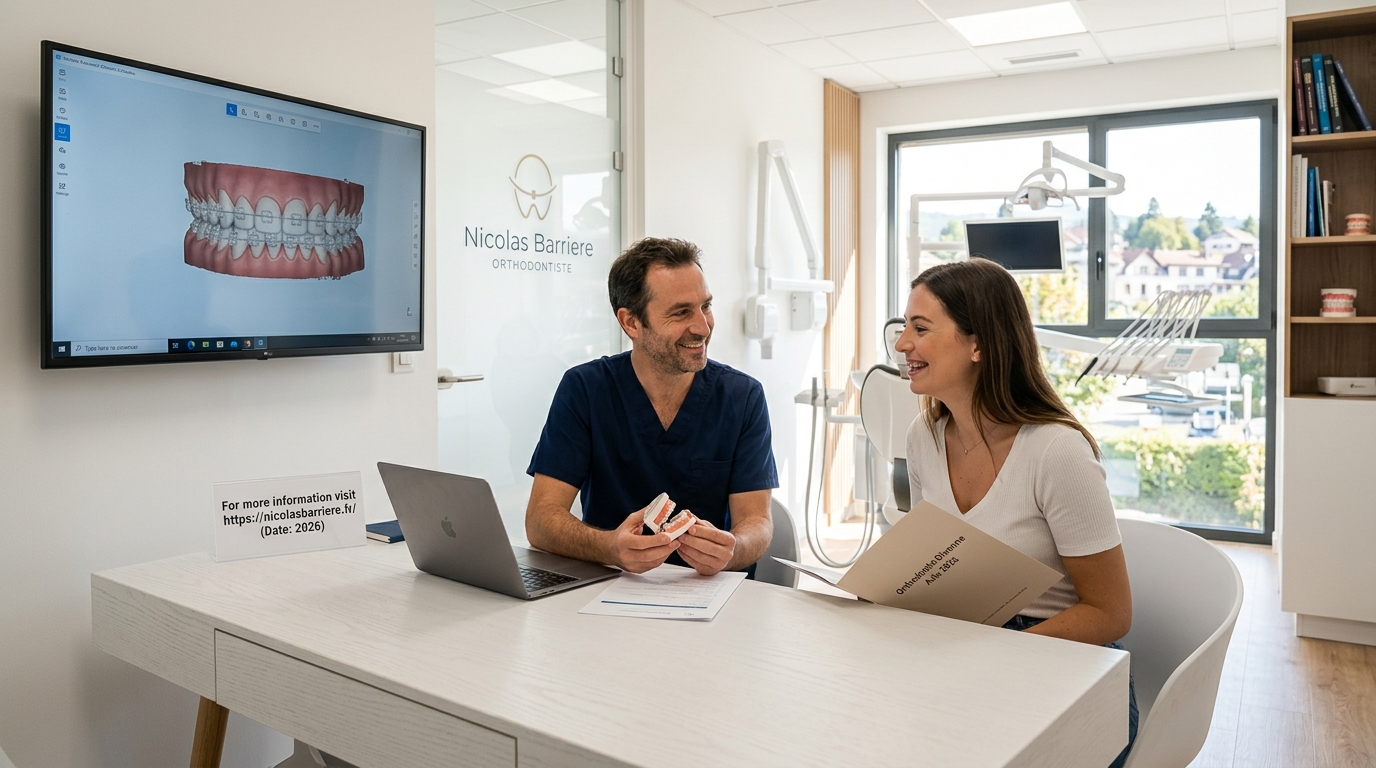
Before contacting an orthodontist in Divonne-les-Bains, several objective pieces of information should be verified: the practitioner's qualifications, the nature of published reviews, and the expected procedure for the initial assessment. This article compiles these points in a strictly informative manner.
- An orthodontist practicing in Divonne-les-Bains (01220) has a Diploma of Specialized Studies in Dentofacial Orthopedics, which can be verified on the Ameli health directory.
- The most informative reviews describe the reception, the teaching methods and the organization of the follow-up, not the isolated aesthetic result.
- The national average waiting time for a dental appointment is estimated at around 11 days according to L'Information Dentaire, with local variations related to the Pays de Gex.
To evaluate an orthodontic practice in Divonne-les-Bains before making contact, patients should look for three types of objective information: the practitioner's official qualifications (specialty in Dentofacial Orthopedics, which can be found in the French National Health Insurance directory), the technologies available on-site (3D imaging, clear aligners, lingual orthodontics), and verified reviews regarding the reception, the explanation of treatment, and the regularity of follow-up appointments. These elements allow patients to calmly prepare for an initial assessment, the procedure for which is largely standardized.
This verification process is often part of a broader reflection on the organization of local orthodontic follow-up. To explore this aspect further, it is useful to Discover the organization of an orthodontic practice in Divonne-les-Bains, From scheduling appointments to regular follow-up care. If you have a specific question about your situation, the firm contact form remains at your disposal.
How to analyze reviews and information about an orthodontist in Divonne-les-Bains?
A helpful review describes a verifiable fact: the punctuality of an appointment, the clarity of an explanation, the regularity of the follow-up. Comments that only evoke an overall feeling, without context, provide little usable information for comparing orthodontic practices in Divonne-les-Bains.
In France, medical appointment booking platforms (such as those referenced by the National Health Insurance Fund) allow users to consult testimonials related to actual consultations. These reviews are regulated: they must not contain defamatory content, and practitioners are required to adhere to the guidelines. code of ethics for dental surgeons, which prohibits any advertising or comparative approach.
Verified review A verified review is a comment left by a patient whose platform has been able to confirm that an appointment did indeed take place with the practitioner in question, by cross-referencing with their digital calendar.
🕐
Punctuality
An objective indicator of the firm's organization and calendar management.
🗣️
Pedagogy
The ability to explain the treatment plan in simple words, noticeable in several converging opinions.
🧼
Hygiene and reception
Patients regularly mention the cleanliness of the premises and the courtesy of the staff.
🔄
Continuity of monitoring
The regularity of check-up appointments and the stability of the care team.
Important point to note: A single opinion, whether highly negative or highly complimentary, should never be interpreted in isolation. A relevant analysis relies on the convergence of multiple feedback over time. A personalized assessment of your situation requires a clinical consultation and a thorough examination.
Which converging indicators should be considered?
Recurring feedback on the reception, the clarity of the quotes, and the regularity of follow-up appointments are generally reliable indicators. Conversely, comments focusing solely on the final aesthetic result, without describing the treatment process, offer little information that can be applied to other clinical situations.
«"In my daily practice, I observe that families who have taken the time to read several opinions arrive at the first appointment with more specific questions, which facilitates the explanation of the treatment plan."»
How can I verify a practitioner's qualifications before consulting them?
An orthodontist practicing in France holds a Diploma of Specialized Studies in Dentofacial Orthopedics, obtained after the qualifying internship. This qualification can be viewed publicly in the health directory of the Health Insurance, which mentions the mention "Dental surgeon specializing in dentofacial orthopedics".
ODF The Diploma of Specialized Studies in Dentofacial Orthopedics (ODF) is the official university qualification that allows a dental surgeon to declare themselves an orthodontic specialist in France, after three years of internship.
Consult the Ameli health directory
Search for the practitioner by name and town (Divonne-les-Bains, 01220) on annuairesante.ameli.fr to check their specialty and practice address.
Check the specialty designation
The form should state "specialist in dentofacial orthopedics" and not simply "dental surgeon," an important distinction for complex treatments.
Watch the conventional sector
The sector (1, 2 or non-contracted) influences the reimbursement procedures, in accordance with the rules of the’Health insurance based on prior agreement.
Confirm registration with the Order
The National Council of the Order of Dental Surgeons maintains the national register, which can be consulted to verify that a practitioner is practicing legally.
Good to know: In France, only a dental surgeon holding a DES ODF (Diploma of Specialized Studies in Orthodontics) can legally present themselves as a "qualified specialist in orthodontics." A general dentist can perform certain orthodontic procedures, but does not have this specialized qualification recorded in their professional file.
What is dentofacial orthopedics?
L'’dentofacial orthopedics Dental surgery is the medical discipline that treats dental malpositions and jaw growth abnormalities. It is used by children, adolescents, and adults, depending on the indications identified during the clinical assessment.’Health Insurance specifies the conditions of care according to the patient's age.
How is an initial orthodontic assessment organized?
An initial orthodontic assessment takes place in four stages: a medical consultation, a clinical examination of the mouth and face, any necessary additional tests (X-rays, digital impressions), and an oral presentation of the findings. The average duration is 30 to 45 minutes, depending on the complexity of the case. Once the treatment plan is approved, the active phase of treatment begins, punctuated by regular follow-up appointments during which the practitioner adjusts the appliance, before the retention phase, which stabilizes the result.
This initial consultation does not necessarily lead to the fitting of a device. Its primary aim is to establish a precise diagnosis and discuss possible treatment options. To anticipate the next steps, it is very useful to Discover the organization of an orthodontic practice in Divonne-les-Bains, from appointment booking to regular follow-up of care.
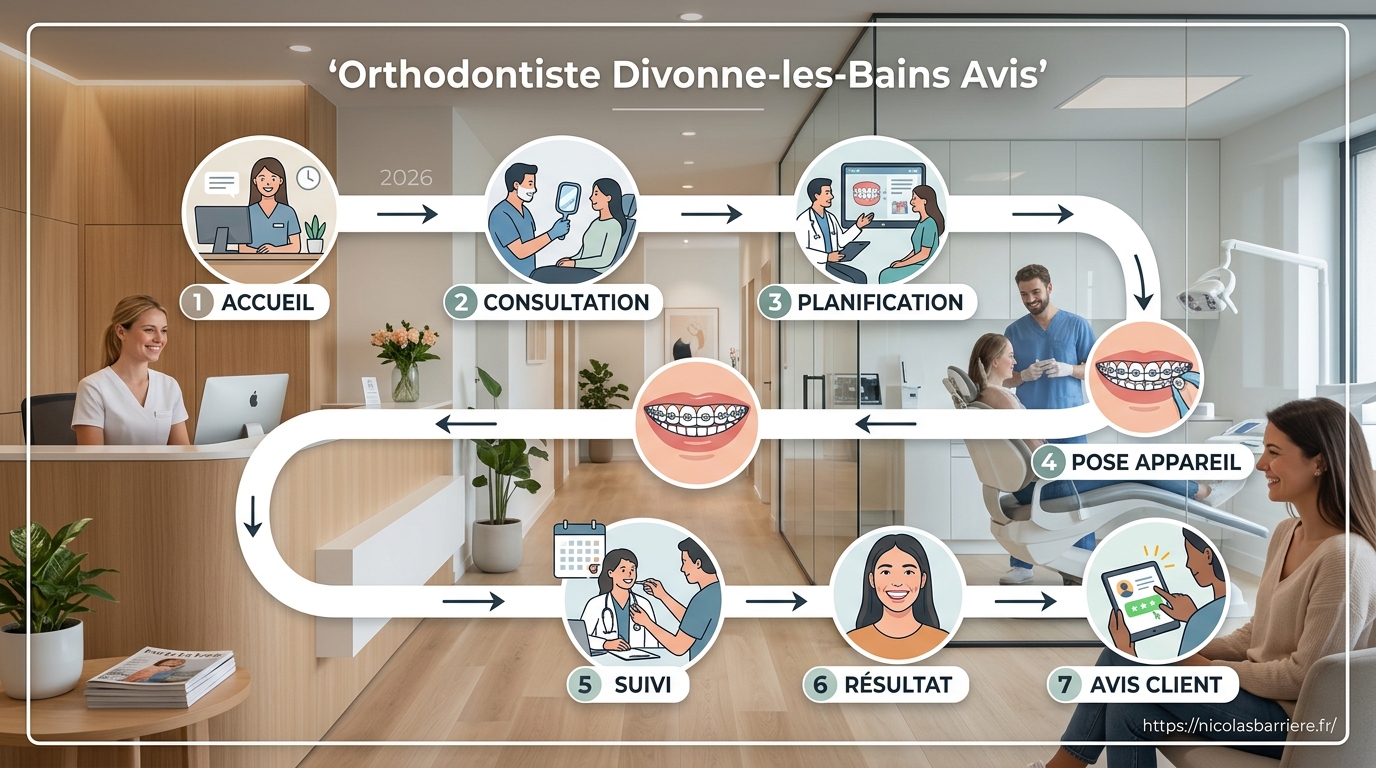
The initial medical interview
The practitioner gathers information on medical history, current treatments, any allergies, and the specific reason for the consultation. Parents are involved when the patient is a child.
The clinical examination
Analysis of occlusion, tooth position, facial balance, masticatory function, and respiration. An examination of the temporomandibular joints may be performed.
Additional examinations
Depending on the needs, panoramic and cephalometric radiographs, clinical photographs, and 3D digital impressions are used. These examinations allow for a precise analysis of bone structures.
The restitution and the treatment plan
The practitioner explains the observations and possible options (braces, clear aligners, lingual orthodontics depending on the indications) and then provides a written treatment plan with a cost estimate. The practitioner remains responsible for choosing the appliance best suited to each clinical situation: the patient does not choose a brand.
The active phase of treatment
Once the plan is approved, the treatment extends over several months with regular follow-up appointments. The practitioner monitors the movement of the teeth and makes the necessary adjustments to the appliance at each stage, until the desired result is achieved.
Restraint
After the appliance is removed, a retention phase (wire glued to the lingual surface, night guard) stabilizes the result obtained and prevents long-term relapses.
Things to prepare before the appointment: Health insurance card, supplementary health insurance card, latest available X-rays, and any letters from the treating dentist. These documents facilitate the preparation of the file and avoid the need for repeat examinations.
Is a reflection period necessary after the first consultation?
A period of reflection between receiving the treatment plan and starting treatment is strongly recommended. This allows the patient (or their parents) to review the estimate, seek a second opinion if desired, and make an informed decision. The code of ethics for dental surgeons explicitly guarantees the patient's freedom of choice.
A question before the first assessment?The coordinators in the office can answer administrative questions.
What is the context of dental care in the Pays de Gex?
The Pays de Gex region is experiencing sustained demographic growth, linked to its border location with Switzerland. This characteristic directly influences access to specialist care, including orthodontics, and partly explains the sometimes long waiting times for a first appointment.
According to the local health diagnosis of the Pays de Gex, According to a report published by the Auvergne-Rhône-Alpes Regional Health Observatory, the territory has one of the highest population growth rates in the region, with a young population and a high proportion of cross-border workers.
11 daysAverage national waiting time for a dental appointment (Dental Information)
01220Postal code of Divonne-les-Bains
4 yearsRecommended age for a first consultation in interceptive orthodontics
THE The average waiting time for a dentist appointment in France is estimated at 11 days. According to L'Information Dentaire, for a specialized orthodontic consultation, this waiting period can be longer, particularly in densely populated areas like the Pays de Gex. Therefore, booking an appointment a few weeks to a few months in advance is a prudent approach.
The unique Franco-Swiss border situation
Many patients in the Pays de Gex region are cross-border workers and fall under specific health insurance schemes (Swiss LAMal, the French scheme with the right of option, cross-border mutual insurance companies). A practice experienced with this patient population can facilitate the administrative management of their files, without guaranteeing specific reimbursement: this depends on individual contracts.
Namely: Cross-border workers may, depending on their status, be affiliated with the Swiss LAMal (Swiss health insurance), the French social security system, or a cross-border health insurance provider. Each system has its own rules for covering orthodontic care. Contacting your health insurance provider will help you anticipate your out-of-pocket expenses.
How can we objectively compare several orthodontic practices?
An objective comparison is based on factual criteria: qualifications, available technologies, firm organization and monitoring methods. It must in no way take the form of a subjective ranking, which is prohibited by the code of ethics for dental surgeons.
To compare several orthodontic practices, it is useful to check factual criteria: the DES ODF qualification on the Ameli health directory, registration with the National Council of the Order of Dental Surgeons, the conventional sector on the practitioner's Ameli sheet, the available technologies (3D imaging, transparent trays, lingual orthodontics according to indications), the organization of follow-up and geographical accessibility, which facilitates the regularity of appointments over several months.
What is useful to look at
- The official qualification listed in the Ameli directory.
- The convergence of several opinions verified over time.
- The clarity of the information provided during the initial telephone contact.
- Geographic accessibility for regular monitoring.
This needs to be put into perspective
- An isolated opinion, either very complimentary or very negative, without context.
- Price comparisons without analysis of the overall treatment plan.
- Promises of quick results, which do not correspond to the biological reality of tooth movement.
- Rankings published without transparent methodology.
The role of clear aligners and lingual orthodontics
The transparent gutters and the’lingual orthodontics Braces (placed on the inside of the teeth) are discreet techniques, regularly offered to teenagers and adults. Their suitability depends on the type of malocclusion: not all clinical situations allow for their use. Only a thorough clinical assessment can confirm their appropriateness for a given case, with the practitioner remaining responsible for choosing the most suitable technique. To explore these options in detail, see the page presentation of treatments the firm provides additional benchmarks.
What information should I prepare before calling the firm?
Preparing your call saves time and allows you to obtain accurate information from the very first exchange. The clinic coordinators are more effective at directing requests when the reason for consultation and the patient's age are clearly stated.
- Age of the patient concerned (child, adolescent, adult).
- Main reason: aesthetic request, recommendation from a dental surgeon, functional impairment, emergency.
- Orthodontic history (treatment already completed, current use of retainers).
- Health insurance scheme (France, Swiss LAMal, right of option).
- Availability for appointments (weekdays, Wednesday, Saturday morning).
- If the patient comes from another practice, the previous orthodontic file is available.
Organizational tip: If you are resuming treatment begun elsewhere, ask your previous practitioner to transfer your orthodontic file before your first appointment. This will greatly streamline the resumption of care.
Special cases of orthodontic emergencies
A loose bracket, a poking wire, or a broken aligner constitutes an orthodontic emergency. These situations are not life-threatening, but require prompt attention to prevent injury to the oral mucosa or interruption of treatment. The practice has a dedicated page for orthodontic emergency detailing the course of action to be taken.
«"When a patient calls for an emergency, the team tries to quickly assess the situation: is it a minor inconvenience or an abnormality that could compromise the ongoing treatment? This telephone assessment determines the response time."»
What are my rights and what medical information should I receive before the consultation?
Before any therapeutic decision, the patient has the right to clear, fair and appropriate information about their condition and the treatments under consideration. This right is enshrined in the code of ethics for dental surgeons and in the public health code.
Informed consent
Agreement given by the patient after receiving full information on the diagnosis, treatment options, risks and alternatives.
Prior agreement
Mandatory health insurance procedure for certain orthodontic treatments, detailed on the website of the’Health Insurance.
Patient file
All medical documents (clinical observations, radiographs, casts) created during the follow-up, available for consultation upon request.
Orthodontic quote
Written document detailing the planned procedures, their coding, the estimated remaining cost and the expected duration of treatment.
ODF
Ameli
Order of Dentists
Pays de Gex
Prior agreement
Patient file
Aligners
Lingual orthodontics
Ameli
Order of Dentists
Pays de Gex
Prior agreement
Patient file
Aligners
Lingual orthodontics
The ethical rules that govern information
The code of ethics prohibits any advertising, comparative, or commercial activity by dentists. Information disseminated by a practice must remain factual and educational. A patient attentive to these guidelines can distinguish legitimate information from unethical promotional material.
Preparing for a first orthodontic consultation
A personalized assessment of your situation or that of your child requires a thorough clinical examination. The team at the practice is available to arrange this initial evaluation.
How can we anticipate the continuation of the treatment and its stability?
Orthodontic treatment does not end with the removal of the appliance: it continues with a retention phase, essential to stabilize the result. This phase is one of the most crucial for the sustainability of the treatment.
Between the validation of the treatment plan and the fitting of the retainer, an active phase takes place with regular follow-up appointments, during which the practitioner adjusts the appliance to accommodate the gradual movement of the teeth. According to the French Society of Dentofacial Orthopedics, in its recommendations for good practice on retention published in 2023, Retention is now considered essential in the long term after most treatments. The devices used (wire bonded to the lingual surface, night guard) are adapted to each clinical situation.
Understanding from the first assessment that orthodontic treatment is accompanied by long-term retention is part of providing the patient with informed consent.
What if we resume a treatment started elsewhere?
Sometimes patients move to the Pays de Gex region during treatment, or wish to continue retention treatment begun at another practice. In these situations, transferring their previous orthodontic file is a helpful first step. Health Insurance website details the main principles of orthodontic diagnosis applicable to any resumption of follow-up.
📌 Key points to remember
- The qualification of an orthodontist in Divonne-les-Bains can be verified on the Ameli health directory.
- The most informative reviews focus on the reception, teaching methods and organization of follow-up, not on an isolated aesthetic result.
- An initial assessment lasts 30 to 45 minutes and includes an interview, a clinical examination and sometimes additional tests.
- After the plan is validated, the active phase involves regular follow-up appointments with adjustments to the device, before the retention phase.
- The national average waiting time for a dental appointment is estimated at 11 days according to L'Information Dentaire, with local variations in the Pays de Gex.
- Preparing your call (reason, age, insurance plan) makes it easier to schedule an appointment.
- Post-treatment retention is now recommended in the long term by the French Society of Dentofacial Orthopedics.
- A personalized opinion always requires a clinical consultation and a thorough examination.

About the author: Nicolas Barrière
Dr. Nicolas Barrière is an orthodontist, a qualified specialist in dentofacial orthopedics, a former hospital intern, and the founder of his practice in Divonne-les-Bains. He treats children, adolescents, and adults with orthodontic treatments (clear aligners, lingual braces), paying particular attention to the care of patients living near the French-Swiss border.
Areas of expertise: Orthodontics, Dentofacial orthopedics, Clear aligners, Lingual orthodontics, Pediatric orthodontics, Adult orthodontics.
Frequently Asked Questions
How can I find reliable reviews of an orthodontist?
To find reliable reviews of an orthodontist, it is recommended to use certified review platforms linked to medical appointment booking, which verify the legitimacy of the appointment. Consulting the national health insurance directory can also confirm the professional's official status and qualifications.
What is the average cost of an initial orthodontic assessment?
The fee for an initial specialist consultation is regulated and partially covered by Social Security, according to the reimbursement rates published by the Health Insurance system. Any additional examinations (X-rays, impressions) are subject to a specific fee detailed in the estimate provided to the patient.
Do you need a prescription to consult an orthodontist?
In France, a prescription or referral from a general practitioner is not required to consult an orthodontist. Patients or their parents can book an appointment directly with the practice, by phone, or through a medical appointment booking platform.
How can you verify that an orthodontist is a true specialist?
The verification is carried out on the Ameli health directory (annuairesante.ameli.fr) by searching for the practitioner by name and town. The official record must state "dental surgeon specializing in dentofacial orthopedics": this qualification corresponds to the Diploma of Specialized Studies in Dentofacial Orthopedics.
At what age should a child consult an orthodontist?
An initial orthodontic consultation can be arranged as early as age 4 to 7, particularly in cases of persistent thumb sucking, mouth breathing, or visible malocclusion. This consultation does not necessarily lead to immediate treatment; it allows for the identification of potential indications for interceptive orthodontics.
How long does an initial consultation last?
An initial orthodontic consultation typically lasts 30 to 45 minutes. This time includes the medical interview, clinical examination, any additional tests, and an oral presentation of the initial observations to the patient or their parents.
Can Franco-Swiss border patients seek medical care in Divonne-les-Bains?
Franco-Swiss border patients can consult a doctor in a French practice, such as the one in Divonne-les-Bains. Reimbursement procedures depend on their health insurance plan (Swiss LAMal, French Social Security, or cross-border health insurance), so it's advisable to check with your provider before your appointment.
Can you change orthodontists during treatment?
It is possible to change orthodontists during treatment, particularly if you move. Transferring your previous orthodontic records (observations, X-rays, impressions) is then essential to allow the new practitioner to continue treatment seamlessly.
📚 Sources and references
Official and institutional sources:
- DREES: Dental surgeons in France
- Legifrance: Code of ethics for dental surgeons
- Ameli: Prior agreement and billing in orthodontics
- Ameli: Dental malpositions
- ORS Auvergne-Rhône-Alpes: Local health diagnosis of the Pays de Gex
Academic and scientific sources:
- PubMed: Good practice recommendations on retention in orthodontics (SFODF, 2023)
- Faculty of Dentistry: Diploma of Specialized Studies in Dentofacial Orthopedics
Specialized press:
📖 Also read:
- Making an orthodontic appointment in Divonne-les-Bains: practice organization and continuity of care
- Resuming retention follow-up with a new orthodontist in Divonne-les-Bains
- Fixed retention and night guard: how they work and indications
- What an orthodontic file contains and how it is transmitted between practitioners
 French
 English