
Clear aligners for teenagers are recommended from age 10 to 11, when most of the permanent teeth are in place. An interceptive phase with specialized appliances remains possible from age 6 to 7 in cases of early growth disturbance. The 11-16 age range is optimal.

Invisible aligners for teenagers: from what age is this technique recommended?
Written by Nicolas Barrière : Orthodontist, Qualified Specialist in Dentofacial Orthopedics, founder of the practice at nicolasbarriere.fr. Updated on . Reading time: approximately 11 minutes.
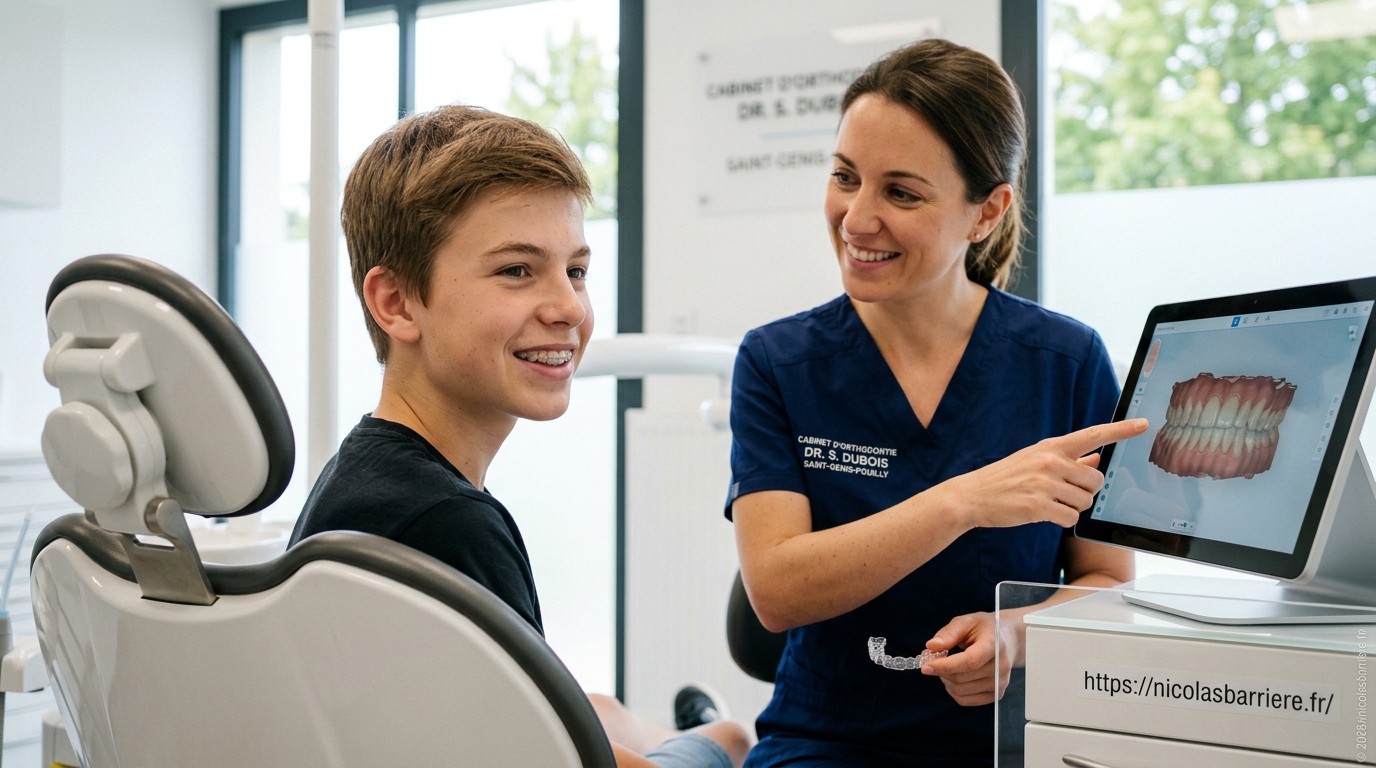
Invisible aligners for teenagers, in Divonne-les-Bains as elsewhere, become a possibility as early as 10 or 11 years old, depending on dental maturity. Biological age is less important than the state of the teeth and the stage of growth.
- Clear aligners for teenagers are recommended from 10 to 11 years old, when most of the permanent teeth are in place.
- An interceptive phase with dedicated devices remains possible from 6 to 7 years of age in case of early growth disorder.
- The 11 to 16 year age bracket is optimal: jaw still malleable, Social Security reimbursement possible with prior agreement.
Clear aligners for teenagers are generally recommended from age 10 to 11, as soon as their permanent teeth have erupted. In Divonne-les-Bains, an orthodontic assessment from age 7 allows for evaluation of dental maturity and planning of the most favorable time to begin treatment with clear aligners.
This long-tail article complements the A complete guide to braces and clear aligners in orthodontics for teens and adults focusing specifically on the issue of age and dental maturity criteria in young patients. If you are wondering when to have your teenager evaluated, the scheduling an appointment at the office remains the most reliable way to get a personalized response.
At what age is it recommended to begin orthodontic treatment with aligners?
Most teenagers can begin treatment with invisible aligners between the ages of 10 and 12., as soon as the dentition is sufficiently mature. Chronological age remains secondary: it is the dental stage (permanent teeth in place, eruption of the second molars) that guides the clinical decision.
Health alert point: No age range can replace a clinical examination. Two adolescents of the same age can have very different levels of dental maturity. A personalized opinion always requires a consultation and a thorough examination in a dental office.
What is a clear aligner?
Clear aligner A clear aligner is a removable tray made of medical polymer, custom-molded from a 3D digital impression, worn 20 to 22 hours a day and replaced every 1 to 2 weeks to gradually move the teeth.
Clinical criteria: development of dentition and maturity
The orthodontist checks several parameters before recommending aligners to a teenager. The first is the mixed dentition or definitive: the presence of permanent incisors, canines, premolars, and first molars determines feasibility. The eruption of the second molars (generally between 11 and 13 years of age) is a key marker.
According to a meta-analysis published on PubMed in 2025 regarding the clinical efficacy of aligners in adolescent interceptive treatment, Clear aligners demonstrate comparable effectiveness to fixed appliances for the majority of moderate malocclusions once the permanent dentition is in place. The young patient's cooperation remains the primary limiting factor.
Gutters for teenagers: why is the 11-16 age range optimal?
The 11-16 age group offers three major advantages: A jaw that is still growing and therefore more receptive to corrections, a nearly complete permanent dentition, and partial coverage by Health Insurance. Understanding The different orthodontic techniques for teenagers and adults helps to measure why this period is strategic.
🦴
Active bone growth
The jaw has not finished its development: orthopedic corrections (expansion, guidance) remain possible in conjunction with tooth movement.
🎓
Easier compliance
At this age, the adolescent understands the aesthetic and social implications, which encourages regular wearing.
💶
Social Security reimbursement
Health insurance covers part of the treatment if it starts before the 16th birthday.
👁️
Aesthetic discretion
Clear aligners are particularly popular during middle and high school years, a sensitive period for self-image.
Consultation in Divonne-les-Bains: how to assess your teenager's eligibility?
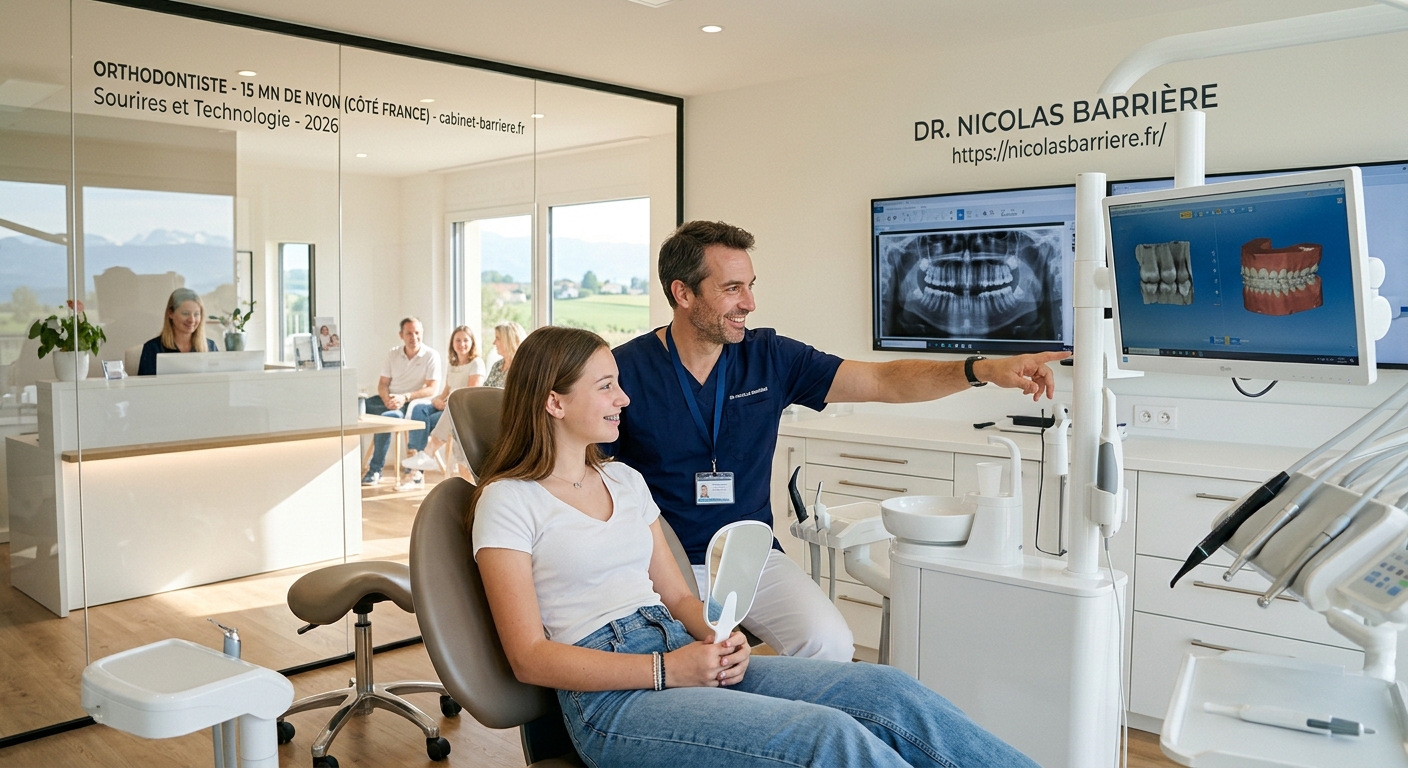
The evaluation is based on a complete clinical examination, a panoramic radiograph and a 3D digital impression. The practice, located in Divonne-les-Bains, welcomes families from the Pays de Gex and neighboring Switzerland, and organizes closely spaced appointments, particularly useful for Franco-Swiss border families.
The importance of early orthodontic assessment
There SFODF It is recommended that the first orthodontic visit take place as early as 6 or 7 years of age, even if treatment with full aligners begins later. This early assessment allows for the detection of dysfunctions (atypical swallowing, mouth breathing) and jaw misalignments that may benefit from interceptive treatment.
-
Initial consultation and medical history
The orthodontist listens to the reason for consultation, examines the occlusion, checks the functions (chewing, phonation, breathing) and observes the stage of growth.
-
Additional tests
Panoramic radiography, lateral cephalometric radiography, 3D optical impression and clinical photographs constitute the orthodontic record.
-
Personalized treatment plan
The practitioner offers a digital simulation of the tooth movement, an estimated duration, and a detailed quote. Prior authorization from Social Security is required for those under 16 years of age.
-
Active phase of treatment
The aligners are delivered in sets, with regular follow-up appointments in the office every 6 to 10 weeks to monitor progress, make adjustments to the device and dispense the next sets.
-
Post-treatment restraint
A retention phase (bonded wire or night guard) is essential to stabilize the result, in accordance with the SFODF's recommendations for good practice on restraint.
Unsure about the right time for your teenager?
A clinical examination in the office remains the only reliable way to assess dental maturity and define the best treatment window.
What is interceptive treatment?
Interceptive treatment An interceptive treatment is an early orthodontic intervention, between 6 and 10 years of age, aimed at correcting a growth problem or a bad habit (sucking, atypical swallowing) before it worsens the malocclusion in adolescence.
This early approach doesn't yet involve aligning all the teeth; it prepares the ground for a possible second phase in adolescence, often shorter and less complex. For a child showing an early sign, the completion of a quick orientation questionnaire can help parents identify whether a consultation is relevant.
What are the eligibility criteria based on the adolescent's age?
Eligibility for invisible aligners varies by age group., Depending on the dentition, the expected cooperation, and the type of correction sought, the indications observed in current orthodontic practice vary primarily according to the dental stage: interceptive treatment in the early mixed dentition (6 to 10 years old), preparation for the permanent dentition and minor corrections in the late mixed dentition (10 to 12 years old), global alignment in the permanent dentition (12 to 16 years old), and standard treatment in adulthood (16 years and older). The practitioner determines, after examination, the technique best suited to each case.
Clinical efficacy by age group
Qualitative benchmarks from orthodontic literature published on PubMed (2024-2025). Individual effectiveness depends on cooperation, the type of malocclusion, and the treatment plan.
«"In adolescents, the right time to begin treatment with aligners is not determined by a birth date but by a panoramic dental X-ray. Two 12-year-olds can have dental maturity levels 18 months apart."»
Why consult in the Pays de Gex: proximity and cross-border monitoring
For families coming from the Pays de Gex, the Ain or neighbouring Switzerland, the proximity of the Divonne-les-Bains practice is a clinical advantage. Aligner treatment requires regular check-ups in the office every 6 to 10 weeks, and sometimes closer appointments in case of loss or breakage of a aligner.
📍
Geographical proximity
A local practice avoids long journeys for check-up appointments, which are particularly important during the school year.
🇨🇭
Franco-Swiss files
Border families benefit from tailored management of Swiss (LAMal, supplementary) and French insurance.
👨👩👧
Ongoing family follow-up
A single practice can follow several children from the same family over time, which simplifies the organization.
🚨
Managing unforeseen events
In case of a broken or lost aligner, a quick appointment at orthodontic emergency avoids any delay in treatment.
An approach adapted to teenagers attending school in Switzerland or France
The Geneva area has a large cross-border population. Teenagers attending school in Geneva or the canton of Vaud can be seen at the Divonne-les-Bains clinic, with appointments available to coincide with Swiss school hours. This flexibility is an often underestimated but crucial factor for treatment adherence.
How long does aligner treatment last for adolescents?
The average duration of treatment with invisible aligners in adolescents varies between 12 and 24 months., Depending on the complexity of the malocclusion, a short interceptive phase (6 to 9 months) may precede the main treatment.
Month 0
Fitting of the first aligners
Handing over the games, learning the protocol (wearing, cleaning, changing).
Months 2 to 3
First check
Checking the fit, possibly applying composite attachments.
Months 6 to 12
Active progression
Progressive tooth movement, check-ups every 6 to 10 weeks.
Months 12 to 24
Finishes
Final treatment adjustments, possible refinement aligners.
After
Restraint
Lingual bonded wire and/or night guard to permanently stabilize the result.
What is orthodontic retention?
Restraint Retention is the phase that follows the end of active treatment: it aims to maintain the teeth in their new position by means of a wire glued behind the teeth and/or a retainer worn at night, to prevent relapse.
Warning: without restraint, recurrence is frequent. THE recommendations for good practice published by the SFODF emphasize that the stability of the result depends directly on adherence to the retention phase, often continued for several years.
Coverage, reimbursement and administrative procedures
Health insurance reimburses part of the orthodontic treatment provided that it starts before the 16th birthday and that prior agreement has been obtained. The remaining cost depends on the supplementary health insurance taken out by the family.
The role of prior agreement
According to information published by the’Health insurance coverage for the treatment of dental malpositions, The prior authorization request must be sent to the health insurance fund before any treatment begins. If the fund does not respond within 15 days, this is considered tacit approval. Treatment is reimbursed every six months, based on a standard rate.
Benefits of treatment before age 16
- Partial coverage by Health Insurance under certain conditions.
- Bone growth still active, orthopedic corrections possible.
- Supplementary health insurance plans are often more generous for those under 16.
- Treatment is often shorter than in adulthood.
Limitations and points of attention
- Strong dependence on the young person's cooperation (wearing 20 to 22 hours/day).
- Impeccable hygiene is necessary to prevent cavities.
- Out-of-pocket expenses vary depending on the health insurance provider and the complexity of the situation.
- A prolonged and essential restraint phase.
Border families: Swiss health insurance (LAMal) and supplementary insurance
Families covered by the Swiss health insurance system (LAMal) should check with their supplemental insurance provider regarding orthodontic coverage, as these vary considerably from one policy to another. A detailed estimate provided by the practice allows for this preliminary step.
«"Prior approval from Social Security is not a mere formality. It is a crucial step that protects the family and ensures reimbursement from the first six months of treatment."»
Teenage aligners versus fixed braces: which to choose depending on age?
The choice between clear aligners and traditional braces depends on the complexity of the case, the expected cooperation, and aesthetic preferences. At 11-12 years old, both options are technically feasible for most common indications. After diagnosis, the practitioner remains responsible for choosing the appliance: visible braces, lingual braces, or aligners; the patient does not choose a brand.
| Criteria | Invisible gutters | Metal rings |
|---|---|---|
| Aesthetic discretion | ✓ | ✗ |
| Removable (for meals, brushing) | ✓ | ✗ |
| Dependence on cooperation | ✗ (strong) | ✓ (fixed) |
| Case of very high complexity | ~ | ✓ |
| Everyday comfort | ✓ | ~ |
| Easier hygiene | ✓ | ~ |
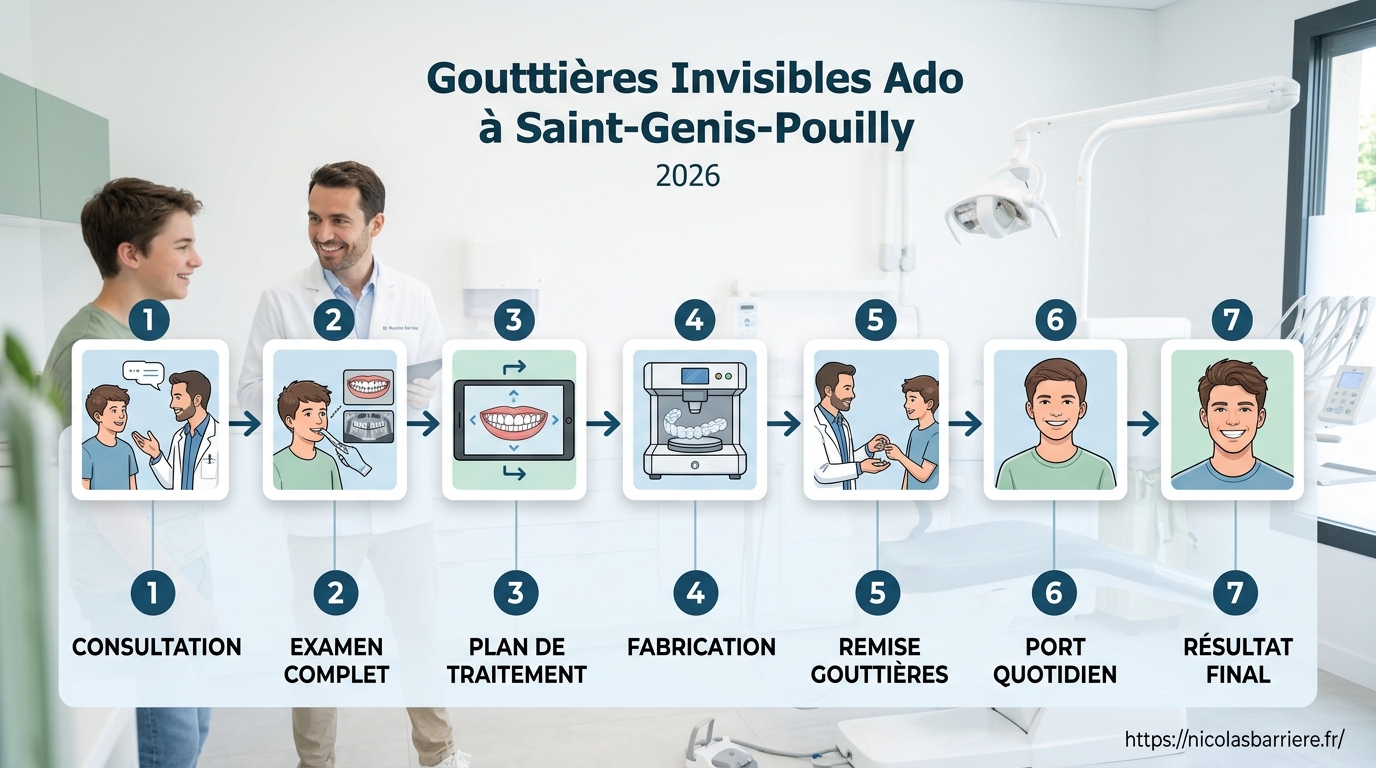
Focus on cases where gutters remain limited
Certain complex orthodontic situations (multiple extractions, orthognathic surgery, significant rotations, impacted teeth) may require a fixed appliance approach, either alone or in combination. The orthodontist, after examination, will propose the most appropriate technique. Discussions with the family will take into account the child's preferences, but the decision remains primarily clinical.
Adolescent cooperation: the real key to success
An aligner that remains in its case does not move any teeth. The success of the treatment depends directly on the daily wearing time: 20 to 22 hours are necessary, with removal only for meals and brushing.
Cooperation is the first predictor of success of aligner treatment in adolescence, even ahead of the initial severity of the malocclusion.
How to promote adherence?
- Involve the adolescent in the decision-making process from the initial consultation.
- Establish routines associated with meals (removal, brushing, replacement).
- Use the wear indicators built into some aligners for teenagers.
- Pack a spare case in your sports bag and at school.
- Maintain an open dialogue with the firm in case of difficulty.
📝 A temporary decrease in adherence (school trip, exam period) does not permanently compromise the treatment, but requires informing the office at the next check-up.
FAQ: Support and frequently asked questions
At what age is it recommended to begin orthodontic treatment?
An initial orthodontic consultation is recommended as early as 6 or 7 years old to detect any potential growth problems. Active treatment with clear aligners generally begins between 10 and 12 years old, once the permanent teeth have erupted. The 11-14 age window is often cited as optimal because bone growth is still active during this period.
Is it possible to start orthodontic treatment before the age of 16?
Yes, it is perfectly possible and even highly recommended to start before the age of 16. The ideal period is often between 11 and 14 years old because jawbone growth is not yet complete, which greatly facilitates the correction of dental malocclusions and allows for reimbursement by Social Security.
At what age is it recommended to wear a dental splint?
Wearing a clear aligner is generally recommended for adolescents from the age of 11, once their permanent teeth have erupted. However, interceptive treatments are available for children as young as 6 or 7 to correct early growth problems using aligners specifically designed for mixed dentition.
What is the price of braces for a teenager or a child?
The treatment plan is tailored to each individual after a clinical examination and further tests: the clinical diagnosis and the practitioner's expertise determine the most appropriate technique for each case. A detailed estimate is always provided during the initial consultation, before any commitment is made.
Is orthodontic treatment for children covered by insurance?
Health insurance covers part of the cost of orthodontic treatment, provided that treatment begins before the child's 16th birthday. Prior approval from Social Security is essential before starting treatment. Reimbursement is made per six-month period of treatment, based on a standard fee schedule.
Do health insurance companies reimburse invisible orthodontics?
Most supplemental health insurance plans offer coverage for invisible orthodontics for children under 16, in addition to reimbursement from the national health insurance system. The amount depends on the coverage included in your supplemental health insurance policy. It is recommended to request a quote from the dental office to obtain a precise estimate from your insurer.
Is my teenager's cooperation really crucial?
Yes, absolutely. The aligners must be worn for 20 to 22 hours a day, removed only for meals and brushing. Insufficient wear delays or compromises treatment. This is why the orthodontist assesses the young person's motivation during the initial consultation and sometimes suggests a fixed alternative if necessary.
Can we start with an interceptive phase and then move on to gutters?
Yes, this is a common approach. An initial interceptive phase between the ages of 7 and 10 corrects a growth problem or a harmful habit. A second phase with full clear aligners then begins around age 11 or 12 for final alignment. This two-step strategy allows each problem to be addressed at the right time.
📌 Key points to remember
- Invisible aligners for teenagers become a possibility from 10 to 11 years old, when most of the permanent teeth are in place.
- The 11 to 16 year window is considered optimal: still active growth, possible Social Security reimbursement, better adherence.
- An interceptive phase with dedicated devices exists from 6 to 7 years old to correct certain growth disorders early.
- An orthodontic assessment from the age of 7 allows planning the best time to start treatment, without immediately initiating treatment.
- Prior approval from Social Security must be obtained before starting, and treatment must begin before the 16th birthday to be eligible for reimbursement.
- The adolescent's cooperation (wearing it 20 to 22 hours/day) is the key factor for success, even more so than the complexity of the case.
- A post-treatment retention phase is essential to stabilize the result in the long term.
Evaluate the ideal treatment window for your teenager
Each situation is unique. A consultation in the office, with clinical examination and radiographic assessment, remains the only reliable way to determine the right time.

About the author: Nicolas Barrière
Dr. Nicolas Barrière is an orthodontist, a qualified specialist in dentofacial orthopedics, a former hospital intern, and the founder of his practice in Divonne-les-Bains. He treats children, adolescents, and adults with orthodontic treatments (invisible aligners, lingual orthodontics), paying particular attention to the care of patients living near the French-Swiss border.
Areas of expertise: Orthodontics for children, adolescents and adults, invisible aligners, lingual orthodontics, dentofacial orthopedics, retention and relapse management, management of orthodontic emergencies.
LinkedIn profile of Dr. Nicolas Barrière · Meet the firm's team
📚 Sources and references
Official and institutional sources:
- Health Insurance (Ameli): Treatment of dental malocclusions and reimbursement conditions
- Ameli: Reimbursement for orthodontic treatments
- SFODF: Recommendations for good practice on orthodontic retention (2023)
- CNP ODF-ODMF: Presentation of the specialty of dentofacial orthopedics
Academic and scientific sources:
- PubMed: Clinical efficacy of clear aligners in interceptive treatment in adolescents (meta-analysis)
- PMC: Prevalence of malocclusions in children and adolescents (systematic review)
- PMC: Treatment of Class II adolescent orthotics using aligners and elastics
- Wikipedia: Orthodontics and dentofacial orthopedics
📖 Also read:
- Braces or clear aligners: understanding the different orthodontic techniques for teens and adults
- Clear aligners for adults: the different options and how to choose the treatment
- Misaligned teeth in adults: orthodontics or veneers, two different approaches
- Lingual braces and clear aligners: comfort, adaptation and everyday experience
- Orthodontic emergency: when to seek urgent care



 French
 English