
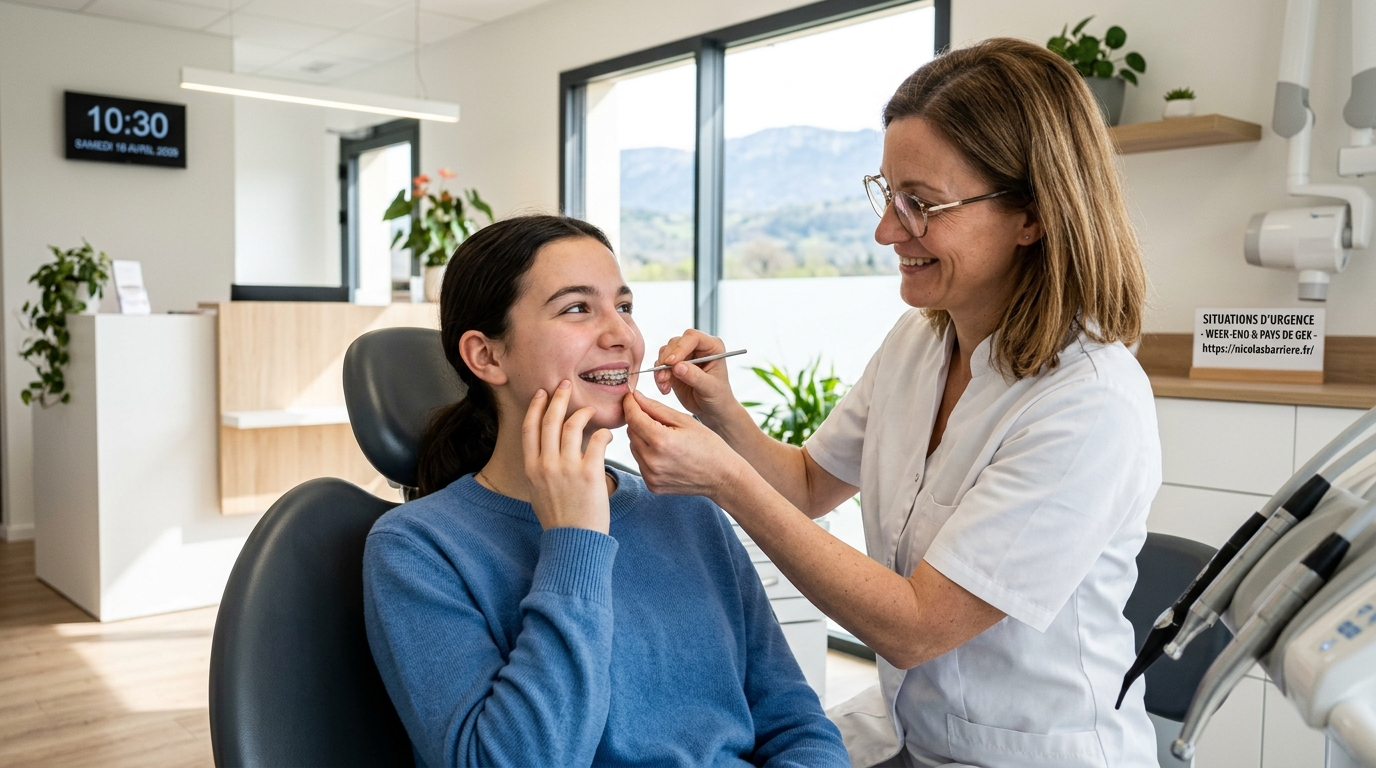
An orthodontic emergency for an itchy wire is a minor discomfort emergency that can be managed at home. The immediate solution: dry the area and then apply a ball of orthodontic wax to the metal end. Divonne-les-Bains has accessible orthodontic practices.

Discomfort related to orthodontic appliances outside of regular appointment hours: what to do while waiting for the next appointment
Written by Nicolas Barrière Orthodontist, Qualified Specialist in Dentofacial Orthopedics at nicolasbarriere.fr. Updated on . Reading time: approximately 12 minutes.
A dental wire that scratches your cheek on a Saturday night or Sunday morning in the Pays de Gex: the situation is uncomfortable, sometimes painful, but rarely serious. A few simple steps can help you manage until the dental office reopens.
- An orthodontist emergency on weekends in the Pays de Gex region for an itchy wire is a comfort emergency, manageable from home.
- The immediate solution: dry the area then apply a ball of orthodontic wax to the metal tip.
- The Pays de Gex has more than 100,000 inhabitants (Tribune de Genève): dentists on call on Sundays treat real medical emergencies, not appliance repairs.
- Contact your orthodontist first thing Monday morning to have the wire cut or repositioned permanently.
If your braces wire is scratching your cheek over the weekend in the Pays de Gex region, it's a minor issue that doesn't require a trip to the emergency room. The immediate solution is to thoroughly dry the metal part of your braces with a cotton swab, then cover the end of the wire with a small ball of orthodontic wax to protect the gums. You can then call your orthodontist's office first thing Monday morning to schedule a prompt appointment.
This article is part of a larger series devoted to orthodontic follow-up for cross-border patients residing between France and Switzerland. Here, the angle is very practical: what actions to take, who to contact, and above all what not to do when a ring, a wire or a ligation causes a problem outside of opening hours, in 2026, in a Franco-Valdo-Genevan basin where the demand for care continues to grow.
What should you do immediately if a dental appliance wire hurts your cheek?
If a wire is pricking your cheek, the first step is to neutralize the irritating metal part with orthodontic wax after drying the area. This physical barrier protects the mucous membrane in seconds and prevents the development of a canker sore or a deeper wound.
The discomfort caused by a sharp piece of metal is very common at the end of treatment, once the teeth have aligned: the metal archwire then becomes "too long" at the back of the mouth and rubs against the cheek. This is not a manufacturing defect in the appliance; it is simply a sign that the teeth have moved as expected.
Orthodontic wax Small strip of flexible food-grade wax, sold in pharmacies without a prescription, intended to temporarily cover a ring, ligature or wire that irritates the oral mucosa of a patient wearing a device.
How to use orthodontic wax for relief?
Orthodontic wax is the first thing to consider. in front of an itchy wire on the weekend. It is sold in pharmacies for a few euros, and many patients receive a box when they have their braces fitted.
-
Wash your hands thoroughly
Use soap and water: you will be putting your fingers in your mouth near any small wounds you may have.
-
Take a small amount of wax
Take off a piece the size of a small pea and roll it between your thumb and forefinger to form a soft ball.
-
Dry the area to be protected
Using a clean cotton swab or a piece of gauze, dab the ring, wire, or ligature that is pricking you. The wax will not stick to a wet surface.
-
Apply and press gently
Press the wax ball onto the metal part, letting it slightly overhang to completely coat the pointed end. The sensation of softness is immediate.
-
Repeat after meals
The wax comes off when eating: reapply after each meal until your appointment at the office.
Practical tip: Always keep a small box of wax in your toiletry bag and another in your backpack or purse. Accidents rarely happen at a convenient time at home.
Should I try to cut the metal wire myself?
The general rule is clear: you do not cut an orthodontic wire yourself. Nail clippers, tweezers or household scissors are neither suitable nor sterile, and the risk of swallowing or inhaling a piece of metal is real.
This action can also disrupt the entire archwire, compromising several weeks of treatment and lengthening the overall wearing time of the appliance. In the vast majority of cases, waxing is enough to get through a pain-free weekend.
Health alert point: Do not attempt to push the wire back in with a pen, matchstick, or toothpick. You risk injuring your gums, dislodging a bracket, or breaking a bonding pad. Waxing, a prompt appointment, and personalized clinical advice are always preferable to DIY solutions.
What if you run out of orthodontic wax at home?
In the Pays de Gex region, some on-call pharmacies are open on weekends. While waiting to get to one, two temporary solutions exist: the thin layer of edible wax from a Babybel-type cheese, or a piece of sugar-free chewing gum molded into a ball and pressed onto the irritated area.
These solutions are not medical and do not replace dedicated orthodontic wax. They simply allow you to hold out for a few hours before going to a pharmacy.
«"In practice, we see that the vast majority of weekend calls for a prickly stitch are resolved in the office in less than ten minutes on Monday morning. The priority, while waiting, is to prevent the wound, which then takes several days to heal."»
How to find an on-call doctor's office on weekends in the Pays de Gex region?
In the Pays de Gex region, no orthodontic practices are open on weekends: only on-call dentists provide emergency care on Sundays for genuine medical emergencies. For an itchy wire, don't bother the on-call dentist; wait until your regular orthodontist opens on Monday.
The Pays de Gex region has a population of over 100,000, according to the Tribune de Genève, and is growing rapidly due to Geneva's attractiveness. Geneva itself is projected to have around 115,000 cross-border workers in 2024, according to RTS, a large proportion of whom reside on the French side of the border.
100 000inhabitants of the Pays de Gex (Tribune de Genève)
115 000cross-border commuters to Geneva in 2024 (RTS)
15 minfrom Nyon to Divonne-les-Bains
What are the opening hours for orthodontic practices in the Pays de Gex region?
Orthodontic practices in the area operate on standard hours: Monday to Friday, generally from 9 a.m. to 7 p.m., sometimes with an opening on Saturday morning. On Saturday afternoons and Sundays, there are no orthodontists available to work on braces.
This organization is consistent with the nature of orthodontic work: procedures are scheduled in advance, true emergencies are rare, and continuous care is shared across the department via the Order of Dental Surgeons.
What is the role of the on-call dentist on Sundays?
The on-call dentist for the Ain department provides continuous care on Sundays and public holidays, in accordance with Article R.6315-7 of the Public Health Code. Their role is to treat real dental emergencies : intense pain, abscess, trauma with a tooth being knocked out, bleeding that does not stop.
Good to know: The on-call dentist is not an orthodontist. They may not have the equipment to cut a rigid wire, reattach a bracket, or redo a ligation. They can stabilize a painful situation, but the final repair of the appliance will be handled by the regular dentist's office once it reopens.
The border context: what to do if you work in Switzerland?
Many residents of the Pays de Gex work in Geneva or the canton of Vaud, often with significant time constraints. For these patients, anticipating appointment scheduling and knowing emergency options in advance is essential: that's why it's helpful to plan your orthodontic follow-up for cross-border patients from the start of treatment.
On the Swiss side, the Geneva University Hospitals have a department of oral surgery and maxillofacial emergencies. This service deals with serious trauma, not discomfort related to orthodontic appliances.
Are you experiencing persistent problems with your device?
After a home repair, a clinical opinion remains essential to adjust your device safely.
Comfort emergency or medical emergency: when should you worry?
An orthodontic comfort emergency (a poking wire, a loose bracket, a lost ligature) can wait until the office opens without risk. A medical emergency (facial trauma, a knocked-out tooth, infected swelling, severe bleeding) requires immediate contact with emergency services (15 in France) or a trip to the hospital emergency room.
What constitutes an orthodontic emergency of convenience?
A comfort emergency refers to an incident related to the device that inconveniences the patient without endangering their health. She can wait until the office opens, usually on Monday morning, without any medical consequences.
Emergency orthodontic care A material incident related to a dental appliance (wire sticking out, lost ligature, detached bracket, broken post) which causes local discomfort without life-threatening risk or infection, and which can be temporarily managed at home with wax until the next appointment.
The most frequent cases observed in the office are quite stereotypical: an arch that protrudes at the end of treatment, a small elastic ligature that pops out, a band that moves after biting into a hard food, a retention wire that comes loose behind the incisors.
Situations that can wait
- Thread that pricks the cheek, relieved with wax
- Elastic ligation lost on one or two teeth
- Ring that moves without being completely detached
- Small glued blob fell off without any further problems
- Lingual retainer wire detached from a tooth
Situations that can't wait
- Facial trauma with open wound
- Tooth knocked out after an impact (sports accident)
- Significant swelling and fever: suspected infection
- Bleeding that does not stop after 15 minutes of compression
- Intense, throbbing pain suggestive of an abscess
When should you really contact the hospital emergency room?
Hospital emergency rooms and the 15 emergency number are reserved for genuine medical emergencies. Major facial trauma following a fall or sports accident, a knocked-out permanent tooth (which should be kept in milk or saline solution until needed), an infectious swelling that deforms the cheek accompanied by fever: these situations are nothing like an itchy thread.
L'’National Order of Dental Surgeons recalls that outpatient care is organized for these medical cases, with coordination via 15. Decree No. 2025-152 of February 19, 2025 (Legifrance) specifies the recent framework.
In summary, a wire that pricks your cheek or a loose bracket is a matter of comfort and can be managed with wax before an appointment at the dentist's office on Monday. A swallowed bracket is harmless and will be replaced by the dentist. A loose retainer wire warrants an appointment within the next few days. However, a tooth knocked out by an impact or swelling accompanied by fever constitutes a medical emergency: call 15 (the French emergency number), the on-call dentist, or go to the hospital emergency room.
How can we prevent the discomfort from worsening?
Over the weekend, a few simple steps can limit discomfort: rinsing your mouth with warm salt water two to three times a day (half a teaspoon of salt in a glass), eating soft foods to avoid further moving the ring or wire, and being vigilant about hygiene to prevent inflammation from developing.
- Rinse your mouth with warm salt water morning and evening
- Avoid hard, sticky or fibrous foods (whole apples, caramel, stringy meat)
- Maintain gentle brushing with a soft brush around the affected area.
- Renew the wax after each meal
- Note down the problem precisely so you can describe it properly at the office on Monday.
How to accurately identify the type of incident on your device?
A wire sticking out at the back, a band that rotates around the tooth, a missing ligature, or a loose retainer wire are easily recognizable by looking at yourself in front of a well-lit mirror. Describing the problem precisely over the phone allows the office to estimate the time and materials needed for the appointment.
Many patients arrive at the office simply saying "it hurts": this is understandable, but not very helpful for planning their care. Taking thirty seconds to observe their device in front of a mirror makes all the difference.
🔎
The protruding wire
The metal tip is visible behind the last ring, which touches the cheek. Immediate waxing, scheduled trimming at the office.
⚙️
The moving ring
The band rotates or slides along the wire. It is no longer glued to the tooth but remains held in place by the archwire. Do not remove it; protect it with wax.
🔗
The lost ligature
A small colored elastic band popped out, leaving the archwire loose on a tooth. Usually painless, to be replaced at the next checkup.
🧵
The retaining wire has come loose
Thin wire bonded behind the teeth at the end of treatment. Detachment on one side: quick but not urgent appointment.
What should you do if your ring comes loose?
A loose ring almost always remains held in place by the metal arch: it therefore does not fall into the mouth. The rule is to Do not attempt to remove it, put it back in place, or reattach it with household glue.. Protect the area with wax if it is irritating, and make an appointment quickly to have it properly reattached at the clinic.
If the ring is completely detached and out of the mouth, it is kept in a small box to bring to the appointment: the practitioner can sometimes glue it back on as is, which avoids ordering a new one.
What should you do if you accidentally swallow a part of the device?
Swallowing a ring, a ligature, or a small piece of wire is almost always harmless: the item travels through the digestive tract and is eliminated naturally within a few days. The real risk, much rarer, would be inhalation into the airways, which would cause an immediate violent cough: this situation warrants a visit to the emergency room.
Reassuring: For decades, medical literature has reported no cases of bowel obstruction attributable to a standard orthodontic appliance in a patient without underlying pathology. The focus is on the airways, not the stomach.
What arrangements should be made to avoid weekend orthodontic emergencies?
The best way to manage an orthodontic emergency is prevention: keeping follow-up appointments, eating a suitable diet, having a home emergency kit, and saving the dentist's contact information. A well-prepared patient can get through an uncomfortable weekend without stress, thanks to the right actions and contacts.
The orthodontic survival kit to have at home
🧰
Basic home kit
A box of orthodontic wax, a pouch of sterile compresses, a small dentist's mirror (optional), a dedicated soft toothbrush and a well-lit mirror in the bathroom.
In the bag
A second box of wax and a pocket mirror for quick fixes at work or on the go.
In the phone
The office number, email address and online appointment booking link, saved in favorites.
For the swimming pool or sports
A mouthguard for contact sports, to be custom-made by the orthodontist.
What foods should be avoided during treatment?
Most weekend emergencies stem from unsuitable foods: rings that come loose after biting into a hard baguette, wires that bend after eating caramel, and wires broken by nuts or bitten ice cubes. Simple food hygiene significantly reduces the risk of such incidents.
Hard foods
Bread crust, whole apples, raw carrots, nuts, ice cubes: cut into small pieces or avoid.
Sticky foods
Caramel, regular chewing gum, soft candies, nougat: to be avoided throughout the treatment.
Fiber-rich foods
Stringy meat, dry chicken breast, fresh pineapple: consume with caution and thorough brushing afterwards.
Risky Habits
Chewing on pens, opening packaging with teeth, biting nails: these should be completely eliminated.
Should you schedule a consultation before a holiday or a long weekend?
Yes, systematically. A routine check-up ten to fifteen days before an extended trip (school holidays, stays abroad, long weekends) allows for the detection of a wire that is starting to protrude, a weakened ligature, or a band that is slightly loose. This preventative check-up avoids the vast majority of emergencies in remote areas.
What reflexes should be used depending on the patient's profile: child, adolescent, adult?
A child needs adult supervision to apply the wax and accurately describe the discomfort. A teenager should be taught the basic techniques independently as soon as the appliance is fitted. An adult can manage their own emergency kit but must be careful not to postpone an appointment due to lack of time.
The child: reassurance above all
In children with braces, the pain of a pricking wire is often amplified by anxiety. The parent's role is twofold: to calmly apply the wax while explaining the procedure, and to reassure the child that the discomfort will disappear within minutes. A consultation dedicated to...’orthodontic emergency will be scheduled starting Monday.
The adolescent: autonomy and responsibility
Teenagers wearing braces or clear aligners are generally able to manage minor issues themselves: applying wax, using mouthwash, or scheduling an online appointment. This is the time to develop good habits that will serve them for life. A teenager who can accurately describe their problem over the phone saves valuable time at the dentist's office.
Adults: do not postpone the consultation
In adults, often those wearing clear aligners or lingual braces, the temptation to ignore a minor problem due to lack of time is real. However, an untreated, itchy wire can lead to a mouth ulcer that lasts for several days, or even delay the progress of treatment. Prompt consultation remains the best strategy.
«"Among working adult patients, particularly cross-border commuters with busy schedules, we observe that those who make an appointment at the first sign of discomfort have shorter and more comfortable treatments than those who wait for their next scheduled check-up."»
A personalized opinion on your situation requires a clinical consultation and a thorough examination: the information above has general educational value and does not replace the assessment by your practitioner.
How to contact the firm after a weekend incident?
As soon as the office reopens on Monday morning, please contact the receptionist by phone or via the online form, describing the incident precisely: type of problem, date it occurred, and actions already taken. An appointment will be scheduled that day or in the following days, depending on the relative urgency.
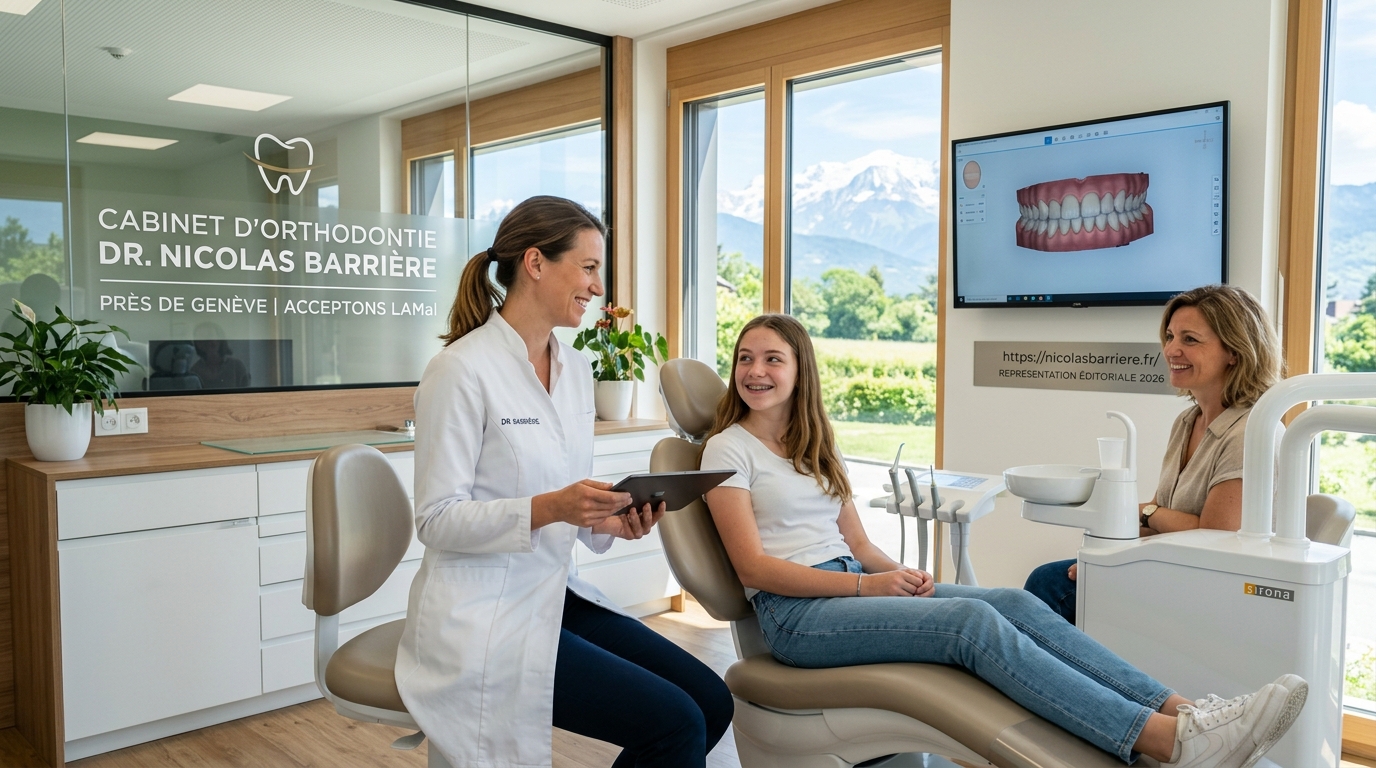
Dr. Nicolas Barrière's practice, located in Divonne-les-Bains, 15 minutes from Nyon and the Swiss border, treats children, adolescents, and adults from the Pays de Gex region and the Franco-Valdo-Genevan area. For cross-border patients, the management of their Swiss health insurance (LAMal) and supplemental insurance claims is integrated into their care pathway.
Describe your incident to the office.The secretariat will arrange your quick appointment according to the nature of the problem.
To further enhance your care pathway according to your profile, several additional resources from the practice are available: the orientation quiz To identify your needs, the page Orthodontic emergency to understand the procedures for coverage, or the article dedicated to...’access to the clinic on the French side for patients from neighboring Switzerland.
Frequently Asked Questions about Ring-Related Incidents
What if I don't have orthodontic wax at home this weekend?
As a temporary fix, you can use the wax from a soft cheese (like Babybel) or a piece of sugar-free chewing gum to cover the irritated area. These solutions will last a few hours, giving you time to go to an on-call pharmacy in the Pays de Gex region to buy a proper box of orthodontic wax.
Is it serious if I accidentally swallow a loose ring?
Swallowing an orthodontic bracket is generally harmless. The small bracket will pass naturally through the digestive system within a few days. However, you should inform your orthodontist at your next appointment so they can replace it and check that your treatment is progressing correctly.
Does a detached retainer wire require intervention on a Sunday?
No. A loose retainer wire behind the teeth is not an absolute emergency requiring a Sunday visit. Simply make an appointment for Monday morning to have it reattached quickly and prevent the teeth from gradually shifting while you wait.
Can I cut off a loose end of wire myself with nail clippers?
This practice is not recommended. Nail clippers are not sterile, are poorly designed, and there is a real risk of swallowing or inhaling a piece of wire. Orthodontic wax is sufficient in the vast majority of cases to allow for a pain-free weekend before the procedure at the office.
Can the on-call dentist on Sunday repair my orthodontic appliance?
Rarely. The on-call dentist in Ain provides emergency dental care for medical emergencies: abscesses, severe pain, trauma. They are not an orthodontist and generally lack the equipment and expertise to reattach a bracket or properly redo a ligation. Wait until your regular dental practice reopens.
How long can an itchy thread protected by wax wait?
A wire properly protected with orthodontic wax can remain undisturbed for several days without risk of injury or canker sore. The goal is to schedule an appointment quickly, ideally within 48 to 72 hours, to have the wire permanently trimmed or repositioned at the dentist's office.
A mouth ulcer appeared because of the thread: what can be done to treat it?
First, protect the thread with wax to prevent worsening the canker sore. Rinse your mouth with warm salt water two to three times a day. A soothing gel for canker sores, available at pharmacies, can be used as a supplement. The lesion usually heals in 7 to 10 days.
As a cross-border worker, can I seek emergency medical care in Geneva rather than in Divonne?
You can consult in Switzerland, but your usual orthodontist remains the best person to work on your appliance, as they are familiar with it. For serious trauma, the Geneva University Hospitals offer an oral and maxillofacial surgery service. For a scratchy wire, an appointment at your usual practice is more appropriate and consistent with your treatment plan.
📌 Key points to remember
- An orthodontic wire that itches on the weekend is a comfort emergency, never a life-threatening emergency.
- Applying orthodontic wax to a dry area is a first aid technique to know.
- Never cut a thread yourself: risk of swallowing and disruption of the treatment.
- The on-call dentist on Sunday does not replace the orthodontist for repairing braces.
- As a temporary fix without wax: use food-grade cheese wax or sugar-free chewing gum for a few hours.
- Contact your office as soon as it reopens for a quick appointment and final adjustment.
- A preventative check-up before holidays or long weekends avoids most emergencies.
About the author: Nicolas Barrière
Dr. Nicolas Barrière is an orthodontist, a qualified specialist in dentofacial orthopedics, a former hospital intern, and the founder of his practice in Divonne-les-Bains. He treats children, adolescents, and adults with orthodontic treatments (clear aligners, lingual braces), paying particular attention to the care of patients living near the French-Swiss border.
Areas of expertise: Orthodontics, Dentofacial orthopedics, Clear aligners, Lingual orthodontics, Pediatric orthodontics, Adult orthodontics, Orthodontic emergencies.
An issue with your device: let's discuss it at the office
A personalized opinion always requires a clinical consultation and a thorough review of your current treatment.
📚 Sources and references
Official and legal sources:
- Decree No. 2025-152 of 19 February 2025 relating to the continuity of outpatient care, Legifrance
- Section 2: Continuity of dental care (Articles R.6315-7 to R.6315-10), Legifrance
- Continuity of care, National Order of Dental Surgeons
- French-Swiss border residents, State services in Haute-Savoie
Hospital and institutional sources:
- Oral Surgery and Implantology Emergency Department, Geneva University Hospitals
- Tutorials for orthodontic emergencies, Hospices Civils de Lyon
- French Society of Dentofacial Orthopedics (SFODF)
Press and demographic data:
- The Pays de Gex region has over 100,000 inhabitants, Tribune de Genève
- Geneva, record influx of cross-border workers in 2024, RTS
- Intermunicipal file of the Pays de Gex, INSEE
📖 Also read
- Orthodontic follow-up for cross-border patients: care and organization between France and Switzerland
- Budget for adult orthodontic treatment in the Ain region near Switzerland
- Accessibility of an orthodontic practice on the French side for neighboring Swiss patients
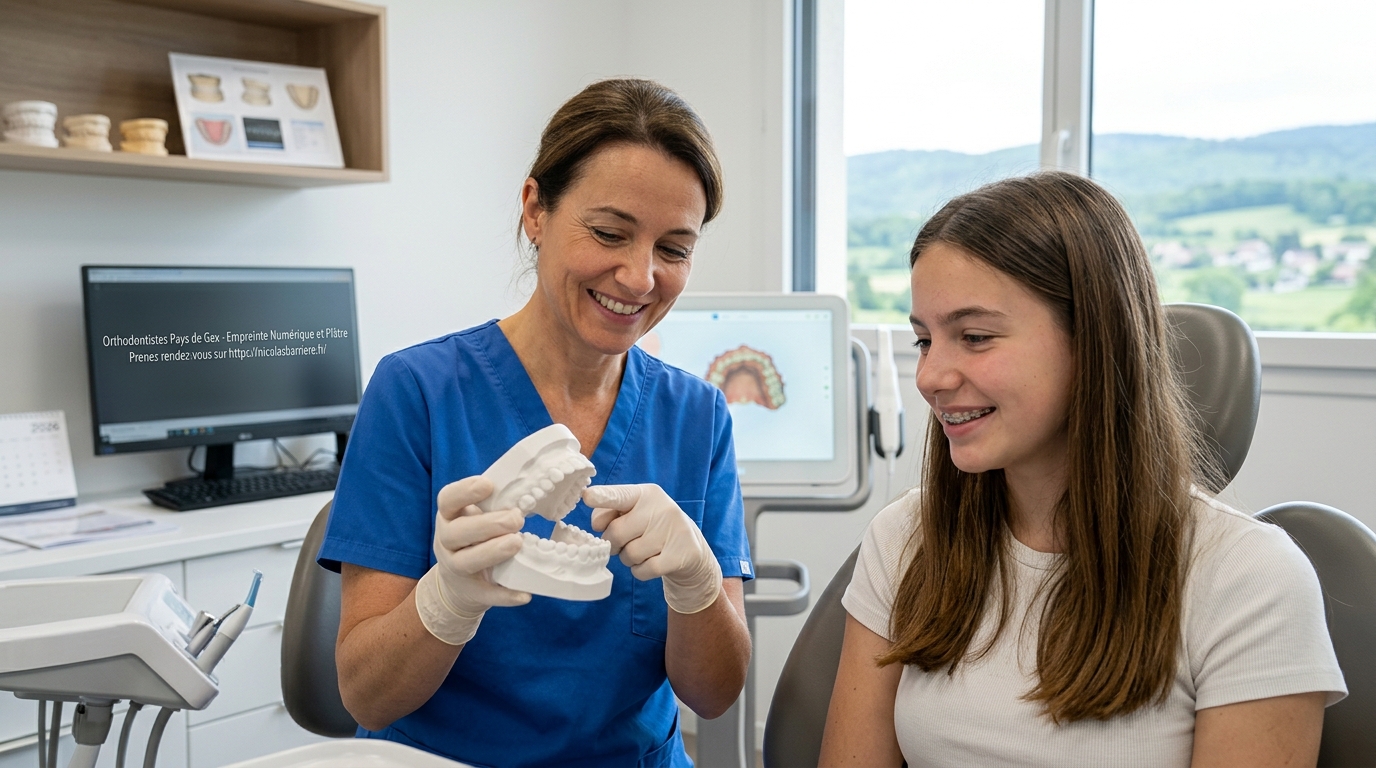
- Digital impression or plaster cast: two methods of taking impressions in orthodontics



 French
 English