
Fixed retention is a wire bonded behind the incisors and canines; it is discreet and permanent. A night guard is a transparent, thermoformed shell worn during sleep. According to the 2023 SFODF recommendations, combining the two offers the most lasting stability, with a lower risk of...

Fixed retention and night guards in orthodontics: how these two devices work and their indications
Written by Nicolas Barrière : Orthodontist, Qualified Specialist in Dentofacial Orthopedics, founder of the practice at nicolasbarriere.fr. Updated on . Reading time: approximately 12 minutes.

The question of "fixed retainer or night guard" inevitably arises at the end of orthodontic treatment, in Divonne-les-Bains as elsewhere. Understanding how these two devices work allows for a more relaxed approach to the stabilization phase.
- Fixed retention is a wire glued behind the incisors and canines, discreet and permanent.
- The night gutter is a thermoformed transparent shell worn during sleep.
- According to the SFODF 2023 recommendations, the combination of the two offers the most lasting stability, with a significantly reduced risk of recurrence over 10 years.
To stabilize dental alignment after orthodontic treatment, two devices are available: fixed retention (a wire bonded lingually from canine to canine) and a removable night guard. According to the French Society of Dentofacial Orthopedics, combining the two remains the most recommended method for ensuring long-term results. A personalized assessment requires a clinical consultation and a thorough examination in the dental office.
This article is part of a series of articles dedicated to orthodontics in Divonne-les-Bains. To understand the overall organization of the practice and what to expect during a first appointment, you can consult our dedicated guide for ensuring continuity of your orthodontic treatment in Divonne-les-Bains. If you wish to ask a direct question to the office, the contact page remains at your disposal.
Why is the retention phase essential after treatment?
The retention phase is essential because the teeth retain a lasting ligamentous memory which tends to make them return to their initial position. Without a stabilization device, the risk of relapse is significant in the months following the removal of the appliance. The best practice guidelines of the French Society of Dentofacial Orthopedics, published in May 2023, establish retention as an integral part of orthodontic treatment.
Restraint Orthodontic retention refers to all devices, fixed or removable, designed to maintain teeth in their new position after the end of active treatment, in order to prevent relapse.
The periodontal fibers and soft tissues (tongue, lips, cheeks) exert continuous forces on the displaced teeth. For several months, sometimes several years, these structures "remember" the former position. The retainer acts as a mechanical safeguard, allowing the bone and ligaments time to reorganize around the achieved alignment.
70 %Relapses occur within the first 2 years without restraint (SFODF literature)
10 yearsMinimum recommended distance for discussing stability
2 devicesCommonly combined: fixed wire + night guard
Health alert point: Discontinuing the use of a retainer, even after several years, can lead to gradual tooth shifting. A night retainer generally does not cause pain if it is properly fitted. Any persistent discomfort warrants a consultation.
In clinical practice, patients who adhere to the retention protocol maintain their alignment over very long periods. Conversely, those who discontinue treatment prematurely frequently require further consultation for anterior relapse, a phenomenon well-documented in the orthodontic literature.
«"Retention is not a decorative option at the end of treatment. It is a fully-fledged clinical step, as important as the active phase, because it is what transforms a result into a lasting one."»
What is fixed restraint and in what cases is it indicated?
Fixed retention is a thin metal wire, often twisted, glued to the lingual (inner) surface of the front teeth, usually from canine to canine. It is completely invisible and acts continuously, without any intervention from the patient. It is particularly indicated in cases with a high risk of recurrence in the anterior sector.
How the lingual wire works
The wire is bonded tooth by tooth using a bonding composite, in a lingual-cervical position that does not interfere with occlusion. Its very thin cross-section makes it imperceptible to the tongue after a few days. Once in place, it stabilizes the teeth impacted by the bond and acts as a mechanical lock in the anterior region.
Advantages of fixed restraint
- Invisible, no aesthetic impact
- Total passivity: nothing to think about on a daily basis
- Permanent protection of the anterior sector
- No risk of forgetting or losing
Limits and vigilance
- Thorough brushing is necessary (sublingual area).
- The use of dental floss or interdental brushes is mandatory.
- Risk of partial detachment (composite coming loose)
- Regular check-ups recommended
Does the restraint wire pose a danger?
The retention wire does not present any danger when it is placed according to best practices and monitored regularly. Risky situations, sometimes grouped under the term "wire syndrome," are rare and involve an undetected partial detachment that allows one tooth to move while the others remain impacted. This is why regular checkups are essential.
Namely: If you experience unusual roughness with your tongue, a pricking sensation from the wire, or a tooth that moves differently, make an appointment quickly. A detachment detected early can be reattached in minutes in the dental chair.
Main clinical indications
- Correction of a significant previous overlap before treatment
- Closed interincisal diastema (space between the central incisors)
- Marked tooth rotations on the incisors or canines
- Young patients whose maxillofacial growth is not yet complete
- Prevention of relapse of the anterior mandibular fold, the statistically most unstable area
How does the removable night guard work to stabilize teeth?
The night guard is a thermoformed transparent shell, custom-made from a digital or physical impression, which covers the entire dental arch during sleep. It simultaneously holds all teeth, including the posterior sectors (premolars and molars) which the fixed wire does not cover.
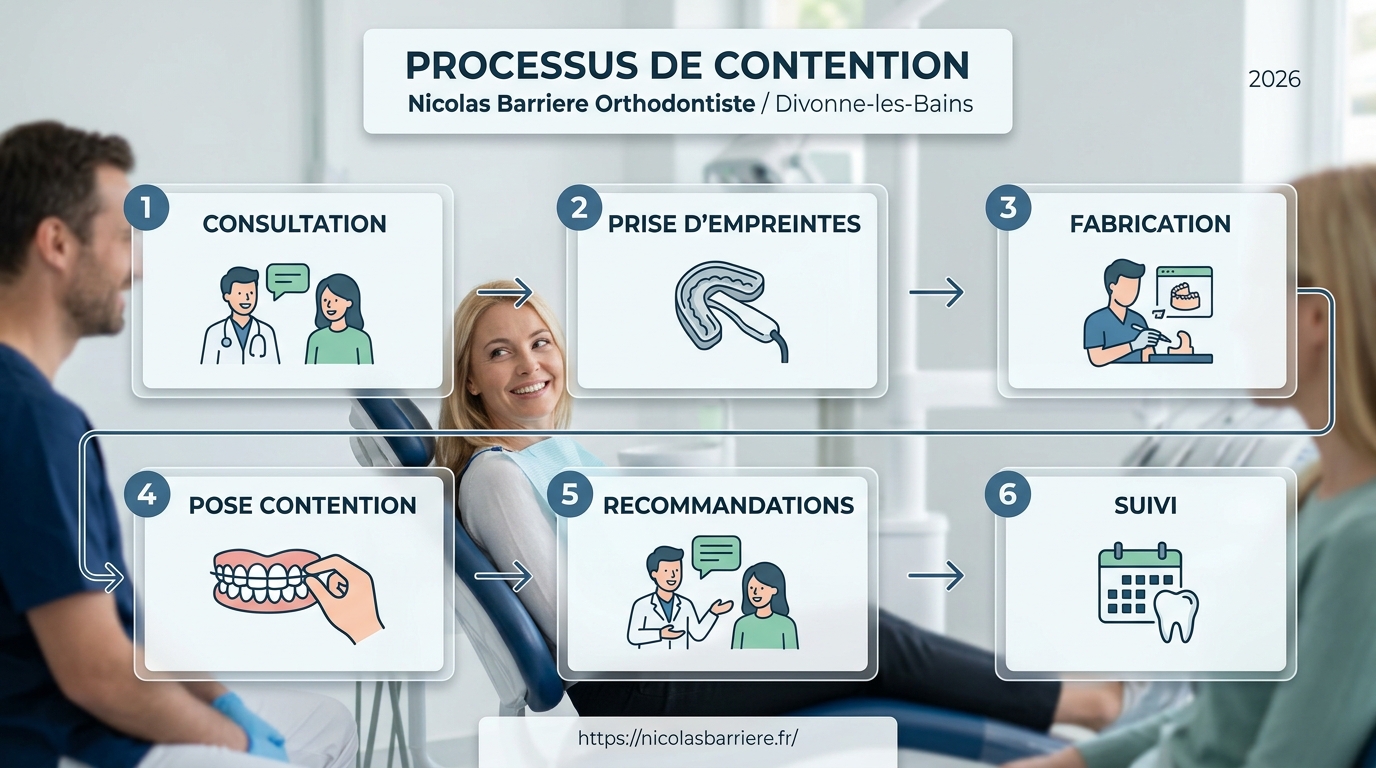
-
End-of-treatment consultation
Evaluation of the stability achieved and selection of the appropriate restraint device for the clinical case.
-
Occlusal analysis and digital impression
Precise intraoral scan of both arches to manufacture a perfectly fitted splint.
-
Device selection
Presentation of the respective advantages of fixed retention, of the splint alone, or of the combination of the two, according to the clinical diagnosis.
-
Installation or delivery
Bonding of the lingual wire in the chair, or handing over of the trays with instructions for use.
-
Regular monitoring
Periodic checks to verify the device, the absence of recurrence and periodontal hygiene.
Recommended porting protocol
The standard protocol begins with continuous wear for a few weeks (except during meals and brushing), then progresses to exclusively nighttime wear. This nighttime phase is maintained over the very long term, often for life, with one use every night followed by less frequent use after several years of confirmed stability.
Systematic nighttime wear, every night. This is the most critical period for stability: the periodontal tissues are actively reorganizing around the new position.
Nighttime use is maintained, with an annual clinical check-up recommended. The fit of the splint is checked and its replacement considered if necessary.
Nighttime wear can be spaced out depending on the individual (2 to 3 nights per week), always with orthodontic advice. Lax wear increases the risk of relapse, even late relapse.
Daily maintenance
- Rinse with cold water after each use
- Gentle brushing with a soft brush and neutral soap (no abrasive toothpaste)
- Occasional soaking in a specific cleansing bath
- Store in a ventilated case, away from heat
- Periodic replacement according to observed wear and tear
Health alert point: Never expose the aligner to hot water (this will deform the thermoplastic) or clean it with an abrasive product. A deformed aligner no longer holds the teeth properly and can, conversely, create unwanted pressure.
Fixed retention or night guard: should you choose one or combine the two?
The current clinical trend, confirmed by the SFODF 2023 recommendations, is to consider the two devices as complementary rather than competitive. The fixed wire secures the anterior sectors (from canine to canine), while the night guard holds the entire arch, including the premolars and molars which remain exposed to relapse.
In summary, fixed retention covers the anterior sector from canine to canine, remains invisible when lingually positioned, and acts passively without risk of forgetting. The main precautions are to avoid undetected detachment and ensure thorough brushing. Night retainers, on the other hand, cover the entire arch, are worn at night, and depend on patient compliance, requiring daily cleaning and periodic replacement as needed. The choice between these devices rests with the practitioner's clinical diagnosis.
The association, a double security
Applying a night guard over a fixed retainer wire provides dual clinical security. The wire continuously locks the anterior area; the guard protects the posterior sectors and takes over if the wire were to detach without immediate notice. This dual approach is particularly relevant in complex cases or in adult patients with more limited intrinsic stability.
A personalized choice in consultation
No universal rule applies to all patients. The choice depends on the type of malocclusion being treated, the patient's age, periodontal condition, hygiene habits, lifestyle, and motivation. A personalized recommendation requires a clinical consultation and a thorough examination.
Discuss your restraint during a consultation
Dr. Nicolas Barrière's practice in Divonne-les-Bains supports the restraint phase for French and Swiss border patients, in compliance with the ethical framework.
What is the role of restraint in a specific clinical case?
Retention is part of the continuity of active treatment and its protocol is decided on a case-by-case basis, depending on the initial malocclusion and the result obtained. Consider the example of an adult patient treated for mandibular anterior crowding: the lower incisor area is statistically the most unstable. A bonded mandibular lingual wire (3x3), combined with a maxillary night guard, is a common and validated approach in this patient profile.
-
Initial situation
Adult patient, moderate mandibular incisor overlap, treatment with clear aligners for 14 months.
-
Active phase of treatment
Regular follow-up appointments and device adjustments until the desired alignment is achieved.
-
End of active treatment
Alignment achieved, occlusion stabilized, retention decision made in consultation with the patient.
-
Selected device
Mandibular lingual wire + maxillary night guard, to cover both arches according to their risk profile.
-
Follow up
Follow-up appointments at 3 months, 6 months, then annually. Checking of the wire, the splint, and the absence of recurrence.
«"During consultations, I always explain that retention is not an additional constraint but a guarantee of the result obtained. A patient who understands why they are wearing their retainer wears it much better in the long run."»
How is restraint financially covered?
In France, the Health Insurance covers orthodontic retention up to an annual fixed amount, for a maximum of two consecutive years, when it follows reimbursed orthodontic treatment for a patient under 16 years of age. Beyond that, coverage falls under supplementary health insurance. For Swiss border patients, reimbursement is divided between basic health insurance (LAMal) and supplementary insurance, depending on the treatment location and insurance status.
Official reference: The precise reimbursement procedures are detailed on the website of the’Health Insurance (Ameli). The office secretary can advise you on your situation.
Franco-Swiss border patients
The practice regularly handles Swiss (LAMal and supplementary) and French insurance claims. Restraints may be covered depending on the patient's insurance policy. A clear estimate is always provided before the device is fitted, as part of a strictly informative process.
FAQ: Your frequently asked questions about orthodontic retention
How much does orthodontic retention cost?
The cost depends primarily on the clinical diagnosis and the device chosen by the practitioner (fixed wire, aligner, or a combination of both), the dental arch involved, and the complexity of the case. In France, fees are regulated for the portion reimbursed by the national health insurance for those under 16. A personalized quote is always provided during the consultation before any fitting, once the clinical examination has been completed.
How long should a retainer be worn at night?
The retainer is worn at night for a very long time, often considered "lifelong" to ensure the desired result. For the first 6 to 12 months, it must be worn every night. After that, the frequency can be reduced with orthodontic advice, but stopping completely can lead to relapse, even several years after the end of treatment.
Does the health insurance cover orthodontic retention?
Health insurance covers compression garments up to a fixed annual amount for a maximum of two years for those under 16. Beyond this age limit, and for adults, reimbursement is entirely the responsibility of supplemental health insurance. Contracts vary considerably: it is advisable to request a quote from the clinic to send to your insurance provider before fitting.
How much does an orthodontic retention splint cost?
The cost of a retainer depends on the clinical diagnosis, the manufacturing technique (digital or physical impression), the material, and the dental arch involved. A detailed estimate is provided before fabrication. As the retainer is a custom-made device, its cost reflects the laboratory time and the precision of the fitting required for its effectiveness.
Is the retainer covered by insurance?
A retainer may be partially reimbursed under the annual retention allowance of the French National Health Insurance (Assurance Maladie) for patients who received orthodontic treatment covered before the age of 16. For adults, it is not covered by the French National Health Insurance and is covered by supplemental health insurance (mutuelle). Specific details can be found on the Ameli website.
What are the disadvantages of a dental retainer?
The main drawbacks are the discipline required of the patient (not forgetting it, not losing it), the need for daily cleaning to prevent tartar buildup and odors, and the risk of deformation if exposed to heat. A poorly maintained retainer loses its effectiveness and can contribute to gum problems.
Does wearing a retainer at night cause pain?
A properly fitted retainer should not cause pain. A slight feeling of pressure is normal for the first few nights or after a period of not wearing it. Persistent pain, occlusal discomfort, or a localized pressure point warrants a prompt consultation for adjustment: the device should never be uncomfortable over time.
What should I do if the retaining wire comes loose?
If the wire becomes partially or completely detached, you should consult the dentist promptly for reattachment. A partially detached wire can allow a tooth to move independently and create an imbalance. The procedure is quick, painless, and preserves the results of the treatment. Until your appointment, avoid manipulating the wire with your tongue.
Points to be aware of and best practices on a daily basis
The success of restraint depends as much on the choice of device as on the patient's involvement in its maintenance and follow-up. A few simple steps can help preserve the results obtained over many years.
🪥
Appropriate hygiene
Thorough brushing around the lingual wire, use of dental floss or interdental brushes, daily cleaning of the tray.
📅
Regular checks
An annual check-up allows for the early detection of detachment or wear.
👁️
Self-observation
Any new sensation (thumping wire, loose tooth, aligner that no longer clips) should be a cause for concern.
🌡️
Preserve the gutter
No hot water, no abrasive products, store in a ventilated case.
For patients who started their restraint treatment elsewhere and wish to continue their follow-up in Divonne, the transition procedures are detailed in our dedicated article: resume retention follow-up with a new orthodontist in Divonne-les-Bains. The specific elements to consider before contacting an orthodontic practice are presented in this Informative guide on choosing an orthodontic practice.
📌 Key points to remember
- Restraint is a therapeutic step in its own right, as important as active treatment.
- Fixed retention is a discreet and passive wire glued lingually, on the anterior sector.
- A night guard is a transparent shell that covers the entire arch during sleep.
- Combining the two systems offers the most durable stability according to the SFODF 2023 recommendations.
- Wearing a mouthguard at night is often recommended over the very long term, sometimes for life.
- Regular checks help prevent the wire from coming loose and the gutter from wearing out.
- A personalized opinion requires a clinical consultation and a thorough examination in the office.

About the author: Dr. Nicolas Barrière
Dr. Nicolas Barrière is an orthodontist, a qualified specialist in dentofacial orthopedics, a former hospital intern, and the founder of his practice in Divonne-les-Bains. He treats children, adolescents, and adults with orthodontic treatments (clear aligners, lingual braces), paying particular attention to the care of patients living near the French-Swiss border.
Areas of expertise: Orthodontics, Dentofacial orthopedics, Clear aligners, Lingual orthodontics, Children's orthodontics, Adult orthodontics, Long-term retention and stability.
A containment project in Divonne-les-Bains?
For any questions regarding your retention phase, Dr. Nicolas Barrière's office welcomes you by appointment. A personalized consultation requires a clinical examination.
📚 Sources and references
Official and academic sources:
- French Society of Dentofacial Orthopedics, Recommendations for good practice on retention in orthodontics, May 2023.
- Orthodontic retention: best practice recommendations, PubMed, 2023.
- Health insurance, Reimbursement for orthodontic treatments.
- Code of ethics for dental surgeons, Legifrance.
- JLE, French Orthodontics, Orthodontic retention: best practice recommendations.
📖 Also read on the blog:
- Making an orthodontic appointment in Divonne-les-Bains: practice organization and continuity of care
- Resuming retention follow-up with a new orthodontist in Divonne-les-Bains
- Orthodontic practice in Divonne-les-Bains: what information should you consult before making contact?
- Patient file in orthodontics: content and transmission between practitioners
 French
 English