
Orthodontics actually moves teeth and their roots within the bone, over a period of 6 to 24 months on average. Dental veneers camouflage surface imperfections in 2 to 3 appointments, without repositioning the tooth. The choice depends on the clinical diagnosis: severity of the malocclusion, the health of the

Misaligned teeth in adults: orthodontics or veneers, two different approaches
Written by Nicolas Barrière Orthodontist, Qualified Specialist in Dentofacial Orthopedics, founder of the practice at nicolasbarriere.fr. Updated on . Reading time: approximately 12 minutes.
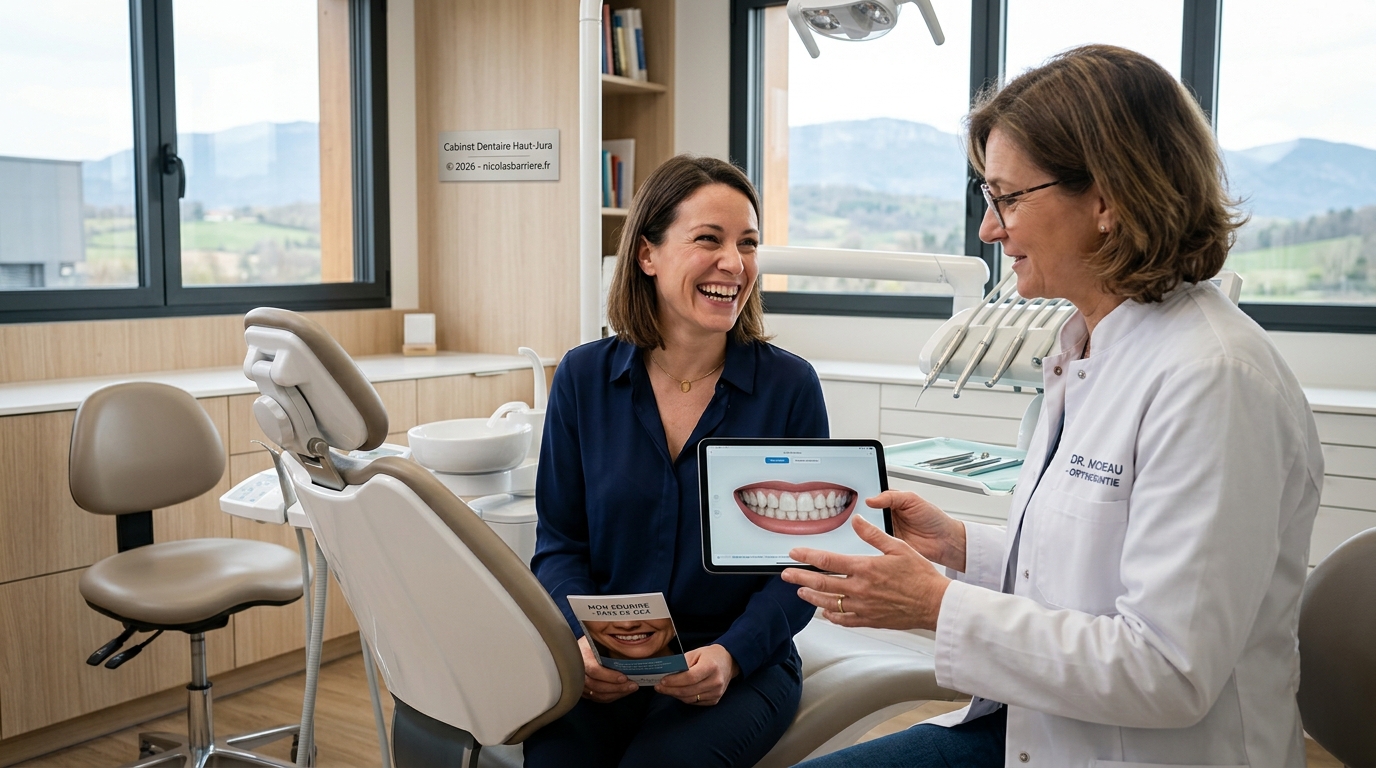
More and more adults, whether working professionals or cross-border commuters, are seeking to correct their misaligned teeth without knowing whether to opt for orthodontics or dental veneers. These two approaches share a common aesthetic goal, but are based on radically different clinical principles.
- Orthodontics actually moves the teeth and their roots into the bone, over a period of 6 to 24 months on average.
- Dental veneers camouflage surface defects in 2 to 3 sessions, without repositioning the tooth.
- The choice depends on the clinical diagnosis: severity of the malocclusion, health of the periodontal tissues, aesthetic expectations.
- A personalized opinion always requires an in-office consultation and a thorough examination.
To correct misaligned teeth in adults, orthodontics and veneers are not interchangeable. Orthodontics physically moves teeth and their roots to correct true malocclusions, over a period of 6 to 24 months. Dental veneers, thin ceramic shells bonded to the visible surface, mask minor alignment issues in 2 to 3 appointments by only altering the surface appearance.
This article is part of an educational series on treatments for adults. To get your thinking started, it is helpful to understanding the different orthodontic techniques for adolescents and adults before even considering a purely aesthetic alternative. In 2026, this clarification is essential: the confusion between medical treatment and aesthetic procedure can lead to unsuitable choices in the long term.
Health alert point: No web content can replace a clinical examination. The information in this article is for educational purposes only. Only a qualified practitioner, after X-rays and impressions, can determine the appropriate solution for your situation.
What is the fundamental difference between orthodontics and veneer placement?
Orthodontics is a medical treatment that moves teeth within the bone; veneers are a prosthetic procedure that covers the visible surface of the tooth. The goal may seem similar (a more harmonious smile), but the clinical approach is opposite: one modifies the actual position, the other only changes the appearance.
This distinction is not insignificant. It determines the duration of treatment, the preservation of the natural tooth, the longevity of the result, and above all, the medical indications. A true malocclusion, where the jaws do not fit together correctly, can never be corrected with veneers.
Orthodontics : medical discipline within the specialty of dentofacial orthopedics which corrects the position of teeth and the relationship between jaws by applying controlled forces, using transparent splints, vestibular or lingual bonded brackets.
Dental veneer : thin film (usually ceramic) glued to the visible surface of a natural tooth to modify its shade, shape or mask very slight positional defects, without moving the root.
How does orthodontic treatment work in adults?
Adult orthodontics relies on the application of light, continuous forces that reshape the alveolar bone around each tooth root. This biological mechanism, called bone remodeling, allows the tooth to gradually move towards its target position without being extracted or filed.
The tools used today vary depending on the clinical case: removable clear aligners, discreet ceramic brackets bonded to the front surface, or lingual brackets placed on the tongue side and therefore completely invisible. The choice depends on the complexity of the case, the lifestyle, and the aesthetic preferences of the adult patient. The practitioner is responsible for choosing the appliance; the patient does not choose a brand.
🦷
Transparent gutters
Removable mouthguards changed every 1 to 2 weeks, worn 22 hours a day.
✨
Ceramic fasteners
Translucent housings glued to the vestibular surface, more discreet than metal.
🔒
Lingual orthodontics
Custom-made fasteners placed on the tongue side, invisible from the outside.
According to data from the French National Health Insurance, correcting misaligned teeth promotes better oral hygiene and helps prevent periodontal disease in the long term (source: Ameli, dental malpositions). It is this functional dimension, beyond aesthetics, that distinguishes orthodontics from a purely cosmetic procedure.
What exactly are dental veneers used for?
A dental veneer is a thin film, most often made of ceramic, glued onto the visible surface of the tooth to mask surface defects. It doesn't move anything: the root and position of the tooth remain unchanged. Only the external appearance is modified.
This prosthetic technique generally requires slightly removing the natural enamel to allow the veneer to bond and avoid a visible thickening. This step is irreversible: a prepared tooth will always require a veneer or crown afterward.
Health alert point: Placing veneers on misaligned teeth without first correcting the malocclusion can worsen wear and chewing problems. While the appearance improves, the functional imbalance remains. A prior clinical evaluation is essential.
In which cases should orthodontics or veneers be preferred in adults?
The choice between orthodontics and veneers is based on specific clinical criteria: the nature of the problem, the health of the periodontal tissues, the preservation of enamel, and the long-term treatment plan. Orthodontics is necessary when a true malocclusion is present; veneers are limited to purely aesthetic corrections on teeth that are already well-positioned.
| Evaluation criteria | Orthodontic treatment | Dental veneer placement |
|---|---|---|
| Principle of action | Actual displacement of roots and crowns | Aesthetic camouflage of the visible surface |
| Clinical indications | Malocclusions, severe crowding, open bite, crossbite | Minor alignment issues, color problems, teeth that are too small |
| Average duration | 6 to 24 months depending on the complexity of the case | 2 to 3 sessions at the office |
| Tooth preservation | 100 % of the preserved enamel | Light to moderate enamel size required |
| Reversibility | Reversible treatment (natural tooth intact) | Irreversible gesture (cut enamel) |
| Functional benefit | Improved chewing and hygiene | Purely aesthetic benefit |
Specific indications for adult orthodontics
Orthodontics is medically necessary as soon as there is a true malocclusion or a significant overlap. It is the only option to correct a crossbite, mandibular prognathism, anterior open bite, or major dental crowding.
According to the French National Health Insurance classification, dental malpositions are divided into several types (overlapping, diastemas, jaw misalignments) which require correction of the actual position of the teeth (source: Ameli, classification of malpositionsNo facet can replace this repositioning work.
Situations where facets can be considered
Facets are considered when the alignment is generally satisfactory but an aesthetic surface defect remains. The patient has well-positioned teeth and a correct functional occlusion, but wishes to modify the shade, shape, or mask very slight discrepancies.
Favorable situations for facets
- Naturally grey or stained teeth, resistant to whitening.
- Teeth that are too small or irregularly shaped.
- Small, limited diastemas between two anterior teeth.
- Minor overlaps on a generally good alignment background.
Situations where veneers are contraindicated
- Moderate or severe dental overlap.
- Malocclusion, severe uncontrolled bruxism.
- Weakened periodontal disease or multiple devitalized teeth.
- Unrealistic expectations or a desire to preserve 100 % of the enamel.
What figures should we remember about dental alignment in adults?
The demand for teeth straightening treatments for adults has increased considerably in France in recent years. This trend can be explained by the increased availability of discreet techniques (clear aligners, lingual orthodontics) and by a growing focus on smiles in social and professional life.
6 monthsminimum duration of adult orthodontic treatment
24 monthsAverage to high duration for complex cases
16 years oldAge limit for health insurance reimbursement
2-3 sessionsnumber of appointments for veneer placement
«"In practice, we regularly observe that adult patients confuse aesthetic and functional objectives. A thorough consultation allows us to distinguish between what constitutes a true tooth movement and what can be improved by a conservative prosthetic procedure."»
Why does the reimbursement stop at age 16?
In France, health insurance only reimburses orthodontics before the age of 16, except in special cases of preparation for jaw surgery. Beyond that, rates are unregulated and coverage depends solely on the supplementary health insurance (source: Ameli, orthodontic reimbursement).
For cross-border patients in the Pays de Gex region who are covered by Swiss health insurance (LAMal), reimbursement for adult orthodontic treatment is also very limited: it relies primarily on private supplemental insurance purchased beforehand. The practice can guide patients through the administrative procedures required by each insurance company.
Do you need a personalized diagnosis of your situation?
An orthodontic assessment in the office helps determine the solution best suited to your anatomy and your goals.
How does the initial consultation in Divonne-les-Bains take place?
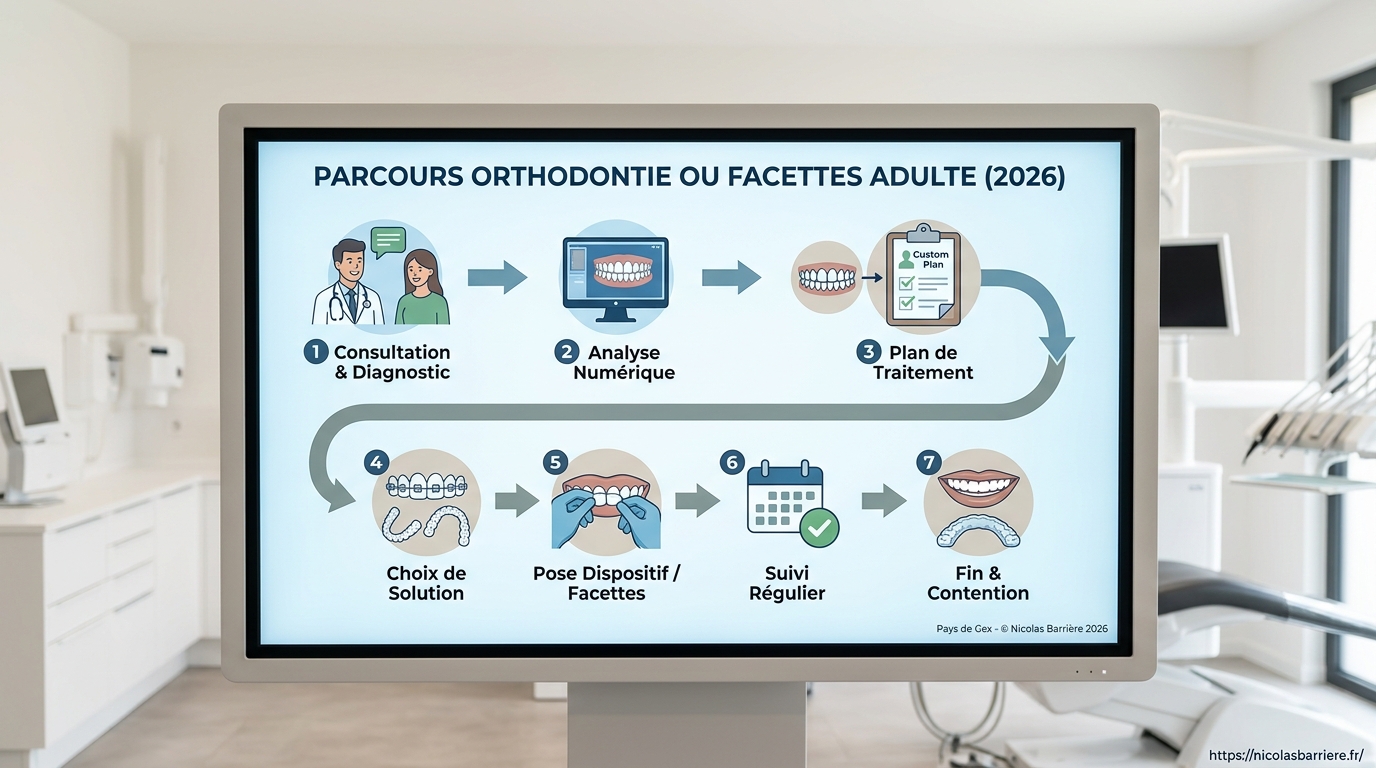
The initial consultation is the only reliable way to determine whether your situation requires orthodontics, veneers, or a combination of both. It is based on a complete clinical examination, panoramic radiographs, digital impressions, and sometimes intraoral photographs.
-
Initial clinical interview
Collection of aesthetic expectations, medical and dental history, habits (bruxism, smoking, diet).
-
Intraoral examination
Evaluation of occlusion, periodontal health, level of tooth wear and enamel quality.
-
Imaging and Impressions
Panoramic radiography, lateral cephalometric radiography, 3D digital impressions for modeling.
-
Diagnosis and treatment plan
Proposal of one or more options with detailed duration, stages, advantages and limitations.
-
Active phase and follow-up
Regular follow-up appointments and adjustments to the appliance throughout the tooth movement, until the target position is reached.
-
Quotes and administrative procedures
A detailed estimate, a letter for the French mutual insurance company or the Swiss supplementary insurance.
Why does the border context matter?
The Pays de Gex, located near Geneva, is home to a particularly active adult population, many of whom are cross-border commuters. According to the Auvergne-Rhône-Alpes Regional Health Observatory, this area has a dynamic socio-demographic profile with a high demand for local healthcare (source: ORS Auvergne-Rhône-Alpes, Pays de Gex report).
This reality shapes expectations: cross-border patients seek long-term treatments, governed by strict regulations (French or Swiss) and compatible with a demanding professional schedule. Discreet techniques (clear aligners, lingual orthodontics) are particularly well-suited to these constraints.
Can orthodontics and veneers be combined in adults?
Yes, a combined approach is sometimes the most suitable solution: orthodontics first repositions the teeth, then veneers finalize the aesthetic appearance. This sequence, called orthodontic-prosthetic treatment, allows for maximum preservation of dental capital while achieving the desired aesthetic objective.
Step 1: Orthodonticstooth movement into the optimal position
Step 2: Restraintstabilization of the result obtained
Step 3: facetsFinal aesthetic correction on aligned teeth
The advantage of this sequence is twofold: it reduces the required veneer thickness (and therefore the amount of enamel to be removed) and it ensures a more stable result over time, because the occlusal forces are exerted on correctly positioned teeth.
A veneer placed on a misaligned tooth is subjected to abnormal chewing forces, resulting in a mechanically reduced lifespan. Correcting the tooth's position first is often the best long-term investment.
How sustainable are the two approaches?
A well-conducted orthodontic treatment, followed by adherence to retention, offers a stable result for several decades. Retention is essential: without it, there is a risk of relapse, especially in adults whose alveolar bone has greater memory (source: SFODF, restraint after treatment).
Ceramic veneers typically last between 10 and 20 years, depending on usage conditions, before needing replacement. They require rigorous maintenance and impeccable hygiene to prevent leaks and detachment.
Orthodontics + retentionLong-term stability
Facets only10 to 20 years on average
What risks and precautions should you be aware of?
Any intervention on the teeth involves medical considerations that must be weighed. Adult orthodontics requires a healthy periodontal system (healthy gums and alveolar bone); veneers require a prior evaluation of the enamel and occlusion.
Health alert point: Express orthodontic treatments or aligners sold online without clinical supervision present real risks of gum recession, bone loss, and worsening of malocclusion. The French Federation of Orthodontics regularly warns against these practices. Dental alignment treatment requires clinical monitoring by a qualified practitioner.
What are the prerequisites before any treatment?
A complete oral examination is mandatory before any orthodontic treatment or placement of veneers. Cavities must be treated, periodontal problems addressed, and rigorous oral hygiene established. This foundation is essential for successful treatment.
🔬
Periodontal health
Gums and alveolar bone must be stable and without active inflammation.
🪥
Strict hygiene
Twice-daily brushing and interdental hygiene are essential throughout the treatment.
📋
Preliminary assessment
Conservative treatments completed before any orthodontic or prosthetic work begins.
«"An adult wishing to correct misaligned teeth must first accept that clinical time is unavoidable: bone biology cannot be forced. The most stable results are those that respect the physiological rhythm of remodeling."»
How to choose between the different orthodontic techniques?
Once orthodontic treatment is chosen, several techniques remain possible: clear aligners, ceramic braces, and lingual braces. The choice is based primarily on the clinical diagnosis and the practitioner's expertise, who ensures the technique is best suited to the individual case, as well as on the constraints of daily professional and social life. The patient chooses the technique best suited to their needs, never a specific brand.
| Criteria | Transparent gutters | Ceramic fasteners | Lingual orthodontics |
|---|---|---|---|
| Visual discretion | ✓ | ~ | ✓ |
| Removable | ✓ | ✗ | ✗ |
| Adaptation to complex cases | ~ | ✓ | ✓ |
| Initial comfort | ✓ | ~ | ~ |
| Depends on patient compliance | ✓ | ✗ | ✗ |
To further explore this technical comparison, the firm's main article details the operation of each device and the selection criteria specific to each patient profile. The final selection is always made jointly with the practitioner during the consultation.
Good to know: The practice in Divonne-les-Bains supports both clear aligner treatments and lingual orthodontics, with particular experience in the care of Franco-Swiss border patients and administrative management with insurance companies in both countries.
What does professional ethics say about these treatments?
The Public Health Code and the National Order of Dental Surgeons strictly regulate the communication and practice of orthodontics and cosmetic dentistry. A practitioner cannot promise a result, compare their practice to that of a colleague, or create an artificial urgency to push for an action.
This ethical framework protects the patient: it guarantees objective, factual information tailored to each situation. This is also why a web article can never replace a clinical consultation. Only a direct examination, with X-rays and impressions, allows for a reliable diagnosis and the development of a personalized treatment plan.
📌 Key points to remember
- Orthodontics actually moves the teeth and roots; veneers camouflage the external appearance without changing the position.
- Orthodontics is medically necessary for any true malocclusion or significant crowding.
- Veneers are reserved for minor aesthetic defects on teeth that are already well aligned.
- The application of veneers is irreversible: it requires removing part of the natural enamel.
- A combined approach (orthodontics then veneers) can be proposed to preserve dental health.
- French health insurance no longer reimburses orthodontics after age 16, except in surgical cases.
- Only a consultation in the office, with clinical examination and X-rays, can determine the appropriate solution.
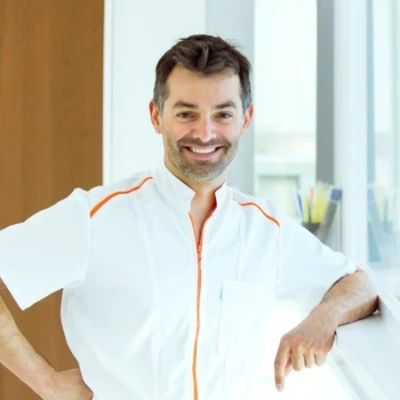
About the author: Nicolas Barrière
Dr. Nicolas Barrière is an orthodontist, a qualified specialist in dentofacial orthopedics, a former hospital intern, and the founder of his practice in Divonne-les-Bains. He treats children, adolescents, and adults with orthodontic treatments (clear aligners, lingual braces), paying particular attention to the care of patients living near the French-Swiss border.
Areas of expertise: Orthodontics, Dentofacial orthopedics, Clear aligners, Lingual orthodontics, Pediatric orthodontics, Adult orthodontics.
FAQ: Your frequently asked questions about misaligned teeth in adulthood
How is the choice of orthodontic treatment for adults determined?
The choice of orthodontic treatment is based primarily on clinical diagnosis and the practitioner's expertise, who determines the most suitable technique for each case (clear aligners, ceramic brackets, lingual braces) as well as the treatment duration. Adult orthodontic fees are unregulated in France and are not covered by national health insurance for those over 16, except in preparation for orthognathic surgery. A good supplemental health insurance plan can help reduce out-of-pocket expenses, but clinical appropriateness takes precedence over all other considerations.
Is it possible to receive orthodontic treatment after age 50?
Yes, there is no age limit for straightening your teeth. The only medical prerequisite is having healthy periodontal tissues: healthy gums and alveolar bone. A preliminary clinical evaluation confirms the feasibility of the procedure. Clinical studies confirm good results in mature adult patients, provided they undergo rigorous follow-up (source: PubMed, orthodontic treatment in adults).
Does orthodontics change the shape of the face?
Orthodontics modifies lip support and jaw alignment, which can harmonize the facial profile, particularly in significant corrections to the position of the incisors. However, it does not alter the bone structure of the skull. The changes are subtle but often perceived positively by patients upon completion of treatment.
Can a dentist perform orthodontics?
A general dentist can legally practice orthodontics in France. However, a specialist qualified in dentofacial orthopedics has completed several years of additional training (a qualifying internship) dedicated exclusively to this complex discipline. For cases requiring advanced expertise, referral to a qualified specialist is often recommended.
Do you need a prescription to go to the orthodontist?
No, no prior medical prescription is required to make an appointment with an orthodontist or dentist in France. Adult patients can consult the practitioner of their choice directly. However, some health insurance providers may require a quote beforehand to validate supplemental reimbursement.
Which is the best country for getting dental veneers?
Dental tourism attracts some patients for cost reasons, but France and Switzerland offer a strict regulatory framework guaranteeing high-quality materials and close post-treatment follow-up. The Pays de Gex benefits from this environment of medical excellence, with easy access to qualified practitioners on both sides of the border and coordinated management of long-term follow-up.
Is it possible to get veneers without shaping the teeth?
There are ultra-thin veneers, known as "no-preparation" veneers, which require little to no enamel preparation. However, their use is limited to very specific situations (small teeth, acceptable base shade). In most cases, minimal enamel preparation is still necessary to ensure a natural aesthetic result.
How long should the retainer be worn after orthodontic treatment?
Retention is essential to maintain the results achieved and prevent relapse. In adults, it is generally recommended long-term, in the form of a bonded wire behind the teeth or a night guard. Without retention, the risk of secondary tooth movement is real, hence the importance of strictly following the practitioner's recommendations.
Ready to have your situation assessed by a specialist?
Since each situation is unique, a thorough clinical examination remains the only reliable way to determine the right solution for your smile.
📚 Sources and references
Official and institutional sources:
- Ameli: Treatment of dental malpositions
- Ameli: Classification of dental malpositions
- Ameli: Reimbursement for orthodontic treatments
- Ministry of Health: Demographics of dental surgeons
- ORS Auvergne-Rhône-Alpes: Health diagnosis of the Pays de Gex
- National Order of Dental Surgeons
Academic and scientific sources:
- PubMed: orthodontic treatment in adults, challenges and outcomes
- SFODF: Retention after orthodontic treatment
- French Federation of Orthodontics
📖 Also read on the blog:
- Braces or clear aligners: understanding the different orthodontic techniques for teens and adults
- Clear aligners for adults: the different options and how to choose the treatment
- Lingual braces and clear aligners: comfort, adaptation and everyday experience
- Contact the office to schedule an initial appointment.

 French
 English