
The treating dentist refers the patient to an orthodontist when a malocclusion requires specialized treatment in dentofacial orthopedics. Verification of qualifications is carried out through the official directory of the National Order of Dental Surgeons, guaranteeing patient safety.

Orthodontic consultation: how does a referral from your dentist and a second opinion work?
Written by Nicolas Barrière : Orthodontist, Qualified Specialist in Dentofacial Orthopedics, founder of the practice at nicolasbarriere.fr. Updated on . Reading time: approximately 6 minutes.
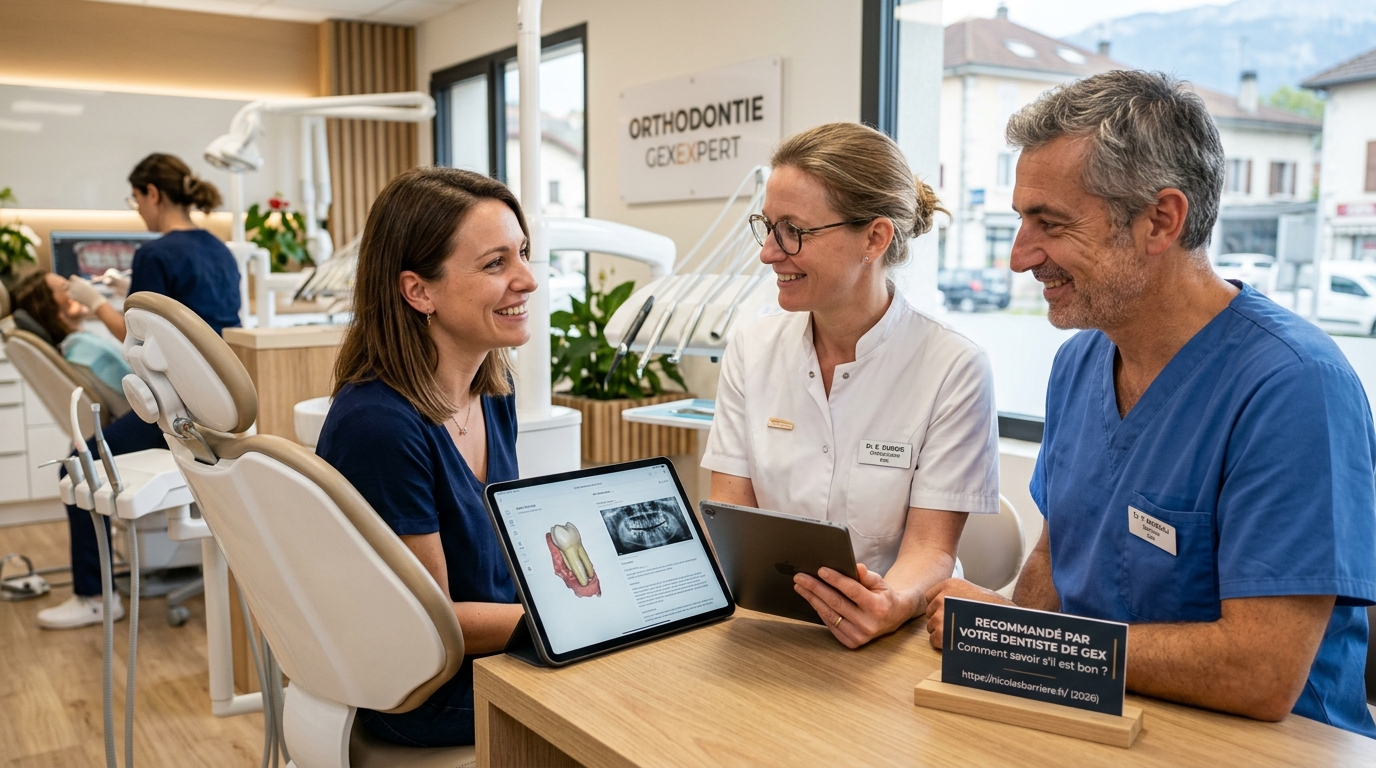
When I'm introduced to an orthodontist recommended by my dentist, determining their suitability relies on objective and verifiable criteria. This article details the process for validating this choice in 2026.
- The treating dentist refers to an orthodontist when a malocclusion requires specialized treatment in dentofacial orthopedics.
- Verification of qualifications is done through the official directory of the National Order of Dental Surgeons, a guarantee of safety for the patient.
- The second opinion consultation includes a clinical examination, additional examinations (X-rays, impressions) and a mandatory written quote.
To evaluate an orthodontist recommended by your dentist, verify their registration with the National Council of the Order of Dental Surgeons and their qualification in dentofacial orthopedics (code 36). During the second opinion consultation, a qualified practitioner will conduct a complete clinical assessment, present the treatment options, and provide a detailed written estimate.
Dentofacial orthopedics (ODF) : specialized medical discipline that corrects dental malpositions and jaw growth abnormalities, practiced by a qualified specialist dental surgeon after several years of additional training.
Why is your dentist recommending an orthodontic specialist?
Your dentist will refer you to an orthodontist when they detect a malocclusion, dental crowding, or a maxillary growth problem that goes beyond the scope of conventional general dentistry. This recommendation reflects a coordinated approach where each professional intervenes within their area of expertise.
The general dentist provides routine care (cavities, scaling, simple prostheses). When faced with a complex alignment problem, they refer the case to a specialist colleague for a more in-depth diagnosis. In the Franco-Swiss border region, from which many patients come, this local approach relies on a network of referring dentists who know each other and communicate regularly.
Health alert point: A referral to an orthodontist does not necessarily mean an emergency, unless otherwise stated by the treating dentist. It aims to assess the potential benefits of treatment, without any immediate obligation to proceed.
What is the role of the treating dentist?
The treating dentist prepares the ground before any orthodontic treatment. He treats cavities, performs tartar removal, and checks gum health. According to Ameli, A healthy mouth is a prerequisite for fitting orthodontic braces, as brackets or aligners can worsen a fragile gum condition.
The treating dentist also remains the point of contact for semi-annual check-ups and general follow-up throughout the orthodontic treatment. This continuity of care is essential and is the subject of a coordinated organization between the firms.
🦷
General dentist
Basic care, hygiene, prevention and detection of abnormalities.
📐
Orthodontist
Orthodontic diagnosis, treatment plan, fitting and monitoring of appliances.
🤝
Coordination
Exchange of files, shared X-rays, joint follow-up.
How can you tell if an orthodontist is good and qualified?
A qualified orthodontist can be recognized by three objective elements: their registration with the National Order of Dental Surgeons, their specific qualification in dentofacial orthopedics (code 36) and the conformity of their practice to ethical rules. These criteria are publicly verifiable and take precedence over online reviews, which are often unreliable.
6 yearsInitial training in dental surgery
3 to 4 yearsAdditional Orthodontic Specialization
1 directoryOfficial registration verification
How can you tell if a dentist is also an orthodontist?
Qualified orthodontic specialist : dental surgeon holding the Certificate of Special Clinical Studies in Orthodontics (CECSMO) or the Diploma of Specialized Studies (DES) in Dentofacial Orthopedics, the only one authorized to use the title of orthodontist in France.
In France, any dentist can perform so-called "simple" orthodontic treatments, but only those holding a recognized qualification can claim the title of qualified orthodontic specialist. This qualification, identified by code 36 with the French National Health Insurance (Assurance Maladie), corresponds to 3 to 4 years of study after the initial dentistry degree (i.e., approximately 9 to 10 years of study in total).
In practical terms, a general practitioner might suggest clear aligners for a mild case. A qualified orthodontist treats all cases, including the most complex (impacted teeth, orthognathic surgery, interceptive treatments for children). The practitioner remains responsible for choosing the appliance (visible braces, lingual braces, or clear aligners), which the patient does not choose themselves.
General practitioner specializing in orthodontics
- Initial training of a dental surgeon
- Continuing education in orthodontics
- Suitable for simple alignment cases
Qualified orthodontic specialist
- Complete university training in orthodontics
- Title recognized by the Order (code 36)
- We handle all cases, including complex ones.
How to verify registration with the National Order?
The verification takes only a few minutes via the public directory of the National Order of Dental Surgeons, which is freely accessible online. You enter the name of the practitioner and their municipality (Divonne-les-Bains) to obtain their official record.
-
Access the official directory
Visit the website of the’National Order of Dental Surgeons, section «Find a dentist».
-
Enter the practitioner's contact information
Name, surname and locality are sufficient to identify the record. Verify the city of practice indicated.
-
Check the qualification
The record mentions the declared specialty. Look for the phrase "qualified specialist in dentofacial orthopedics" or the equivalent.
-
Cross-reference with the SFODF
There French Society of Dentofacial Orthopedics lists member practitioners, guaranteeing continuing education.
📝 For the question "Dr Olivier Quinty review" or any other practitioner in the sector, the official directory of the Order remains the most reliable source, much more so than an isolated review on a general public platform.
What happens during a second opinion consultation with an orthodontist?
The second opinion consultation is a time for listening, clinical examination and discussion which generally lasts between 30 and 60 minutes. This is the moment when the patient assesses the professionalism of the practice, the clarity of the explanations, and the quality of the relationship with the healthcare team.
- Courteous welcome from the secretary, reasonable waiting time.
- Visible hygiene: gloves, mask, sterile equipment, clean treatment room.
- Listening to the reasons for consultation and the patient's expectations.
- Clear explanations without unnecessary jargon or commercial pressure.
- A detailed written quote will be systematically provided.
What are the steps involved in the first orthodontic assessment?
The initial orthodontic assessment combines a clinical examination and additional tests necessary for diagnosis. The orthodontist analyzes the position of the teeth, the occlusion, the growth of the jaws and function (breathing, swallowing, phonation).
-
Clinical Interview
Medical history, reasons for consultation, aesthetic and functional expectations.
-
Intraoral clinical examination
Observation of teeth, gums, occlusion and joint mobility (TMJ).
-
X-ray examinations
Panoramic dental X-ray and lateral cephalometric X-ray to analyze bone structures.
-
3D digital footprints
Intraoral scanner replacing plaster casts, more comfortable and more precise.
-
Clinical photographs
Documentation of the initial state of the smile and face for follow-up.
-
Reporting the diagnosis
Presentation of different orthodontic treatment options, with advantages, limitations and estimated duration.
-
Active phase of treatment
After validation of the plan, treatment continues with regular follow-up appointments and adjustments to the device, before the retention phase.
«"The initial assessment serves both to make a diagnosis and to create a relationship of trust. A patient who understands their treatment engages in it more calmly and is better able to follow the recommendations."»
A referral from your dentist? Let's take the time to discuss it.
A consultation allows for a thorough clinical examination and a personalized response to your situation. No individual response can replace an in-office consultation.
The importance of the quote and financial transparency
A detailed written estimate is a legal obligation for any treatment exceeding 70 euros, as stipulated by the national agreement for dental surgeons. It specifies the nature of the procedures, the materials used, the fees, the Social Security reimbursement basis and the estimated remaining cost.
| Element | Expected content | Legal framework |
|---|---|---|
| Practitioner identification | Name, RPPS, qualification | Mandatory |
| Description of the acts | CCAM codes or specific labels | Mandatory |
| Fees | Amount per transaction and total | Mandatory |
| Support | Social Security base, remaining balance | Mandatory |
| Validity period | Generally 3 to 6 months | Recommended |
Health alert point: Any treatment undertaken without a signed quote or without allowing the patient time to reflect violates informed consent, an ethical obligation enshrined in the Public Health Code.
What to do when several orthodontists propose different treatment plans?
When two orthodontists propose different treatment plans, this divergence often reflects legitimate therapeutic approaches rather than an error on the part of either one. Orthodontics allows several strategies for the same diagnosis, each with its advantages, limitations and durations.
A second opinion is particularly warranted when the initial plan involves extraction, orthognathic surgery, or a treatment duration exceeding 30 months. It is essential to understand the rationale behind the proposed plan, placing the clinical diagnosis and the practitioner's expertise at the forefront.
📋
Compare the diagnoses
Two practitioners may identify the same malocclusion but propose different solutions depending on their school of thought and clinical experience.
Questioning logic
Ask why this approach is preferred.
Take the time
A period of reflection is a patient's right.
For families with children, age-appropriate educational support is essential. You can consult our article on supporting children who are apprehensive about orthodontics. For teenagers, the first consultation during adolescence addresses specific growth and aesthetic challenges.
Should you choose an independent practice or a dental center?
The choice between an independent orthodontic practice and a dental center depends mainly on the continuity of care and the practitioner-patient relationship. Each model has its advantages, but orthodontics relies on a long treatment (18 to 30 months on average) which benefits from a stable team.
Independent practice: practitioner stability85
Large center: rotation possible55
To delve deeper into this topic, consult our dedicated analysis on the choice between referral by the treating dentist and the care pathway.
Good to know: Geographical proximity is important because orthodontic treatment involves 15 to 25 appointments spread over several years. An easily accessible practice in Divonne-les-Bains makes it easier to adhere to the treatment schedule, including for patients coming from the Pays de Gex region or neighboring Switzerland.
What warning signs should you look out for when choosing an orthodontist?
Certain signs should prompt caution: absence of a written quote, promise of results outside of physiological timeframes, commercial pressure or refusal to answer questions. The ethical framework established by the National Order of Dental Surgeons prohibits any aggressive commercial approach.
No qualification displayed
A legitimate practitioner displays their diplomas in the waiting room and on their documents.
Vague or refused quote
A detailed quote is a legal obligation, never negotiable.
Unrealistic promises
No serious orthodontic treatment guarantees a result in a few weeks.
Pressure to sign
The time for reflection is a right enshrined in informed consent.
⚡ A qualified orthodontist is recognized by their transparency, their patience in explaining things, and their respect for the patient's decision-making time. These qualities are worth more than any online review.
FAQ: Frequently Asked Questions about Choosing Your Orthodontist
How can you tell if an orthodontist is good?
A good orthodontist is registered with the National Order of Dental Surgeons, has a qualification in dentofacial orthopedics, systematically provides a detailed written estimate, takes the time to explain the diagnosis and treatment options, and respects the patient's reflection time without commercial pressure.
How can you tell if a dentist is good or not?
A good dental surgeon takes the time to explain the treatment, presents impeccable premises with sterilized equipment, provides clear quotes in accordance with regulations, respects informed consent and is listed on the official register of the National Order of Dental Surgeons accessible online.
How can you tell if a dentist is also an orthodontist?
Only a dental surgeon holding the CECSMO or the DES in dentofacial orthopedics can claim the title of qualified specialist in ODF, identified by code 36. This qualification corresponds to 3 to 4 years of additional studies after the initial diploma and can be verified in the directory of the National Order.
How can we know if braces suit us?
During the treatment plan presentation, the specialist explains in detail the expected aesthetic and functional benefits, sometimes offers a digital simulation of the result, and details the different options (metal braces, ceramic braces, lingual braces, clear aligners) according to their suitability for the clinical case. The practitioner remains responsible for choosing the appliance best suited to each individual situation.
How long does it take to adapt to braces?
The initial adjustment to orthodontic braces usually takes 3 to 7 days, during which time mild tooth sensitivity, discomfort in the tongue or cheeks, and a temporary change in speech may occur. These sensations gradually diminish with time.
What are the disadvantages of dental braces?
The main drawbacks include rigorous daily maintenance (prolonged brushing, water flosser), temporary dietary restrictions (hard, sticky, or overly sweet foods), regular check-ups every 4 to 8 weeks, and cosmetic adjustments for visible braces. Alternatives such as clear aligners or lingual braces address these constraints.
How much does a second opinion consultation in orthodontics cost?
The fee for an initial orthodontic consultation is not fixed and depends on the practitioner, the nature of any additional examinations performed (X-rays, digital impressions), and the time spent. A treatment plan provided at the end of this consultation is mandatory for any treatment costing more than 70 euros.
Is approval from Social Security required before orthodontic treatment?
For treatments in children under 16, prior authorization must be requested from the Health Insurance (Assurance Maladie) before treatment begins. This formality is a prerequisite for partial reimbursement by Social Security and is handled by the orthodontic practice.
📌 Key points to remember
- Referral by the treating dentist is part of a coordinated care pathway, without obligation for immediate commitment.
- Qualification in dentofacial orthopedics (code 36) can be verified in the official directory of the National Order of Dental Surgeons.
- The second opinion consultation lasts 30 to 60 minutes and combines clinical examination, x-rays and digital impressions.
- A detailed written quote is mandatory for any treatment exceeding 70 euros, in accordance with ethical and legal requirements.
- The patient's time for reflection is a right enshrined in informed consent.
- Geographical proximity facilitates long-term follow-up of appointments, with the Divonne-les-Bains office also receiving patients from the Pays de Gex and neighbouring Switzerland.
- A serious practitioner displays their qualifications, explains without pressure, and respects the professional code of ethics.
About the author: Nicolas Barrière

Dr. Nicolas Barrière is an orthodontist, a qualified specialist in dentofacial orthopedics, a former hospital intern, and the founder of his practice in Divonne-les-Bains, fifteen minutes from Gex and the Swiss border. He treats children from the age of four, adolescents, and adults with orthodontic treatments (clear aligners, lingual orthodontics, dentofacial orthopedics), paying particular attention to the care of Franco-Swiss border patients.
Areas of expertise: Orthodontics, Dentofacial orthopedics, Clear aligners, Lingual orthodontics, Pediatric orthodontics, Adult orthodontics, Orthognathic surgery, Sleep apnea.
LinkedIn profile of Dr. Nicolas Barrière · Meet the firm's team
Unsure about your orthodontic treatment plan? A consultation allows for a personalized assessment.
A personalized opinion requires a clinical consultation and a thorough examination. Dr. Barrière's practice in Divonne-les-Bains receives patients from the Pays de Gex and the border region.
📚 Sources and references
Official and institutional sources:
- National Order of Dental Surgeons: official website
- Official directory: find a dentist
- Recognized specialties in dentistry
- Ameli: Orthodontic diagnosis of dental malpositions
- Ameli: Mandatory quote from the dentist
- French National Authority for Health: indications for dentofacial orthopedics
- HAS: criteria for successful completion of orthodontic treatment
- French Society of Dentofacial Orthopedics (SFODF)
- Official SFODF fact sheet on data.gouv.fr
Academic sources:
- DES in Dentofacial Orthopedics: University of Rennes
- Department of Orthodontics: Faculty of Dental Surgery of Strasbourg
- Epidemiological study on malocclusions in children in France
📖 Also read



 French
 English