
Clear aligners are removable, discreet, and suitable for mild to moderate corrections. Lingual braces, fixed behind the teeth, are completely invisible and effective for complex cases. The average duration of adult treatment is between 12 and

Braces or clear aligners: understanding the different orthodontic techniques for teens and adults
Written by Nicolas Barrière Orthodontist, Qualified Specialist in Dentofacial Orthopedics, founder of the practice at nicolasbarriere.fr. Updated on . Reading time: approximately 5 minutes.
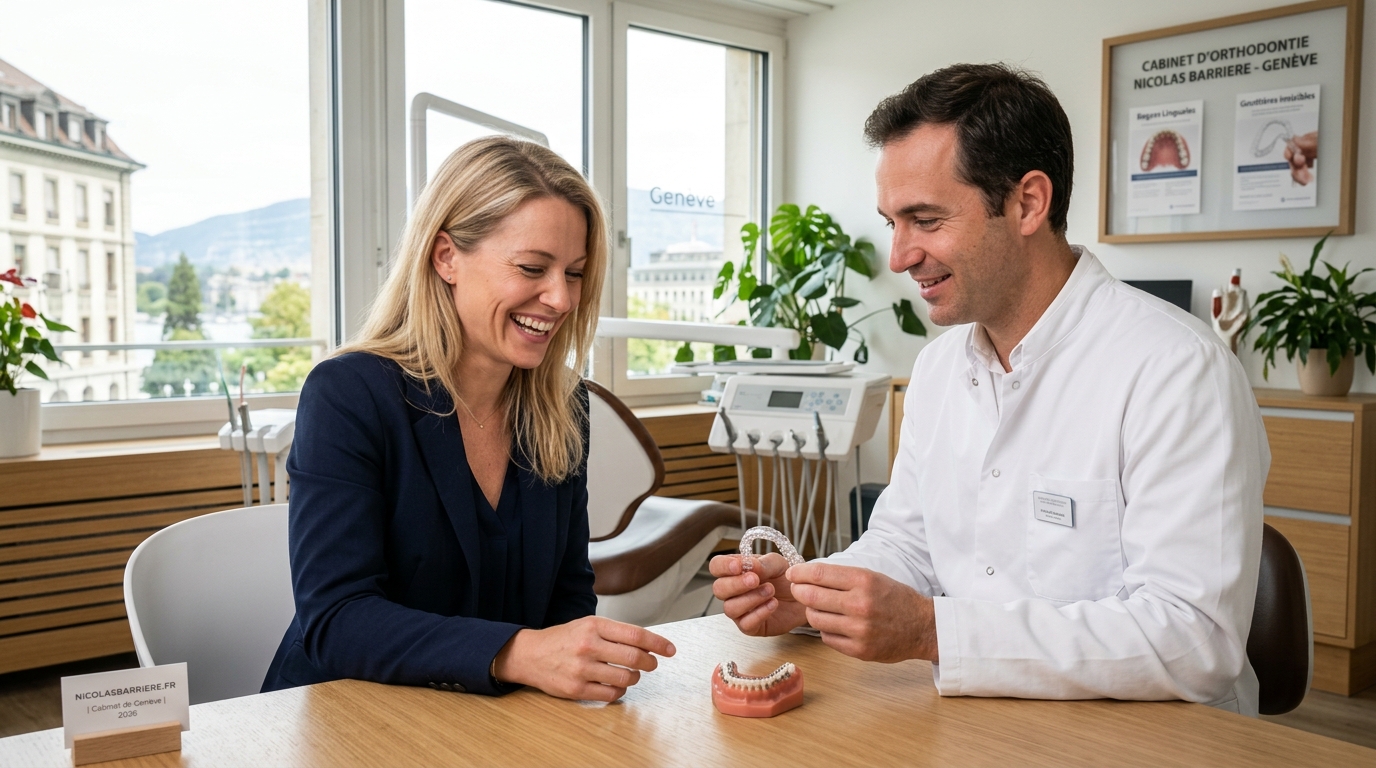
Correcting your smile in adulthood without sacrificing your professional image is now possible thanks to two discreet orthodontic techniques: lingual braces and invisible aligners for adults near Geneva. Each addresses specific clinical indications.
- The clear aligners are removable, discreet and suitable for mild to moderate corrections.
- Lingual braces, fixed behind the teeth, are completely invisible and effective in complex cases.
- The average duration of adult treatment is between 12 and 24 months, depending on the complexity of the malocclusion.
The choice between lingual braces and clear aligners for adults near Geneva depends on the clinical complexity and the patient's aesthetic requirements. Clear aligners are particularly suitable for mild to moderate corrections due to their comfort and discreetness, while lingual orthodontics, fixed to the inside of the teeth, offers complete invisibility and maximum precision for severe malocclusions. A clinical orthodontic consultation remains essential to identify the most suitable technique for your teeth: the practitioner is responsible for choosing the appropriate appliance (visible braces, lingual braces, or clear aligners).
What are the main differences between these two invisible orthodontic treatments?
Lingual braces are fixed and positioned behind the teeth; clear aligners are removable and placed on the visible surface. This difference in design determines both the comfort experienced, the perceived discretion, and the types of tooth movements that are possible. The year 2026 confirms a major technological advancement: 3D intraoral scanning and computer-aided design have significantly improved the precision of both techniques.
Recent clinical studies on orthodontic treatment in adults highlight that satisfaction depends primarily on the suitability of the chosen technique to the patient's expectations (source: Orthodontic treatment in adults, PubMed, 2024). Invisibility, chewing comfort, and ease of hygiene are the criteria most frequently mentioned in satisfaction surveys.
Lingual orthodontics : orthodontic technique in which the brackets and wires are fixed to the inside of the teeth, on the tongue side, making the appliance completely invisible from the outside.
Clear aligner : removable medical polymer shell, custom-made from a digital impression, which gradually moves the teeth through a series of appliances changed every 1 to 2 weeks.
Malocclusion : misalignment of the teeth or of the interlocking between the upper and lower jaws, which can affect aesthetics, chewing, phonation or dental wear.
How does lingual orthodontics work for adults?
Lingual orthodontics relies on custom-made brackets bonded to the inner surface of the teeth, exerting a continuous force 24 hours a day. The laboratory designs each bracket from a digital impression of the patient's teeth, allowing for millimeter-precise adjustments. This precision is particularly useful for correcting tooth rotations and severe malpositions (source: SFODF, Lingual Orthodontics).
The adaptation period, primarily phonetic, generally lasts two to four weeks. The tongue learns to cope with the presence of the brackets, and speech returns to a natural state. This timeframe is well documented in the scientific literature on lingual orthodontics (source: Practice of lingual orthodontics, PubMed, 2021).
What is the principle behind clear aligners or trays?
The clear aligners move the teeth using a series of successive aligners, worn for about 22 hours a day. Each aligner applies a calculated force for a precise movement and is then replaced by the next one every 1 to 2 weeks. The patient can remove the appliance to eat and brush their teeth, simplifying oral hygiene.
Health alert point: The effectiveness of the aligners depends entirely on the patient's adherence. Wearing them for less than 20 hours a day slows down or compromises the result. Daily discipline is therefore as important a selection criterion as clinical complexity.
22 hours/dayMinimum recommended wearing time for aligners
24 hours a daycontinuous action of lingual (fixed) brackets
2 weeks.average duration of wearing a mouthguard
Braces or aligners: which technique to choose according to your clinical indications?
The choice between lingual orthodontics and clear aligners is based primarily on a clinical evaluation of the malocclusion, not just on aesthetic criteria. To properly assess your situation, you can consult our guide to the different options for clear aligners for adults, which details the anatomical criteria taken into account during diagnosis. Each dentition presents a unique combination of factors: type of malposition, crown height, bone thickness, periodontal health.
Lingual braces: complex cases90
Gutters: mild to moderate cases75
Which dental problems are more likely to require a lingual brace?
Lingual braces are indicated for severe malocclusions and complex tooth movements that aligners struggle to achieve. This includes significant tooth rotations, closure of large spaces (for example, after an extraction), correction of deep occlusion (overbite), and dental intrusions and extrusions. The classification of dental malpositions published by the French National Health Insurance (Assurance Maladie) details these different clinical situations (source: Ameli, types of dental malpositions).
An adult presenting several of these combined criteria (rotation + space + crossbite) will benefit from more precise control with fixed brackets capable of applying simultaneous multidirectional forces. This is a regular observation in practice: in the most complex cases, the stability of the appliance becomes a therapeutic advantage.
«"In adults, the question is never which technique is the best in absolute terms: it is the one that best addresses the biomechanics of the clinical case and the patient's lifestyle."»
In what cases should invisible aligners be preferred?
Clear aligners are particularly suitable for slight overlaps, small diastemas and orthodontic relapse treatments. Many adults who wore braces during adolescence notice, 10 or 15 years later, a slight shift in their lower incisors: aligners then offer a quick and comfortable solution. They are also suitable for cosmetic corrections prior to prosthetic work (veneers, crowns).
Advantages of gutters
- Discretion and seclusion for meals
- Easier hygiene (classic brushing)
- Comfortable in the mouth, minimal irritation
- Remote follow-up is possible between visits
Gutter boundaries
- Effectiveness depends on consistent use.
- Less efficient at high rotations
- Frequent additions of visible fasteners (cleats)
- Demanding discipline on a daily basis
In summary, lingual braces offer complete invisibility and high precision for mild to complex cases, including severe rotations, with a fixed appliance that acts continuously and requires minimal discipline. Clear aligners, which are very discreet, are suitable for mild to moderate cases and relapses, with standard brushing after removal but a minimum wear time of 22 hours per day. Lingual braces require two to four weeks to adapt, while aligners adapt quickly despite slight initial discomfort.
A personalized diagnosis for an informed choice
Only a complete clinical examination can identify the technique best suited to your teeth. Schedule an appointment at the office for an orthodontic assessment.
Comfort, feel and daily life: what to expect?
Both techniques generate moderate discomfort in the first few days, which fades quickly thanks to the natural adaptation of the mouth. Lingual braces primarily lead to phonetic adaptation and sometimes tongue irritation, while aligners cause a feeling of pressure with each new fitting. This sensation is described in detail in our dedicated article on comfort and ease of daily use of lingual braces and clear aligners.
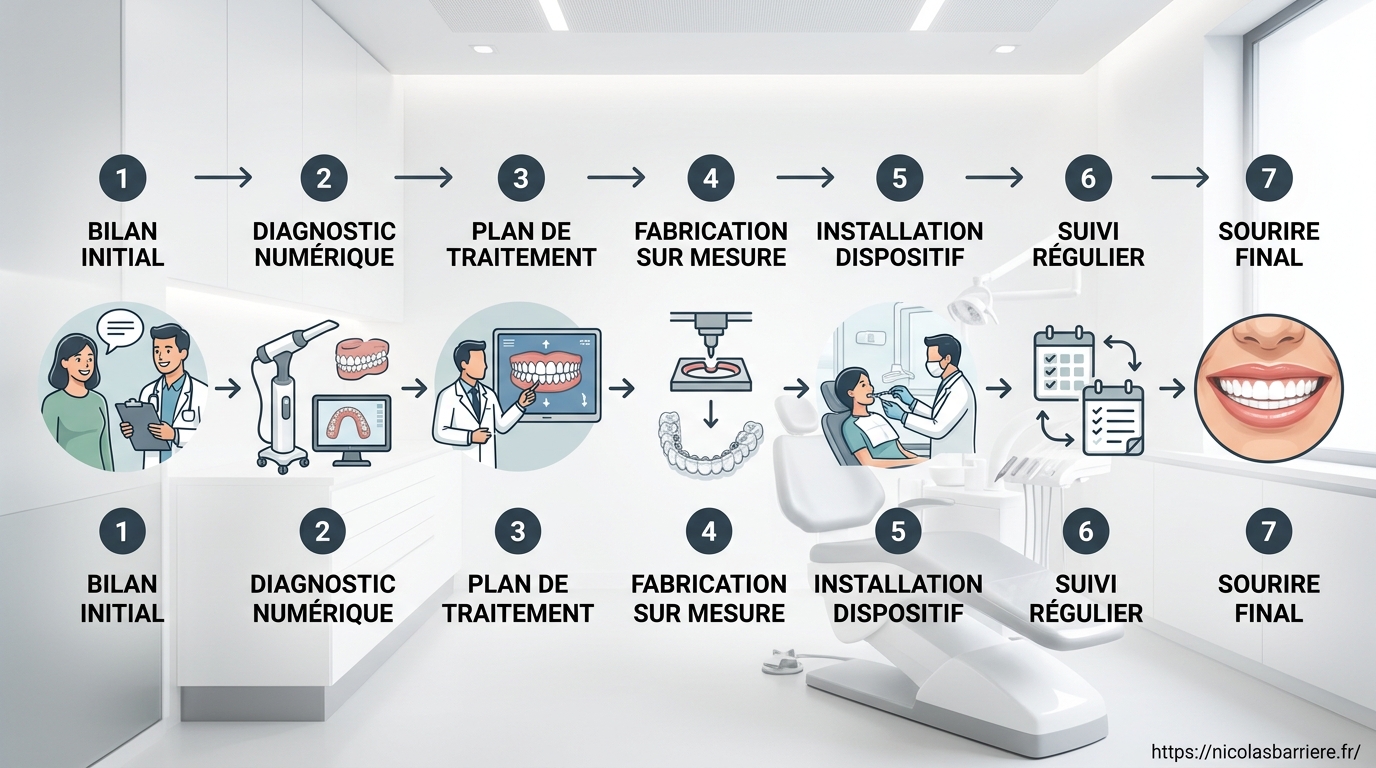
Initial consultation
Clinical examination, X-rays, discussion of expectations and lifestyle.
3D intraoral scan
Digital impression without paste, basis of therapeutic simulation.
Treatment plan
Choice of technique, presentation of the virtual setup and the estimated duration.
Fitting or replacement of the first aligners
Fitting of custom-made lingual brackets or delivery of the tray kit.
Active phase
Regular check-up appointments (every 6 to 10 weeks) with adjustments to the appliance to accommodate tooth movement.
Restraint
Wearing a glued wire and/or a night guard to stabilize the result.
What is the average price and how does the refund process work in Switzerland?
The choice of technique is based primarily on the clinical diagnosis and the expertise of the practitioner, who determines the device best suited to the situation. The cost depends on the complexity of the case, the estimated duration, and the number of appointments. Each treatment plan is subject to a detailed and personalized quote during the consultation.
Swiss insurance (LAMal and supplementary): Basic health insurance (LAMal) does not cover adult orthodontics, except in cases of severe and rare pathologies (source: Groupe Mutuel, dental expense coverageSupplementary insurance taken out before treatment may cover part of the orthodontic costs, depending on the contract and waiting periods.
12At 24 months: average duration of adult treatment
22hours per day of wearing gutters
4weeks: phonetic adaptation of language
For patients living near the Geneva border, the issue of healthcare coverage deserves special attention: coordination between Swiss insurance and any French supplemental health insurance can be facilitated through administrative support at the office. A personalized assessment of your situation requires a clinical examination and a review of your insurance policies.
And for teenagers: what techniques are suitable?
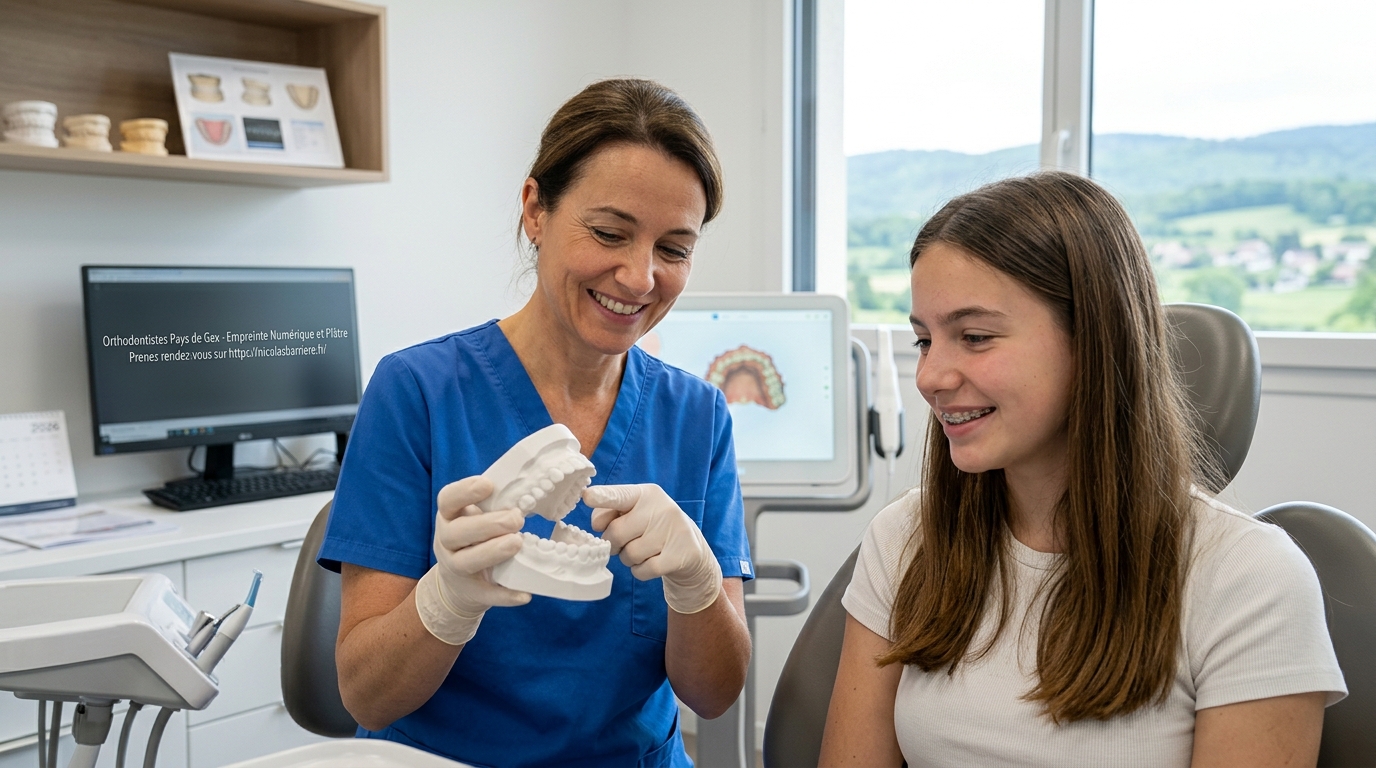
In adolescents, invisible aligners are a possibility once the permanent teeth are sufficiently established and behavioral maturity allows for consistent wear. The age and compliance criteria are detailed in our article on the invisible aligners for teenagers. Lingual braces, less frequently offered to young patients, remain an option for strong aesthetic demands during significant events (competitions, public speaking engagements).
Note that an adult hesitating between orthodontics and prosthetic solutions (veneers) will find further information in our dedicated article on Misaligned teeth: orthodontics or veneers. These two approaches do not pursue the same objective and are not interchangeable.
«"The satisfaction of adult patients undergoing orthodontic treatment is closely linked to the quality of the information received beforehand and to the personalization of the treatment plan."»
📌 Key points to remember
- Lingual braces and clear aligners are two complementary, not competing, invisible orthodontic techniques.
- The aligners are suitable for mild to moderate corrections and require strict adherence to wearing rules.
- Lingual braces are suitable for complex malocclusions and work 24 hours a day without compliance effort.
- The average duration of adult treatment is between 12 and 24 months, depending on the clinical complexity.
- LAMal does not cover adult orthodontics: Swiss supplementary insurance plays a central role.
- Only a clinical consultation with a thorough examination will allow the appropriate technique to be chosen.
- Post-treatment compression is essential to stabilize the result in the long term.

About the author: Nicolas Barrière
Dr. Nicolas Barrière is an orthodontist, a qualified specialist in dentofacial orthopedics, a former hospital intern, and the founder of his practice in Divonne-les-Bains (15 minutes from Nyon and the Swiss border). He treats children, teenagers, and adults with orthodontic treatments (invisible aligners, lingual orthodontics, dentofacial orthopedics), paying particular attention to Franco-Swiss border patients and managing Swiss and French insurance claims.
Areas of expertise: orthodontics, dentofacial orthopedics, invisible aligners, lingual orthodontics, orthodontics for children, adolescents and adults, orthognathic surgery, sleep apnea, retention.
Frequently Asked Questions: Your questions about adult orthodontics
Are invisible aligners as effective as braces?
Yes, for mild to moderate cases, thanks to 3D digital modeling and custom-made aligners. Braces remain superior for complex movements, particularly significant rotations, large-amplitude root movements, and closure of large spaces. The choice is therefore made on a case-by-case basis, after clinical examination.
What is the average duration of orthodontic treatment for adults?
The average duration of orthodontic treatment for adults is between 12 and 24 months. This depends on the complexity of the malocclusion, the chosen technique (lingual braces, aligners), and the patient's adherence to treatment (particularly wearing the aligners for 22 hours a day). Some simple cases are completed in 6 to 12 months, while complex cases can take up to 30 months.
Is lingual braces painful?
Tongue discomfort and irritation are common during the first two to four weeks, while the tongue adjusts to the brackets. Speech may also be temporarily altered. The discomfort then subsides, and most patients quickly forget they are wearing the appliance in their daily lives.
Is it possible to eat normally with transparent gutters?
Yes, because the aligners are removed for meals and brushing. Therefore, there are no dietary restrictions, unlike with fixed braces. However, you must brush your teeth before putting the aligners back in and only drink plain water while they are in your mouth to maintain their transparency and prevent cavities.
Are lingual braces really invisible?
Yes, lingual braces are fixed to the inside surface of the teeth, making them completely invisible from the outside. They offer superior discretion compared to aligners, which can sometimes show slight reflections or attachments on the visible surface. This is the most undetectable option for an adult who is out in public.
Does LAMal reimburse adult orthodontics in Switzerland?
No, basic health insurance (LAMal) does not cover orthodontic treatment for adults, except in very rare cases (severe congenital malformations, post-surgical complications). Supplemental dental insurance taken out beforehand may cover part of the costs, depending on the contractual limits and waiting periods specific to each insurer.
Is it possible to switch from aligners to lingual braces during treatment?
Yes, a reassessment during treatment may lead to a change in technique if clinical goals are not met with aligners. This is rare when the initial plan was well-established, but it remains a therapeutic option during follow-up. The decision is always made after a new examination and a discussion with the patient.
Should compression stockings be worn after treatment?
Yes, retention is essential to stabilize the results achieved and prevent orthodontic relapse. It generally takes the form of a bonded wire behind the incisors and/or a retainer worn at night. This phase is lengthy, often lifelong for the lower incisors, as physiological tooth movement continues throughout life.
Do you have a project for invisible orthodontics in mind?
Every clinical situation is unique. A thorough examination at the office will allow us to provide you with a personalized opinion and a suitable treatment plan.
📚 Sources and references
Official and institutional sources:
- Ameli, classification and types of dental malpositions
- Ameli, orthodontic diagnosis of dental malpositions
- Ministry of Health, demographics of dental surgeons
Professional sources:
Academic sources:
- PubMed, Orthodontic treatment in adults: challenges, outcomes and satisfaction, 2024
- PubMed, Practice of lingual orthodontics, 2021
- PubMed, Lingual orthodontic treatment evidence base
- PubMed, Implications of lingual orthodontics compared to conventional orthodontics
Insurance and reimbursement in Switzerland:
📖 Also read
- Clear aligners for adults: the different options and how to choose the treatment
- Misaligned teeth in adults: orthodontics or veneers, two different approaches
- Invisible aligners for teenagers: from what age is this technique recommended?
- Lingual braces and clear aligners: comfort, adaptation and everyday experience


 French
 English