
Lingual braces are fixed brackets placed on the inside surface of the teeth, invisible from the outside. The technique treats the same malocclusions as traditional braces, including complex cases, in an average of 12 to 24 months. The tongue's adaptation to speech generally takes...

Lingual braces in adults: principle, indications and daily wear
Written by Nicolas Barrière : Orthodontist, Qualified Specialist in Dentofacial Orthopedics, founder of the practice at nicolasbarriere.fr. Updated on . Reading time: approximately 13 minutes.
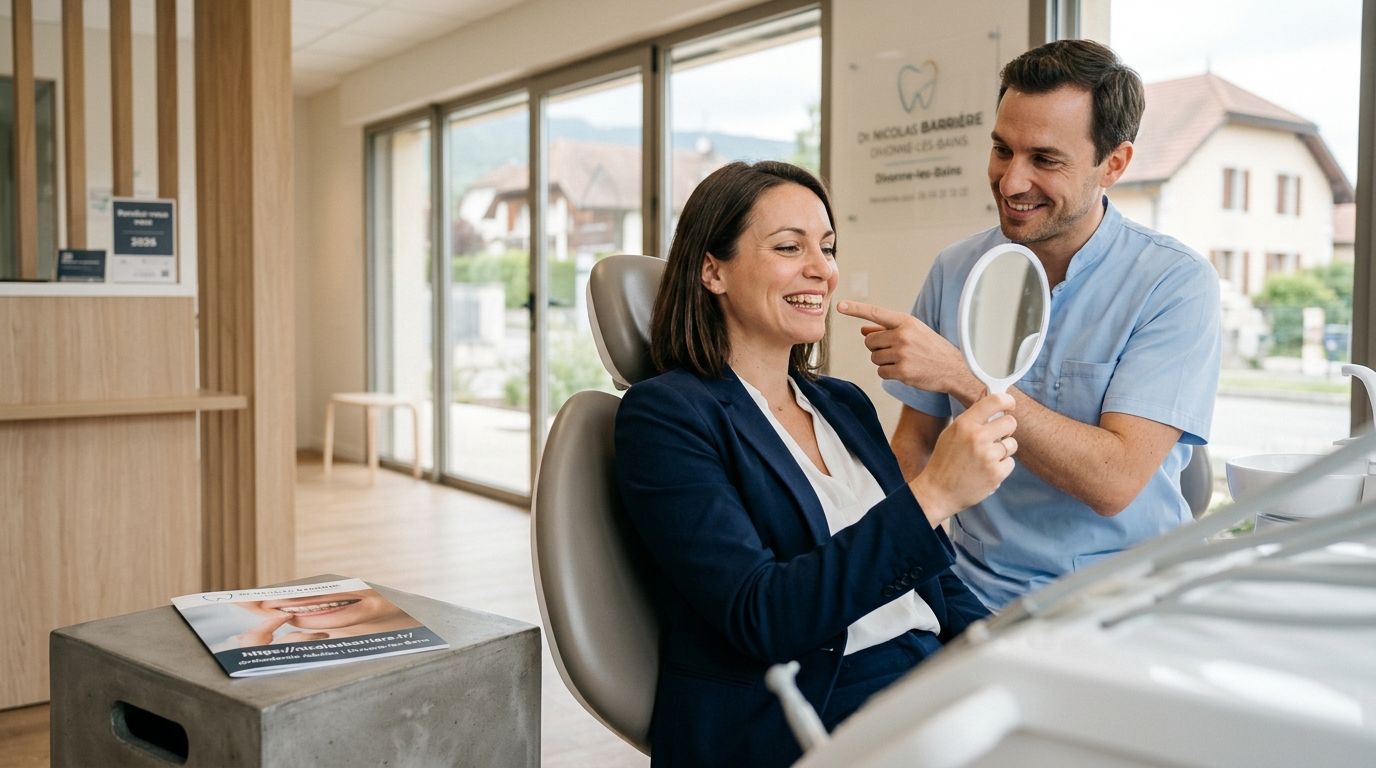
Adult lingual braces in Divonne-les-Bains offer a practical solution for those who want to correct their teeth without their braces being visible at work. This technique places the brackets on the tongue side, for complete invisibility from the front.
- Lingual braces are fixed brackets placed on the inside of the teeth, invisible from the outside.
- The technique treats the same malocclusions as conventional braces, including complex cases, in 12 to 24 months on average.
- Adapting the language to speech usually takes 1 to 3 weeks, with simple tips to speed it up.
Adult lingual braces are orthodontic brackets fixed to the inside surface of the teeth, on the tongue side. This placement makes them completely invisible during meetings, public speaking, or client interactions. In Divonne-les-Bains, this solution is available to adults requiring absolute discretion at work, following a clinical assessment confirming the suitability.
To better understand this technique among the options available today, it may be helpful to first read our A complete guide to discreet orthodontics for adults, which offers lingual braces and clear aligners according to clinical profiles. In 2026, the demand for invisible orthodontics among working adults in the Franco-Swiss border region continues to grow, driven by the arrival of digital technologies and the need for a controlled professional image. For advice tailored to your situation, a consultation at the office remains indispensable.
Health alert point. The information below is for educational purposes only. It does not replace a thorough clinical examination: only a qualified orthodontist can determine the suitability of lingual treatment after a complete assessment (x-rays, impressions, occlusal analysis).
How do lingual braces for adults work?
Lingual braces work using the same biomechanics as traditional braces, but from inside the dental arch. Each bracket is custom-made from a digital impression of the teeth and then bonded to the lingual (tongue) surface. A metal wire then connects the brackets and exerts calibrated forces that gradually move the teeth into the planned position.
What is the principle of lingual orthodontics?
Lingual orthodontics relies on fully customized brackets, designed to fit the precise anatomy of each of the patient's teeth. Unlike standardized vestibular brackets, each lingual bracket is 3D modeled and then milled to precisely match the inner surface of the tooth. This precision is essential because tongue morphology varies considerably from tooth to tooth, and even from patient to patient.
Lingual orthodontics An orthodontic technique that involves placing fixed brackets on the inner surface of the teeth, on the tongue side, in order to make the appliance invisible from the outside.
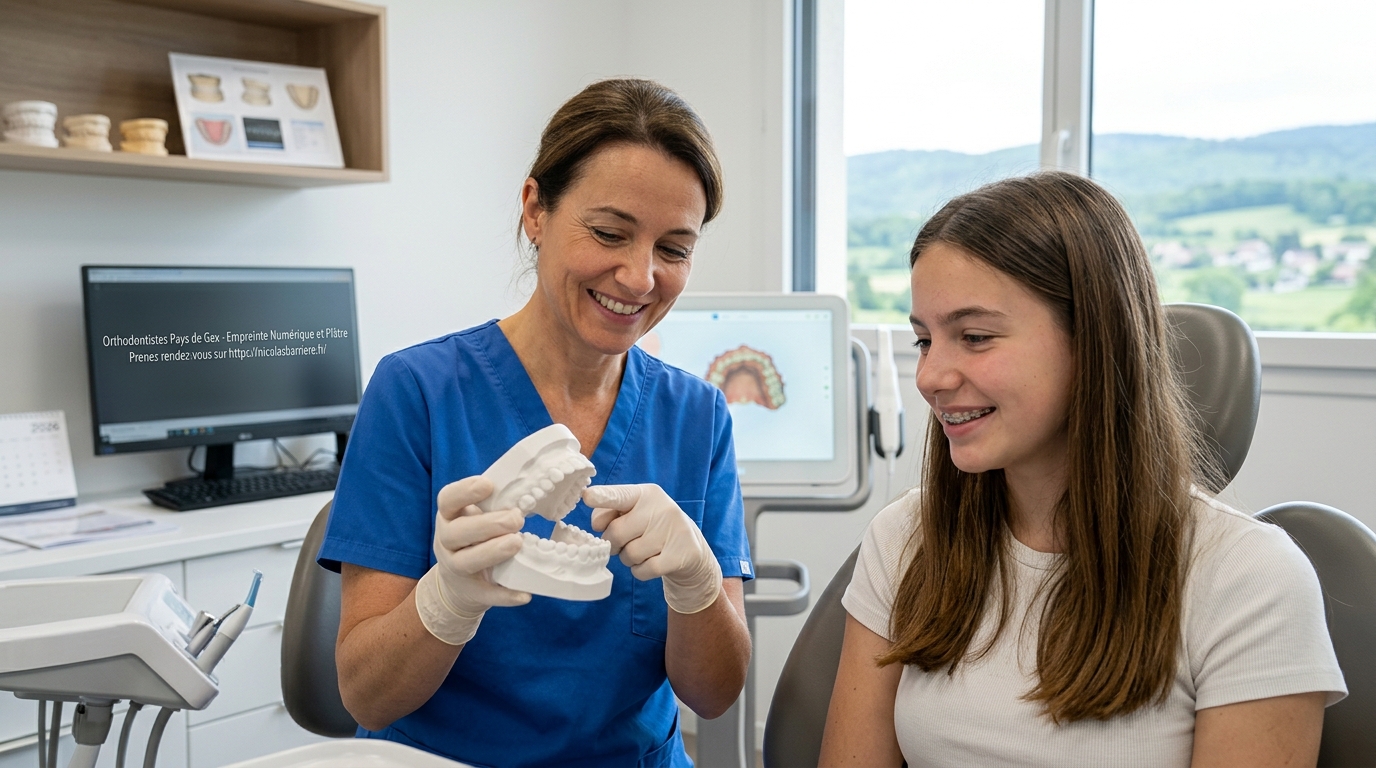
The manufacturing process begins with a digital impression taking without paste Using an intraoral scanner, the data is transmitted to the laboratory, which designs custom brackets and pre-bends the archwires according to the treatment plan approved by the orthodontist. This digital approach, documented in the scientific literature (PMC, systematic review of lingual orthodontics), improves the precision of tooth movement.
Why is this technique completely invisible at work?
Lingual braces are physically hidden behind the teeth: no metal elements appear when the patient speaks, smiles, or eats. For an executive, teacher, salesperson, lawyer, or healthcare professional consulting in Divonne-les-Bains, this discretion is the decisive factor. Even those closest to them don't detect the presence of the device.
👔
Speeches
Meetings, video conferences, client presentations: nothing is visible from any angle.
📸
Professional photos
LinkedIn profiles, company events, interviews: the smile remains natural.
🤝
Customer relations
Jobs in direct contact with the public: no discomfort related to the gaze of others.
Reading: qualitative index of perceived discretion, based on the position of the device relative to the interlocutor's gaze. Source: synthesis of SFODF data and clinical literature.
«"In my practice, the request for lingual braces often comes from professionals whose image is part of their daily lives. What reassures them is knowing that they can attend meetings and appointments without ever having to explain their treatment."»
In which clinical situations are lingual braces indicated?
Lingual braces are indicated for the majority of adult malocclusions, including complex cases that would exceed the capabilities of other discreet techniques. They correct crowding, spacing, arch discrepancies, and vertical dimension problems with comparable effectiveness to traditional vestibular braces, according to the French Society of Dentofacial Orthopedics.
What dental problems can this method correct?
Lingual technique covers a very wide range of indications, including tooth movements that are difficult to achieve with removable aligners. Clinical studies, including the systematic review published on PubMed Central (PMC10837819), show clinical efficacy equivalent to external braces for most malocclusions. To understand in more detail The differences in indications between lingual orthodontics and clear aligners, A dedicated article is available on the firm's blog.
| Malocclusion | Lingual indication | Clinical commentary |
|---|---|---|
| Severe congestion | ✓ Excellent | Enables precise rotations and coordinated extractions |
| Diastemas (spaces) | ✓ Excellent | Controlled space closure via tongue arcs |
| Supra-clusion (vertical overlay) | ✓ Very good | well-controlled incisor intrusion |
| Anterior gap | ✓ Very good | The tongue position helps with closure |
| Class II/III moderate | ✓ Good | Often combined with intermaxillary elastics |
| Surgical cases | ✓ Possible | Discretion is appreciated during the pre-surgical phase. |
Are there any contraindications for an adult patient?
Certain clinical situations limit the use of lingual braces and must be identified during the initial assessment. The crown height (visible part of the tooth) must be sufficient to allow for stable bonding of the lingual brackets. In patients with very short crowns, often due to tooth wear, adhesion may be compromised.
Favorable terrain
- Rigorous oral hygiene and motivation
- Sufficient coronal height for stable bonding
- Healthy or stabilized gums and periodontium
- No severe bruxism requiring treatment
- Ability to adapt to the first few days of discomfort
Situations to be assessed
- Very short clinical teeth (wear, abrasion)
- Active, unstable periodontal disease
- Insufficient hygiene increases the risk of tongue decay.
- Known allergies to metal alloys
- Pronounced phobia of tongue contact
Health alert point. Untreated periodontal disease is a major contraindication to any orthodontic treatment, whether lingual or not. Periodontal treatment is always required before fitting braces. A personalized assessment requires a clinical consultation and a thorough examination.
What does the adaptation period represent for the adult patient?
The adjustment period for lingual braces generally lasts one to three weeks for speech and tongue comfort. During these first few days, the tongue comes into contact with the brackets with every movement, which temporarily alters the pronunciation of certain sounds (especially sibilants) and may cause minor irritation at the tip of the tongue.
How to manage speech and comfort during the first few weeks?
The tongue needs 7 to 21 days to map the new attachments and regain normal speech. In the first few days, speaking slowly and consciously articulating significantly accelerates the process. Published studies (Dentis Futuris, on patient perception in lingual orthodontics) show that almost all patients regain fluent speech in less than three weeks.
-
Days 1 to 3: Initial contact
Sensitivity of the teeth (like unusual clenching), constant tongue contact, increased salivation. This is normal: the mouth is identifying the new environment.
-
Days 4 to 10: Learning
Slight lisp on the "s" and "ch" sounds. Reading aloud for 10 minutes a day (newspaper, novel) significantly accelerates phonetic adaptation.
-
Days 10 to 21: Stabilization
The tongue has memorized the anatomy of the attachments. Speech becomes fluent again. Tongue irritations become less frequent.
-
After 3 weeks: routine
The patient almost forgets the device is there. Adjustment appointments every 4 to 8 weeks structure the treatment.
⚡ Practical tip: Orthodontic wax, provided during consultations, can be placed over any bracket that irritates the tongue. It creates a smooth barrier while the mucous membrane strengthens.
What new hygiene habits should be adopted?
Oral hygiene must become rigorous and daily, with tools adapted to lingual braces. The internal position of the brackets makes regular brushing insufficient: it is necessary to supplement this with interdental brushes and, ideally, a water flosser. These tools remove food debris trapped under the archwires, protecting gums and enamel.
3minimum brushings per day
2Additional tools (brush + jet)
6months between two hygiene inspections
21average adaptation days
«"Lingual orthodontics allows for the treatment of all malocclusions without aesthetic constraints, making it a particularly suitable option for adults in high-risk professions."»
How does lingual treatment work in Divonne-les-Bains?
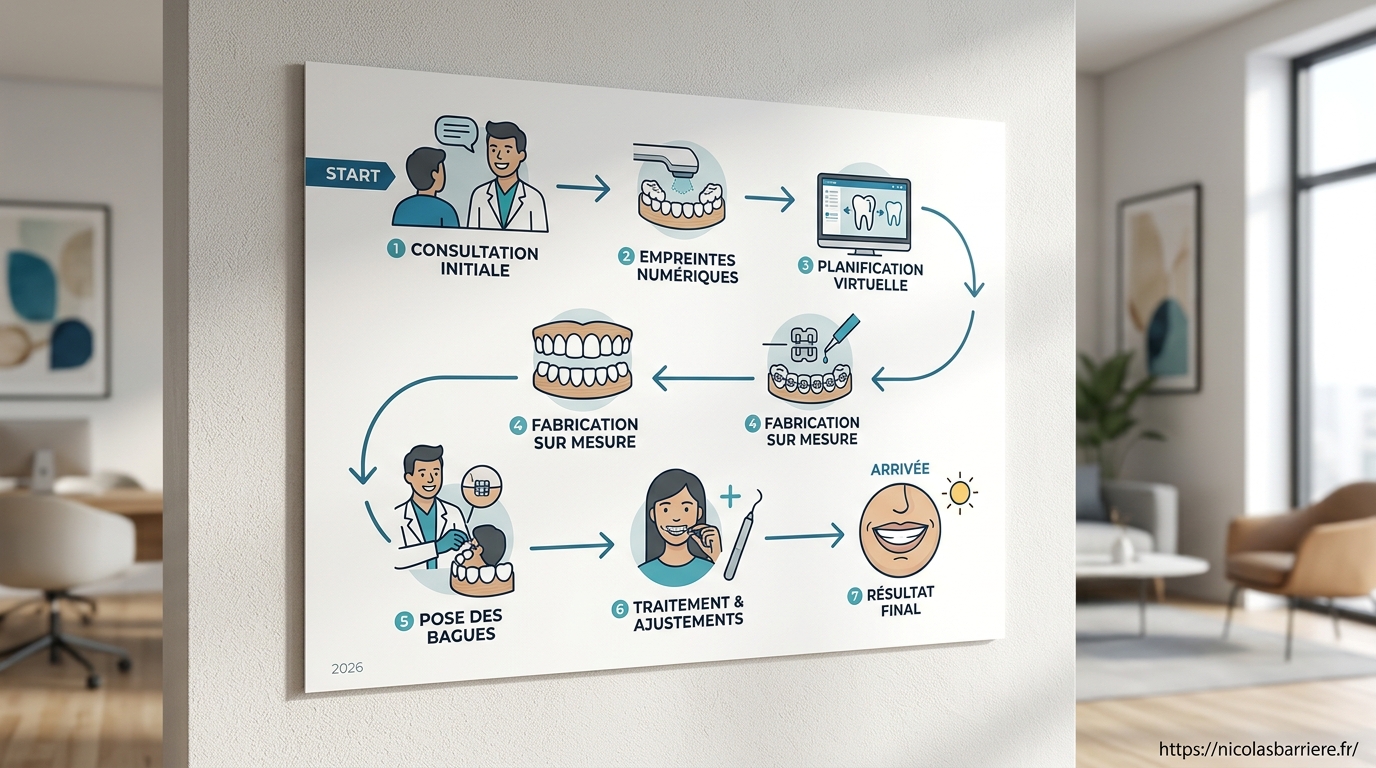
Treatment with lingual braces in Divonne-les-Bains follows a structured process: initial assessment, digital impressions, validation of the treatment plan, fitting of the braces, then regular adjustment appointments until removal and the retention phase. For cross-border patients, the practice handles Swiss (LAMal, supplementary) and French insurance claims.
Balance sheetClinical examination, X-rays, photos, discussion of the aesthetic objective
FootprintsIntraoral scanning without paste, then 3D design in the laboratory
LaidSimultaneous bonding of all attachments via a transfer gutter
Follow upAppointments are scheduled every 4 to 8 weeks to adjust the bows.
RestraintGlued wire or night guard, essential to stabilize the result
An invisible orthodontics project in the works?
Make an appointment at Dr. Nicolas Barrière's office in Divonne-les-Bains for a personalized assessment.
How long does lingual braces treatment last?
The average duration of lingual treatment in adults ranges from 12 to 24 months, depending on the complexity of the case. Cases requiring mild aesthetic alignment can be completed in 10 to 12 months, while complex malocclusions requiring extractions or surgical coordination may take 24 to 30 months. A study published in PMC (4228173) on lingual appliances confirms these timeframes.
Average duration of adult lingual treatment: 18 months100 /100
Score0 /100
What place is there for Franco-Swiss border patients?
Divonne-les-Bains, located 15 minutes from Nyon and the Geneva border, welcomes a large cross-border clientele seeking discreet orthodontics. Patients covered by Swiss health insurance (LAMal), supplementary insurance, or the French system receive tailored administrative support. The practice is familiar with the specificities of Swiss and French dental care, which are often complementary for adults.
🇫🇷🇨🇭
Border area
The practice in Divonne-les-Bains welcomes patients from Nyon, Geneva and the Pays de Gex.
LAMal
In Switzerland, adult orthodontic care is generally not covered by basic LAMal.
Mutual insurance companies
In France, Social Security does not cover orthodontics after age 16: only supplementary insurance covers it.
Detailed quote
A clear quote is systematically provided before any commitment, in accordance with regulations.
What are the alternatives to lingual braces?
The two main alternatives to lingual braces are removable clear aligners and vestibular (outer) ceramic braces. Each option has specific indications, a different level of discretion, and its own constraints in daily practice. The choice of appliance rests with the practitioner, who ensures the technique is appropriate for the clinical case: the patient does not choose a brand.
Lingual braces: Fixed, invisible from the front, with a very wide range of indications including complex cases. Initial tongue fitting and rigorous hygiene are required. Ideal when total discretion is non-negotiable.
Transparent gutters: Removable, very low visibility, comfortable to wear. Requires 22 hours of wear per day. Best suited for light to moderate congestion. To learn more, see our A guide dedicated to adult clear aligners.
Ceramic rings: Fixed on the outer surface, tooth-colored, less visible than metal but perceptible up close. Technically similar to traditional braces, with fewer tongue adjustment requirements.
| Criteria | Lingual | Gutters | Ceramics |
|---|---|---|---|
| Total invisibility from the front | ✓ | ~ | ✗ |
| Complex cases | ✓ | ~ | ✓ |
| Easier hygiene | ~ | ✓ | ~ |
| No wearing restrictions | ✓ | ✗ | ✓ |
| Rapid tongue adaptation | ✗ | ✓ | ✓ |
«"There is no single best technique: there is a technique adapted to each patient, their clinical case, their lifestyle and their priorities. That is the whole point of a complete assessment before any decision is made."»
Field observations: what we see in the office
During consultations in Divonne-les-Bains, three profiles frequently emerge when requesting lingual orthodontics. These qualitative, non-quantitative observations help to understand why this technique appeals to a specific patient population in the border region.
👩⚖️
Image-driven professions
Lawyers, doctors, executives, teachers, consultants: their daily lives involve speaking out. Absolute invisibility is a non-negotiable requirement.
🎤
Communication professions
Journalists, key account managers, public figures: opportunities to speak or be filmed are frequent, sometimes unexpected.
💍
Personal projects
Weddings, family events, career changes: some adults wish to complete their treatment before a specific date, without compromising on their image.
An anonymized, concrete example: a bank executive patient in the Nyon area, in daily contact with an international clientele, wanted to correct a previous crowding without his appliance being visible during frequent video conferences. After an assessment, lingual treatment was chosen. The adaptation took place in less than two weeks, and follow-up appointments were conducted without his colleagues detecting the treatment.
📝 Note: This example is presented for educational purposes, is anonymized, and does not constitute a promise of results or a guarantee. Each clinical situation is unique.
What should you know about post-treatment compression?
When lingual braces are removed, a retention phase begins and lasts several years. Its goal is to stabilize the new position of the teeth and prevent relapse, the natural phenomenon of a return to the initial position. The SFODF (2023) recommendations are clear on the importance of not interrupting this phase.
Restraint Phase following the cessation of active treatment: it maintains the teeth in their new position via a wire glued behind the teeth or a night guard, in order to prevent relapse.
During treatment
- Forces applied by the arcs
- Gradual movement of the teeth
- Regular adjustment appointments
- Visualizing progress at each session
After the removal
- Retainer wire glued behind the incisors
- Night guard for enhanced stability
- Annual restraint checks
- Long-term stability of the result
Namely: Not wearing a retainer increases the risk of relapse, meaning the partial or complete return of teeth to their original position. This is one of the main reasons for repeating treatment in adulthood.
FAQ: Your frequently asked questions about lingual braces
Do lingual braces hurt?
The application of lingual braces is completely painless. Temporary discomfort and tooth sensitivity are common in the first few days, while the teeth begin to move and the tongue adjusts to the brackets. This sensitivity is easily relieved with simple painkillers and disappears within a few days.
How long does lingual orthodontic treatment last?
The duration varies depending on the complexity of the clinical case. On average, lingual braces for adults last between 12 and 24 months. Adjustment appointments are necessary every 4 to 8 weeks, and a retention phase systematically follows removal to stabilize the result.
What coverage is available for adult lingual braces?
The choice of technique is based primarily on clinical diagnosis and the practitioner's expertise, who determines the appropriate appliance for each individual case. In France, social security does not cover orthodontics after the age of 16, but many private health insurance companies offer dedicated packages. A detailed estimate is provided during the consultation; no commitment is made without full information (source: Selectra).
Is it possible to eat normally while wearing lingual braces?
Yes, the diet remains generally normal. Certain foods should be avoided to prevent dislodging the attachments: caramels, chewing gum, whole apples, and very crusty baguettes. It is recommended to cut hard foods and chew them with the premolars rather than directly with the incisors.
Do lingual braces change the way someone speaks?
During the first few days, a slight lisp may appear on hissing sounds while the tongue adjusts to the braces. This discomfort disappears within one to three weeks. Reading aloud for 10 minutes a day significantly speeds up the recovery of perfectly fluent speech.
Are lingual braces suitable for all adults?
No, certain clinical factors limit their use: very short dental crowns, unstable periodontal disease, insufficient oral hygiene. A complete assessment is essential to confirm the suitability of this technique. Only a qualified orthodontist can determine if this technique is appropriate for your situation after a thorough examination.
Is there any specific follow-up to be expected?
Follow-up appointments are scheduled every 4 to 8 weeks throughout the treatment. These appointments allow for adjustments to the archwires, monitoring of tooth movement, and oral hygiene. In the event of a bracket coming loose or persistent discomfort, an emergency orthodontic appointment can be scheduled.
What happens at the end of the treatment?
After the braces are removed, a retention phase begins: a wire bonded behind the incisors, a night guard, or a combination of both. This phase is essential to stabilize the new position of the teeth in the long term. Annual checkups allow us to verify that the result is being maintained.
Need advice on your situation?
A clinical assessment at the office allows us to determine, in complete transparency, whether lingual orthodontics is suitable for your case.
📌 Key points to remember
- Lingual braces are placed on the inner surface of the teeth: total invisibility at work and in society.
- They treat the vast majority of malocclusions, including complex cases, with an effectiveness comparable to traditional braces.
- The manufacturing is custom-made from a digital impression, for maximum anatomical precision.
- The language adaptation (speech, sensations) usually lasts 1 to 3 weeks.
- Hygiene must be rigorous: brushing after each meal, interdental brushes, water jet.
- The average duration of treatment is 12 to 24 months, followed by an essential retention phase.
- Only a complete clinical assessment can validate the indication and exclude contraindications.

About the author: Dr. Nicolas Barrière
Dr. Nicolas Barrière is an orthodontist, a qualified specialist in dentofacial orthopedics, a former hospital intern, and the founder of his practice in Divonne-les-Bains. He treats children, adolescents, and adults with orthodontic treatments (invisible aligners, lingual orthodontics), paying particular attention to the care of patients living near the French-Swiss border.
Areas of expertise: Orthodontics, Dentofacial orthopedics, Invisible aligners, Lingual orthodontics, Children's orthodontics, Adult orthodontics, Orthognathic surgery, Management of complex cases, Sleep apnea, Retention.
📚 Sources and references
Official and institutional sources:
- French Society of Dentofacial Orthopedics (SFODF): Lingual orthodontics
- French National Authority for Health: Indications for dentofacial orthopedics
- Ameli: Orthodontic diagnosis of dental malpositions
- Legifrance: Decree on the qualification of orthodontic dentists
- National Order of Dental Surgeons: Specialties in Dentistry
Academic and scientific sources:
- PMC: Efficacy of lingual orthodontics, systematic review
- PubMed: Lingual orthodontic treatment, current evidence base
- PMC: Duration of treatment in lingual orthodontics
- PMC: Adult orthodontic retreatment using lingual technique
Professional references:
📖 Also read:


 French
 English