
An orthodontic practice located in Divonne-les-Bains is about a 15-minute drive from Nyon, a distance of approximately 10 km. Divonne-les-Bains has several orthodontic practices accessible to residents of the canton of Vaud, with appointment slots adapted to cross-border travel constraints.

Accessibility of an orthodontic practice on the French side for patients residing in neighboring Switzerland
Written by Nicolas Barrière Orthodontist, Qualified Specialist in Dentofacial Orthopedics, founder of the practice at nicolasbarriere.fr: Updated on Reading time ≈ 11 minutes.
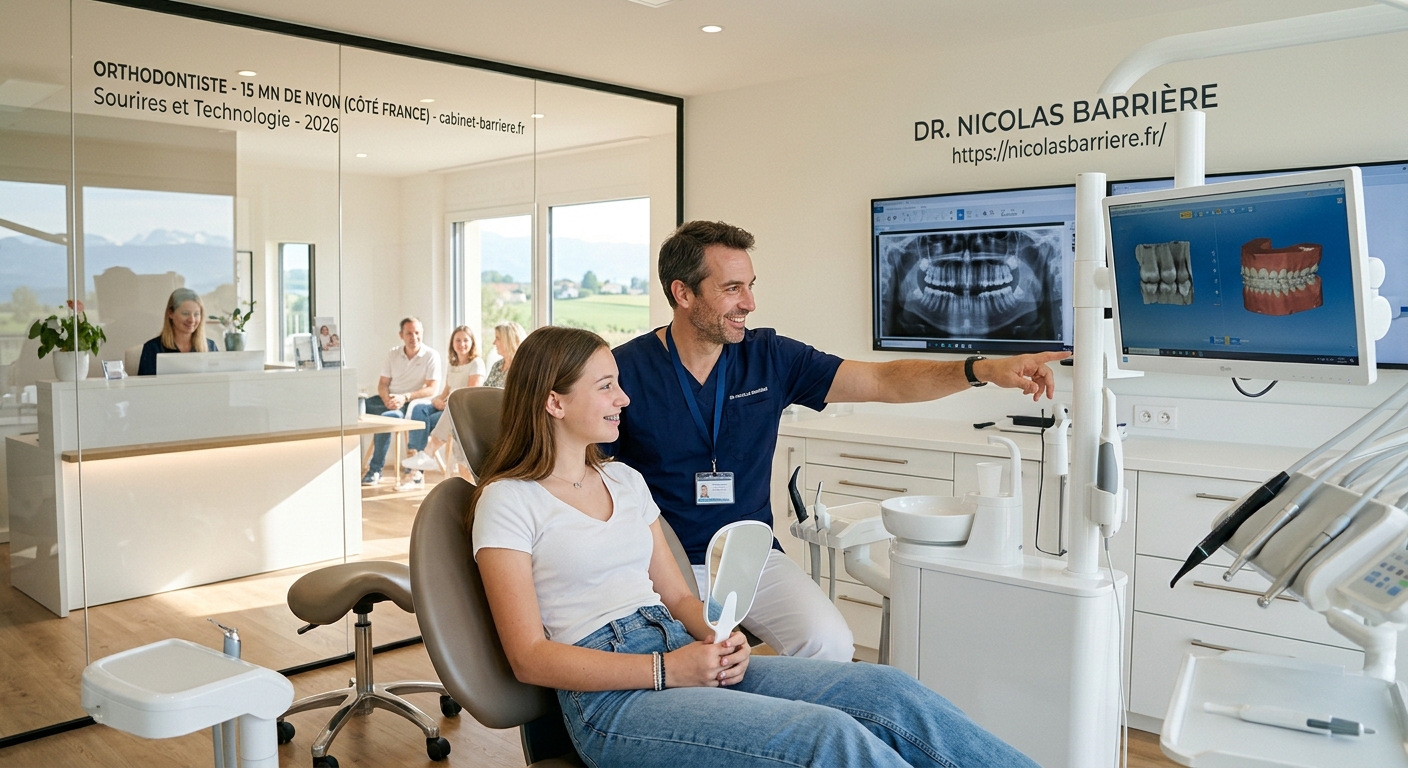
Living in Nyon and consulting an orthodontist 15 minutes away on the French side has become a natural option for many families in the Lake Geneva region. Divonne-les-Bains, directly bordering the canton of Vaud, offers direct road access and a well-equipped practice to accommodate cross-border patients.
- An orthodontic practice located in Divonne-les-Bains is about a 15-minute drive from Nyon, for a distance of about 10 km.
- Divonne-les-Bains welcomes residents from the canton of Vaud, with time slots adapted to border constraints.
- The consultation remains subject to a prior clinical examination: a personalized opinion requires an appointment at the office.
Patients residing in Nyon can access an orthodontist on the French side in approximately 15 minutes by car, in Divonne-les-Bains, a border town. The French practice adapts its logistics and opening hours to facilitate access for cross-border workers and families residing in neighboring Switzerland, taking into account traffic flow during peak hours.
How to arrange to see an orthodontist 15 minutes from Nyon?
Consulting an orthodontist 15 minutes from Nyon on the French side relies on three simple elements: getting to Divonne-les-Bains, close to the border, scheduling appointments outside of peak traffic times, and anticipating parking. The practical organization is more about day-to-day logistics than complex administrative procedures.
The Franco-Swiss Lake Geneva basin is structured by strong daily cross-border mobility. According to the’Insee (Auvergne-Rhône-Alpes), Over 115,000 residents of the region work in Switzerland, a significant proportion of them in the Pays de Gex and the canton of Vaud. This dynamic has naturally led firms in France to adapt their operations.
Good to know: Before any trip, a telephone or online appointment allows you to secure the time slot and discuss the documents to bring (previous x-rays, orthodontic follow-up book, insurance details).
Which municipality in neighboring France is the focus of the intervention?
Divonne-les-Bains, in the Ain department, is located approximately 10 km from Nyon, which is a road journey of about 15 to 20 minutes depending on traffic. This proximity makes it a direct access point for patients in the canton of Vaud.
The route planner Rome2Rio This confirms the proximity between Nyon and Divonne-les-Bains. This accessibility makes Divonne-les-Bains a logical location for regular orthodontic follow-up, where appointments are generally spaced 4 to 8 weeks apart during the active phase of treatment.
📍
Divonne-les-Bains
Approximately 10 km from Nyon, direct access via the Divonne road, thermal setting and easy parking.
📍
Proximity to the border
Direct access from the canton of Vaud, approximately 15 minutes from Nyon depending on the route taken.
📍
Patients from the Pays de Gex
Patients from the Pays de Gex or the Ain region also come to the practice in Divonne-les-Bains.
📍
Patients from neighboring Switzerland
Residents of the canton of Vaud can easily reach the office from the border.
How to reconcile consultation schedules with a cross-border lifestyle?
The firm on the French side generally offers slots early in the morning, at lunchtime and at the end of the day, precisely to avoid traffic peaks related to commuter flows to Geneva and Lausanne. This organization allows cross-border workers and children attending school in the canton of Vaud to limit the impact on their schedules.
7:30 am - 9:00 amEarly morning slots before school or work in Nyon
12:00 - 13:30Quick meetings during the lunch break
4:30 PM - 7:00 PMSchool's out, back to work on the Swiss side
Saturday morningFamily time slot outside of work-related traffic
Health alert point: Orthodontic appointments must be kept regularly to avoid prolonging the treatment. Uncontrolled gaps between visits can compromise the expected progress. If you are unable to attend, please contact the office as soon as possible to reschedule.
What are the logistical advantages of orthodontic treatment in France?
The main logistical advantages are the ease of parking, direct road access from Nyon, extended opening hours and continuous monitoring throughout the treatment period. These factors, taken together, reduce the time spent on each visit, often a decisive factor in long treatments.
To fully understand the general framework of this cross-border care, particularly the insurance and administrative aspects, it is useful to understanding the management and organization of orthodontic follow-up between France and Switzerland. This reading complements the practical guidelines presented here.
≈ 10 kmDistance from Nyon to Divonne-les-Bains
≈ 15 minAverage off-peak road journey
4-8 weeks.Usual frequency of active appointments
What is dentofacial orthopedics?
Dentofacial orthopedics (ODF) Orthodontics (ODF) is the medical specialty that deals with jaw growth and tooth alignment in children, adolescents, and adults. It encompasses all orthodontic treatments and bone growth modification procedures.
What is an invisible aligner?
Invisible aligner An invisible aligner is a removable, transparent tray, worn in series, that gradually moves the teeth. This discreet technique is used for many alignment situations in adolescents and adults, as prescribed by an orthodontist.
What is orthodontic retention?
Orthodontic retention Retention is the phase that follows the end of active treatment. It relies on a fixed (bonded wire) or removable (aligner) device designed to stabilize the position achieved and limit the risk of orthodontic relapse.
Direct road access from the canton of Vaud
The route between Nyon and Divonne-les-Bains follows direct roads, bypassing any dense urban areas. Crossing the border within the Schengen Area is smooth, apart from occasional checks. This geographical continuity is a major advantage for ensuring consistent orthodontic treatment, which typically lasts 12 to 30 months depending on the complexity of the clinical situation.
Easier parking compared to a Swiss urban center
The practice in Divonne-les-Bains generally benefits from a less densely populated environment than the major Swiss cities in the Lake Geneva region. Parking in the immediate vicinity of the practice, whether free or in a blue zone, reduces walking time and ensures safe appointments, including for families with young children or patients with reduced mobility.
Accessibility information from Nyon
From Nyon, the Divonne-les-Bains practice is about a 15-minute drive outside of peak hours, covering a distance of approximately 10 km. Parking is generally easy in the suburban area, appointment slots are available at various times (early morning, midday, and evening), and consultations are conducted in French. These practical advantages explain the possibility of regular follow-up appointments for patients in the canton of Vaud.
Regular follow-up takes precedence over all other considerations: it is better to have a practice that is easily accessible than one that is theoretically the closest but difficult to reach in practice.
«"The stability of the appointment schedule largely determines the success of orthodontic treatment. Choosing a practice whose logistics integrate naturally into your daily life already gives you a better chance of completing the treatment within the planned timeframe."»
What is the patient journey like from Nyon to the clinic on the French side?
The typical patient journey includes an initial contact, a clinical and radiographic assessment, an active treatment phase with regular appointments, and then a retention phase. At each stage, the logistical organization must be compatible with family or professional life on the Swiss side.
-
Initial contact and first meeting
Appointments can be made by phone or online. The initial conversation allows us to clarify the request, the patient's age range, and to secure a time slot that suits the travel from Nyon.
-
Initial consultation and examinations
Clinical assessment and additional examinations (X-rays, impressions or optical scan). A personalized treatment plan is then proposed, with a detailed quote.
-
Active phase of treatment
Once the plan is approved, the active phase begins: regular follow-up appointments, generally every 4 to 8 weeks, with adjustments to the device necessary for progress. The total duration varies depending on the technique chosen and the complexity of the clinical situation.
-
Containment phase
After the appliance is removed, the retention (bonded wire or retainer) stabilizes the result. Appointments are gradually spaced further apart, reducing the logistical impact.
Health alert point: No online content can replace a clinical examination. Every orthodontic situation is unique. A personalized opinion, treatment plan, and cost estimate require an in-office consultation with a thorough examination.
Do you live in Nyon and wish to arrange an initial assessment?
Contact the office to discuss a time slot that suits your travel constraints.
What treatments are offered depending on the age group?
An orthodontic practice located 15 minutes from Nyon takes care of children from a very young age, adolescents and adults, with distinct therapeutic approaches. The choice of technique depends on the clinical situation, never on an isolated age criterion.
Interceptive orthodontics. In children, an initial early assessment may be recommended to detect dental malpositions or functional disorders (thumb sucking, mouth breathing). Interceptive treatment aims to guide jaw growth. To learn more, see the page Orthodontics for children.
Adolescent orthodontics. At this age, several options exist: metal braces, ceramic braces, or clear aligners, depending on the specific needs. The orthodontist is responsible for choosing the appliance best suited to the clinical situation. Follow-up care takes into account schooling and extracurricular activities.
Adult orthodontics. Discreet techniques (clear aligners, lingual orthodontics, aesthetic brackets) allow for the treatment of many situations without significant visual impact. The choice of appliance is made by the practitioner, and the planning takes into account professional constraints.
«"The treatment of dental malpositions relies on devices adapted to each patient and monitored over time."»
What to do in case of an orthodontic emergency when living in Nyon?
If you experience discomfort related to orthodontic appliances outside of opening hours, a few simple steps can often help you wait until your next appointment. The proximity of the practice to the French side then facilitates a rapid response.
To learn more about best practices outside of regular consultation hours, see our dedicated article: discomfort related to orthodontic appliances outside of regular hours. In a genuine emergency, the page Orthodontic emergency specifies the procedure to follow.
How to find your way among the available orthodontic techniques?
Orthodontic techniques are divided into several major families: multi-bracket appliances (metal or ceramic brackets), clear aligners, lingual orthodontics and dentofacial orthopedic devices. Each one responds to specific indications, assessed during the initial evaluation, and it is the practitioner who remains responsible for choosing the device adapted to each case.
Transparent gutters
Metal rings
Ceramic rings
Lingual orthodontics
ODF interceptive
Fixed restraint
Removable restraint
Metal rings
Ceramic rings
Lingual orthodontics
ODF interceptive
Fixed restraint
Removable restraint
What a French-based firm near Nyon brings to the table
- Immediate geographical proximity from the canton of Vaud.
- Time slots designed for cross-border patients.
- Linguistic continuity in French.
- Parking is generally easy.
Points to anticipate
- Check your health insurance coverage details with your insurer.
- Plan travel times during peak hours.
- Keep previous medical records for continuity of care.
- Schedule appointments taking into account the school or work calendar.
Digital impression or traditional molding?
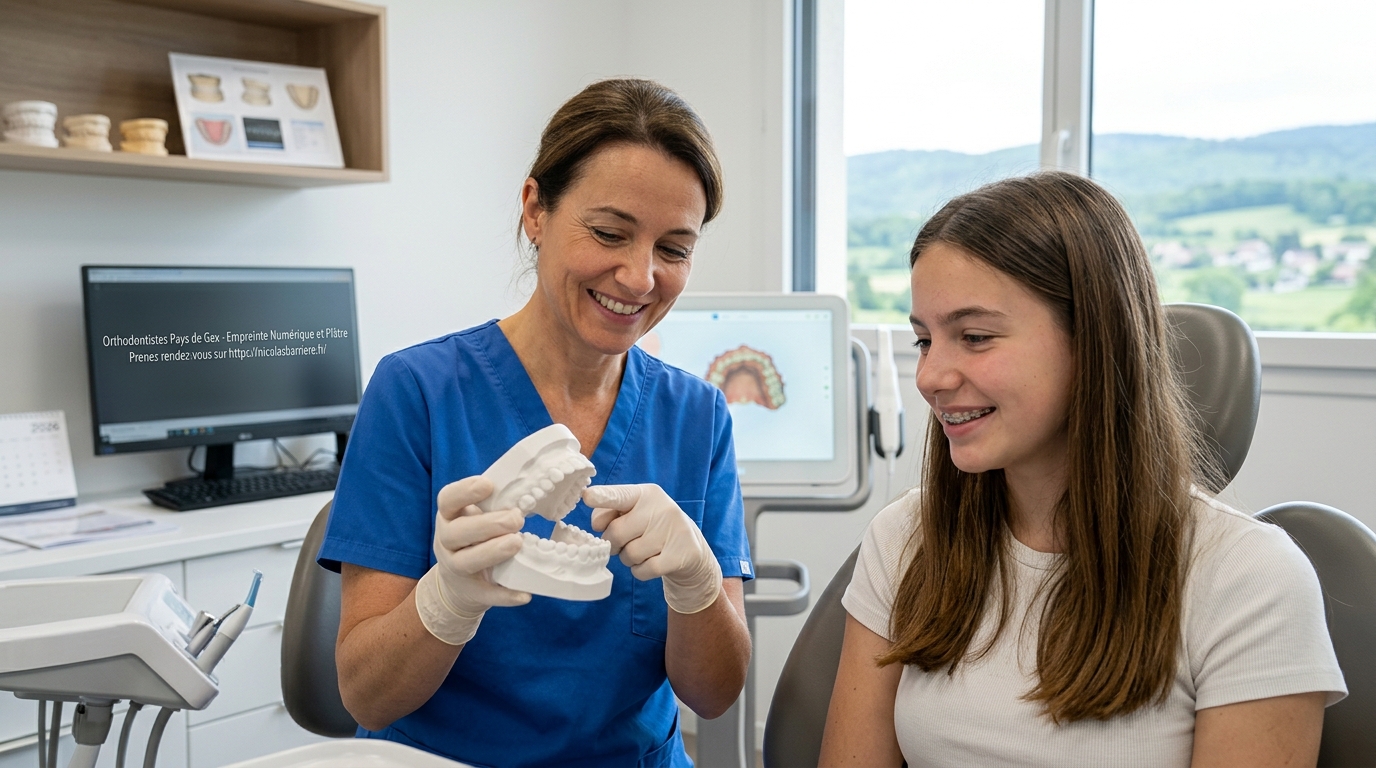
Depending on the dental practice, impressions can be taken using intraoral scanning or traditional molding. To understand the practical differences between these two methods, our dedicated article explains the subject in detail: Digital impression or plaster cast: two methods of taking impressions in orthodontics.
Clinical diagnosis and health coverage
The choice of technique is based primarily on clinical diagnosis and the practitioner's expertise, which determines the solution best suited to each situation. For a general framework of the rules applicable to adults, the organization France Health Associations publishes some guidelines, and the details are developed in our article Orthodontic treatment for adults in the Ain region.
Ethical framework: Clinical diagnosis and the practitioner's expertise always take precedence. The estimate provided after the clinical assessment details the fees according to the applicable fee schedule and the nature of the planned procedures. A consultation allows for a thorough review of the proposed treatment plan.
FAQ: Frequently asked questions about orthodontics in cross-border areas
What is the fastest orthodontic treatment?
The shortest treatments generally involve limited corrections to dental alignment, achievable with clear aligners in 6 to 18 months depending on the individual case. The exact duration always depends on the clinical diagnosis and can only be determined after a complete assessment by the orthodontist.
How is an orthodontic treatment plan established?
The treatment plan is based primarily on the clinical diagnosis and expertise of the orthodontist, who determines the appropriate technique, its duration, and its complexity. The practitioner is responsible for choosing the appliance (visible braces, lingual braces, or aligners); the patient does not choose a brand. Only the estimate provided at the office then reflects the details of the proposed treatment plan.
How long does orthodontic treatment typically last?
The duration of orthodontic treatment generally varies from 12 to 30 months depending on the complexity of the malocclusion, the patient's age, and the technique used. The retention phase, which follows, then extends over several years to stabilize the result.
How does orthodontic treatment work in neighboring Switzerland?
The terms of coverage by Swiss health insurance (LAMal, supplementary insurance) differ significantly from the French system and should be verified with your insurer. In France, the clinical diagnosis and the practitioner's expertise remain the basis of any treatment plan, regardless of the patient's place of residence.
How to calmly prepare for your orthodontic treatment?
Several options exist: having an initial assessment before age 16 can, if applicable, lead to coverage by the French national health insurance system (Assurance Maladie) depending on your affiliation status, and checking the coverage provided by your supplemental health insurance or cross-border health insurance plan. A discussion with your insurer before starting is strongly recommended, but the choice of technique depends on the clinical diagnosis and the practitioner's expertise.
Which is the best country to get your teeth done?
France and Switzerland both boast a recognized level of medical excellence and highly qualified professionals. The main difference lies in reimbursement procedures, which vary depending on the patient's status, and logistical proximity. Ultimately, the best choice is the one that guarantees regular, high-quality follow-up care over the long term.
Is a specific medical file required to consult a doctor on the French side from Nyon?
No specific medical records are required for the consultation itself. However, it is helpful to bring any previous X-rays, reports from previous assessments, and your insurance card. These items facilitate continuity of care and avoid redundant tests.
At what age should a child consult an orthodontist?
An initial orthodontic assessment can be considered as early as 6 or 7 years of age, particularly in cases of visible functional problems (mouth breathing, prolonged thumb sucking) or obvious jaw growth abnormalities. A clinical examination by an orthodontist will determine if interceptive treatment is indicated.
📌 Key points to remember
- An orthodontic practice located in Divonne-les-Bains is accessible in about 15 minutes by car from Nyon.
- The extended time slots (morning, midday, late afternoon, Saturday) facilitate cross-border life.
- Patients from the Pays de Gex, the Ain and neighbouring Switzerland come to the practice in Divonne-les-Bains.
- Continuity of monitoring takes precedence over mere kilometer distance.
- The available techniques (clear aligners, braces, lingual orthodontics) are adapted to each age group, with the practitioner remaining responsible for choosing the appliance.
- An initial assessment is essential to establish a personalized treatment plan and a quote.
- Any questions regarding reimbursement procedures should be checked with your insurer or the affiliated fund.
About the author: Nicolas Barrière
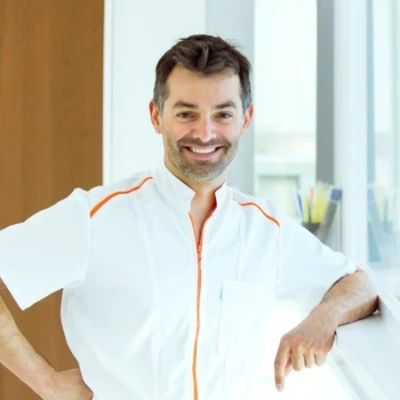
Dr. Nicolas Barrière is an orthodontist, a qualified specialist in dentofacial orthopedics, a former hospital intern, and the founder of his practice in Divonne-les-Bains. He treats children, adolescents, and adults with orthodontic treatments (clear aligners, lingual braces), paying particular attention to the care of patients living near the French-Swiss border.
Areas of expertise: Dentofacial orthopedics, orthodontics for children, adolescents and adults, clear aligners, lingual orthodontics, orthognathic surgery, sleep apnea, retention and relapse.
An orthodontic treatment plan to be considered calmly
A clinical examination is essential for any personalized advice. Please schedule an initial consultation at the office.
📚 Sources and references
Official sources:
- Ameli: Treatment of dental malpositions: dentofacial orthopedics and orthodontics
- Ameli: Reimbursement for orthodontic treatments
- Cleiss: You work in Switzerland and reside in France (cross-border worker)
- INSEE Analyses: Cross-border work in Auvergne-Rhône-Alpes
- Haute-Savoie Prefecture: Illness, Franco-Swiss border workers
Health press and information:
- France Assos Santé: Orthodontic care, how much does it cost?
- Rome2Rio: Route from Nyon to Divonne-les-Bains
📖 Also read
- Orthodontic follow-up for cross-border patients: care and organization between France and Switzerland
- Orthodontic treatment for adults in the Ain region: coverage and reimbursement procedures
- Discomfort related to orthodontic appliances outside of regular hours
- Digital impression or plaster cast: two methods of taking impressions in orthodontics

 French
 English