
The orthodontic file contains the clinical history, radiographs, photographs, impressions, and the initial treatment plan. Its transmission is a patient right governed by Article L1111-7 of the Public Health Code. Two possible methods in Divonne-les-Bains: transmission

Orthodontist in Divonne-les-Bains: what a patient file contains and how information is transmitted between practitioners
Written by Nicolas Barrière : Orthodontist, Qualified Specialist in Dentofacial Orthopedics, founder of the practice, at nicolasbarriere.fr. Updated on . Reading time: approximately 12 minutes.
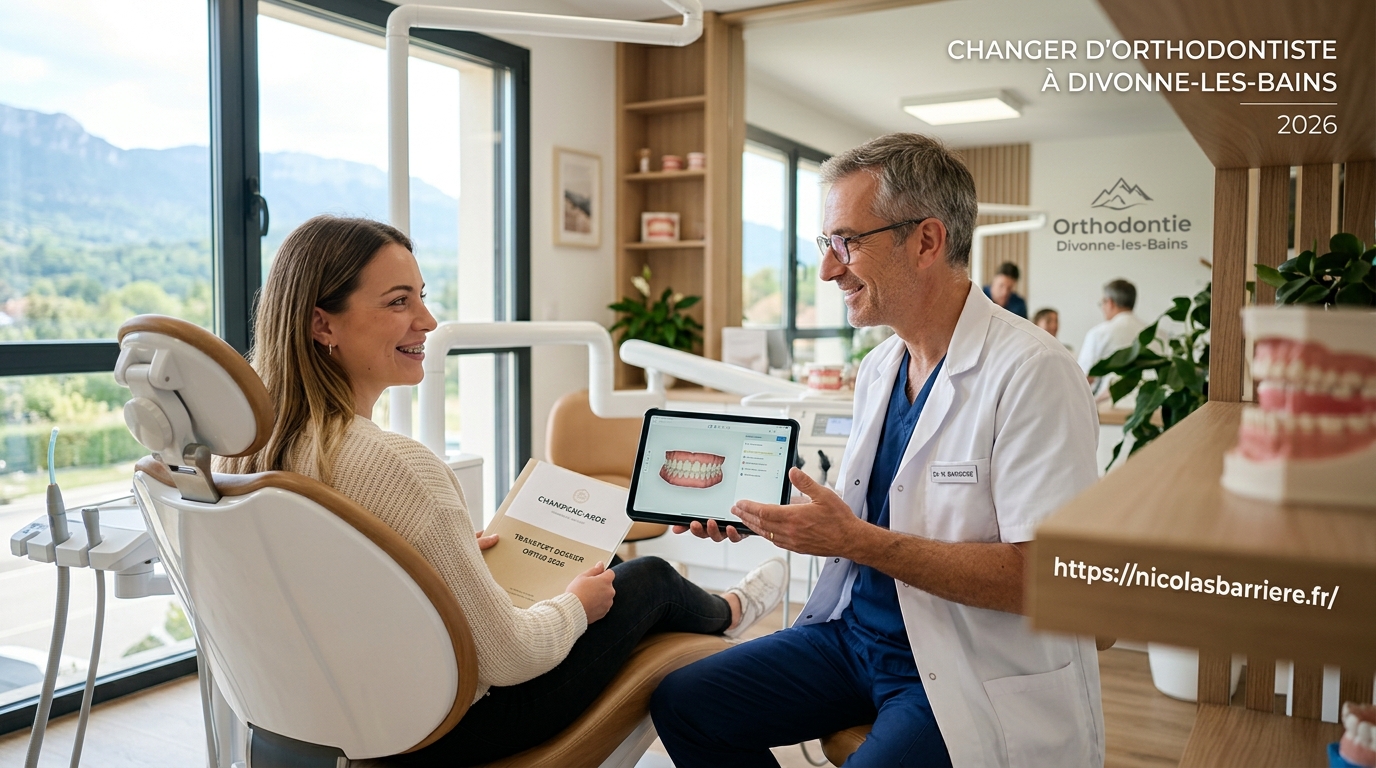
Continuing orthodontic treatment in Divonne-les-Bains after moving house or changing practitioners depends on the quality of the transferred patient file. This medical document, which details all previously completed treatments, ensures a consistent clinical resumption without any loss of information.
- The orthodontic file contains the clinical history, radiographs, photographs, impressions, and the initial treatment plan.
- Its transmission is a patient right governed by article L1111-7 of the Public Health Code.
- Two possible routes in Divonne-les-Bains: direct transmission between colleagues or delivery to the patient against receipt.
An orthodontic file includes the patient's clinical history, panoramic and cephalometric radiographs, medical photographs, impressions (physical or digital), and treatment plan. When changing orthodontists to continue treatment in Divonne-les-Bains, this file can be transferred directly between healthcare professionals or given to the patient in person upon written request, to ensure continuity of care.
Changing orthodontists mid-treatment to a practice in Divonne-les-Bains is a regulated, legitimate, and facilitated process when the medical file is complete. In 2026, the Divonne-les-Bains orthodontic practice regularly receives patients transferred from neighboring Switzerland, the Lyon region, and other departments. To understand the practical arrangements for welcoming and resuming treatment, it is helpful to know the organization of the practice and the continuity of orthodontic follow-up in Divonne-les-Bains, which is essential for a proper analysis of the transferred file.
Health alert point: Any resumption of orthodontic treatment requires a new, thorough clinical examination. Reviewing the submitted file never replaces an in-office consultation, which is the only time a personalized treatment plan can be validated.
What exactly does a patient's orthodontic file contain?
The orthodontic file brings together all the clinical, iconographic and administrative data necessary for monitoring a treatment. It constitutes the medical and legal record of the care pathway, and serves as an objective basis for any practitioner required to resume treatment.
According to the National Council of the Order of Dental Surgeons, this file must be kept up to date for each patient and retained for a minimum regulatory period. Its content meets a dual requirement: traceability of actions performed and possible transmission to a colleague in case of continuity of care.
Orthodontic file A documented and structured collection of clinical, radiographic, photographic and administrative information for a patient undergoing orthodontic treatment, intended to ensure traceability of treatment and its continuity in the event of a change of practitioner.
What are the mandatory clinical and administrative documents?
The basic administrative and clinical file includes the patient's identification, medical history, and documents attesting to their consent. These elements ensure the legal security of the practitioner and a good understanding of the overall medical context.
🪪
Identification sheet
Name, surname, date of birth, contact details, social security number and, where applicable, LAMal information for cross-border patients.
📋
Medical history
General medical history, allergies, current treatments, chronic conditions that may influence orthodontic treatment.
✍️
Informed consent
Signed documents attesting that the patient has been informed of the treatment plan, therapeutic alternatives and potential risks.
✉️
Correspondences
Correspondence exchanged with the treating dentist, maxillofacial surgeon or other specialists involved in the care pathway.
What is the importance of X-rays and casts?
Iconographic elements and imprints constitute the visual and morphological memory of the treatment. They allow the practitioner taking over to accurately compare the initial state with the current progress of the treatment.
Dental panoramic
Comprehensive radiograph showing all teeth, jaws and adjacent bone structures.
Lateral cephalometric radiograph
Image allowing cephalometric analysis, that is to say the study of the bony relationships between the upper jaw, mandible and base of the skull.
Clinical photographs
Intraoral (front, profile, occlusal) and extraoral (front, profile, three-quarter view) photographs documenting the aesthetic and functional state.
Digital footprints or models
Physical reproductions or 3D scans of dental arches, used for initial analysis and monitoring of progress.
Practical tip: If your X-rays and photographs are in digital format, request them on a USB drive or via secure delivery. These files are essential to avoid repeat imaging exams and to expedite the resumption of treatment.
How is the medical file structured at the start of treatment?
The orthodontic file is built from the first assessment appointment, also called the study consultation. It is at this point that the practitioner makes the diagnosis, defines the treatment plan and records the data that will serve as a reference throughout the follow-up.
Why is the initial examination essential to creating the file?
The initial examination establishes the diagnostic and strategic basis for treatment. Without this initial snapshot, no successor practitioner can assess the actual progress or adjust the care plan consistently.
-
Medical interview and reason for consultation
The practitioner gathers information on the patient's dental history, habits (sucking, mouth breathing), any joint pain, and aesthetic or functional expectations.
-
Endo and exo-oral clinical examination
Analysis of the dental arches, temporomandibular joints, facial musculature, and static and dynamic occlusion.
-
Radiographic assessment
Prescription of panoramic and cephalometric radiographs necessary for the analysis of bone and dental relationships.
-
Fingerprinting and photography
Recording of the initial morphology of the arches and the aesthetics of the smile before any therapeutic action.
-
Formulation of the treatment plan
The practitioner will write the diagnosis, choose the appropriate appliance (visible braces, lingual braces, or clear aligners), estimate the treatment duration, and provide the patient with comprehensive information. The practitioner is responsible for selecting the technique best suited to the clinical case; the patient does not choose a brand.
«"A well-maintained orthodontic record is, in my view, a complete act of care in itself. It is what allows a colleague, months or years later, to resume treatment, fully understanding the initial strategy and the steps taken."»
As treatment progresses, the file is systematically enriched: notes from each session, adjustments to the equipment, follow-up X-rays, and any referral letters. Each step is time-stamped, allowing for a precise reconstruction of the treatment history.
The orthodontic record is simultaneously a clinical tool, a legal document, and an instrument for continuity of care between practitioners.
Under what conditions can this file be transferred to another practitioner?
The transmission of medical records is based on a fundamental right of the patient, regulated by French law. The former practitioner cannot refuse or withhold these documents, provided that the request is made in accordance with the rules.
What does the law say about the right of access to medical information?
Article L1111-7 of the Public Health Code guarantees every person a right of direct access to all information concerning them held by a health professional. This right naturally extends to the transmission to another practitioner chosen by the patient.
Essential legal framework: according to the National Council of the Order of Dental Surgeons, The documents must be provided within 8 days of the request (extended to 2 months for information older than 5 years).’Article R4127-232 of the Public Health Code It also recalls the duty of continuity of care.
The Code of Ethics for dental surgeons also imposes on practitioners an obligation of collegiality: they must facilitate the exchange of information useful for the continuation of treatment, solely in the patient's interest. This principle is reiterated in the...’Article R4127-259 et seq. of the Public Health Code.
Direct access to the entire file, the right to request a copy, the right to designate another practitioner as the recipient, and the right to refuse certain transmissions. For a minor patient, the request is made by the holders of parental authority.
File retention for the required period, transmission within legal deadlines, respect for professional secrecy, informing the patient of their rights, delivery of documents without excessive charges (only reproduction costs may be charged).
Communication within 8 days for recent documents, within 2 months for information older than 5 years, from the date of receipt of the written request accompanied by proof of identity.
How exactly does the data transfer take place?
There are two main ways to organize the transmission of an orthodontic file: direct transmission between colleagues or delivery to the patient against receipt. The choice depends on the patient's preferences and the technical options available in each practice.
Direct transmission between practitioners
- Secure sending from colleague to colleague (secure health messaging, registered mail).
- Includes a clinical summary letter written by the former practitioner.
- Guarantees the integrity and confidentiality of data.
- Requires prior written consent from the patient.
- Often preferred for complex ongoing treatments.
Handing to the patient
- Documents handed over in person against signature of a release.
- USB flash drives for digital X-rays and photographs.
- Paper copies for administrative documents and correspondence.
- The patient brings the file to the new office himself.
- A common solution when moving house early.
Health alert point: Always keep a personal copy of the documents provided. In case of loss during transfer, this backup avoids having to reconstruct a complete file and preserves continuity of care.
How to arrange the transfer of your case to a firm in Divonne-les-Bains?
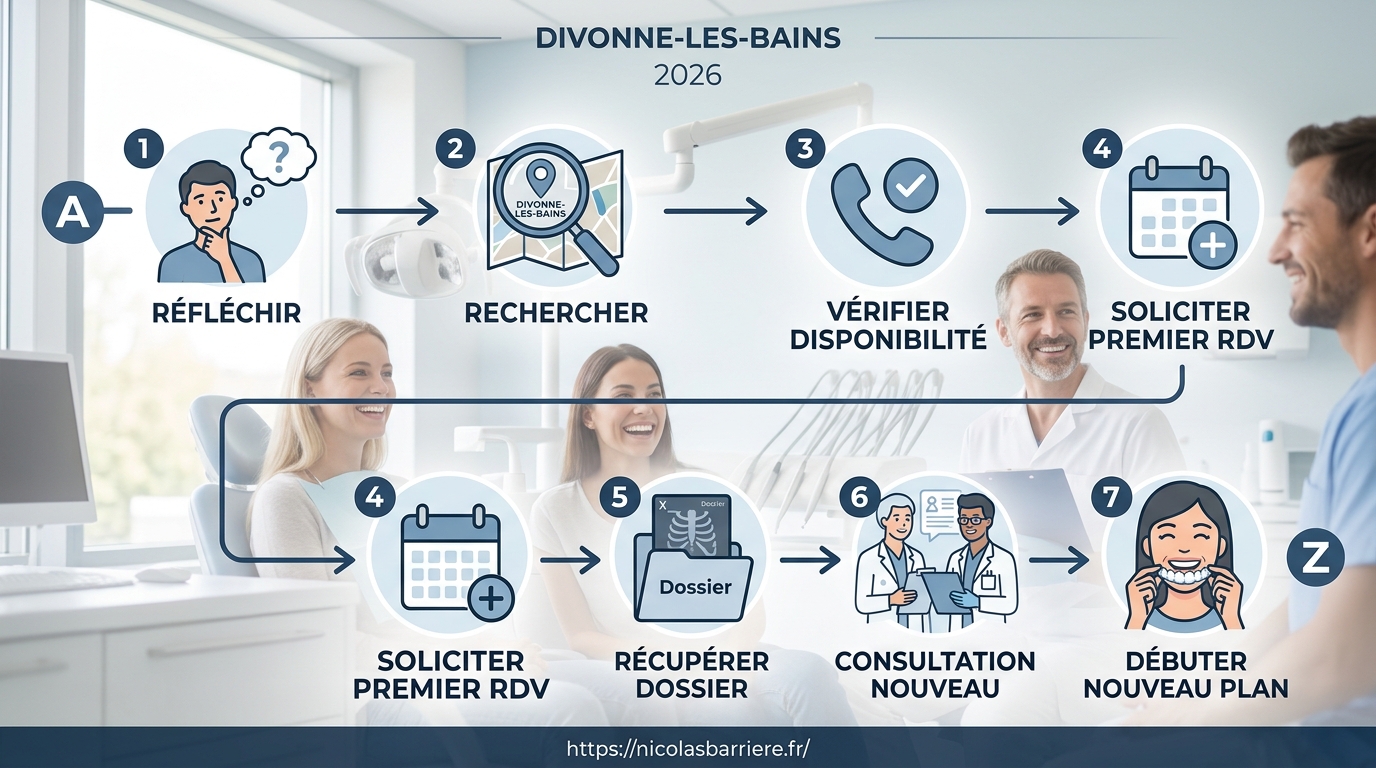
The organisation of the transfer to an orthodontic practice in Divonne-les-Bains is based on a three-step process: notification to the former practitioner, formal written request, and scheduling of a takeover appointment. This procedure, simple in appearance, deserves to be anticipated to avoid any prolonged interruption of treatment.
-
Notify the former office
Inform your current orthodontist in writing (by regular or registered mail as appropriate) of your decision to continue your treatment elsewhere, stating the reason (moving, change of region, personal convenience).
-
Submit the transfer request
Write an explicit request specifying the documents desired (radiographies, photographs, treatment plan, letters, digital impressions) and the chosen method of transmission (hand delivery or direct sending to a specifically named colleague).
-
Make an appointment in Divonne-les-Bains
Contact the office in Divonne-les-Bains to schedule a follow-up appointment. Be sure to mention from the outset that you are currently undergoing treatment and bring all relevant documents.
-
Clinical evaluation consultation
The new practitioner analyzes the file, performs a thorough clinical examination and may prescribe additional tests if some documents are missing or outdated.
-
Validation of the recovery plan
An updated treatment plan is proposed, taking into account the patient's history and current clinical condition. An active follow-up phase is then organized, with regular appointments and appliance adjustments, up to the retention phase. A new cost estimate and, if applicable, a prior authorization request are then prepared.
To facilitate this transition, it is helpful to understand the organization of orthodontic reception and follow-up in Divonne-les-Bains, This ensures that the new clinical team can analyze the transferred case under optimal conditions. The practice in Divonne-les-Bains, accustomed to treating Franco-Swiss cross-border patients, has specific expertise in coordinating between healthcare systems (French National Health Insurance Fund, Swiss Health Insurance Act, supplementary insurance).
Written requestto the old office
Recoverywithin 8 legal days
Appointment bookingin Divonne-les-Bains
Retake examcase analysis
Updated plancontinuity of care
Are you planning to continue your orthodontic treatment in Divonne-les-Bains?
An in-office appointment allows us to analyze your submitted file and define a personalized recovery plan.
What specific elements should be checked in a transferred file?
Beyond standard documents, certain elements deserve special attention during an orthodontic file transfer. Their presence determines the accuracy with which the new practitioner will be able to resume treatment.
- Complete initial diagnosis with numerical cephalometric analysis.
- Treatment plan written with detailed therapeutic objectives.
- Initial quote and terms of service (prior agreement request, reimbursements).
- Session-by-session history with time-stamped clinical notes.
- Intermediate control X-rays if performed.
- Follow-up photographs (evolution of alignment, smile, occlusion).
- Digital files of transparent gutters or setup plans if treatment with aligners.
- Report on containment if this phase has already begun.
- Correspondence with other specialists (surgeon, periodontist, treating dentist).
Which documents are particularly valuable for aligner treatments?
Clear aligner treatments are based on a digital setup plan specific to each patient. The transmission of this 3D file is essential for the new practitioner to understand the programmed tooth movement strategy.
Depending on the type of appliance, certain documents must be collected first. For metal or ceramic braces, the wire protocol, current ligatures, and slot number are essential. For clear aligners, the 3D setup file, the current aligner number, and the remaining series are indispensable. For lingual orthodontics, the custom technical prescription, the setup plan, and the archwire number are indispensable. In pediatric dentofacial orthopedics, the removable appliance used, the wearing protocol, and the growth assessment are essential. Finally, for the retention phase, the type of device, the placement date, the wearing protocol, and the latest photographs are essential.
«"In my practice in Divonne-les-Bains, I've noticed that patients who arrive with a complete digital file, including setup files for clear aligners, benefit from a much smoother treatment resumption. Anticipating the transfer request, ideally several weeks before the move, makes all the difference."»
What happens if some elements of the file are missing?
In the event of an incomplete file, the new practitioner may have to reconstruct certain examinations, which lengthens the total duration of the procedure and may generate additional costs. However, continuity of care remains ensured thanks to the initial clinical resumption examination.
Complete file submitted
- Rapid resumption of treatment, often without further imaging examinations.
- Immediate understanding of the initial therapeutic strategy.
- No additional cost related to the redesign of the diagnostic assessment.
- Continuity is maintained with the existing prior agreement request.
- A comparative analysis is possible between the initial state and the current state.
Incomplete or missing file
- Some X-ray images need to be redone.
- Partial reconstruction of the history through interview with the patient.
- Longer initial consultation time.
- Risk of delaying the effective resumption of active treatment.
- A new prior agreement request may sometimes be required from the CPAM (French Health Insurance Fund).
📝 Note: If the former practitioner does not respond to the request within the legal time limits, the patient can contact the Departmental Council of the Order of Dental Surgeons, which plays a mediating role between the parties.
How is continuity of care guaranteed for cross-border patients?
The Pays de Gex region has a high proportion of patients working in Switzerland, whose health coverage often combines LAMal, supplementary insurance and the French system. The orthodontic practice in Divonne-les-Bains is used to handling the administrative coordination related to these situations.
Franco-Swiss peculiarity
For a patient who has started treatment in Switzerland and wishes to continue it in Divonne-les-Bains, the file should ideally include the nomenclature of procedures in both systems, in order to facilitate coordination with the CPAM and French supplementary health insurance.
The transfer of a patient's file between a Swiss orthodontist and a French practice follows the same ethical principles: patient consent, direct transmission or hand delivery, and respect for professional confidentiality. Clinical documents (X-rays, photographs, digital models) are perfectly interpretable from one country to the other.
LAMal
CPAM
Supplementary health insurance
Cross-border transfer
List of acts
Prior agreement
CPAM
Supplementary health insurance
Cross-border transfer
List of acts
Prior agreement
Points to consider before initiating a transfer process
Before formally changing orthodontists, certain checks can help avoid gaps in care and delays in resuming treatment.
Key health awareness points:
- Never interrupt the wearing of the current appliance without the advice of an orthodontist: a loosening, even temporary, can lead to a relapse of tooth movement.
- Anticipate the transfer request at least 4 to 6 weeks before the actual move.
- Check with the CPAM (French Health Insurance Fund) regarding the procedures for continuing coverage in the event of prior agreement already validated.
- Keep a personal copy of all documents transmitted.
- Schedule a follow-up consultation as soon as possible to limit the period without active monitoring.
Resuming orthodontic treatment is never a simple administrative formality. It requires a thorough clinical evaluation, which is essential for adapting the treatment plan to the patient's current condition. For more complex situations involving a retainer already in place elsewhere, it may be helpful to consult our dedicated article on resuming retention treatment with a new orthodontist in Divonne-les-Bains.
Frequently asked questions about changing orthodontists and medical records
Is it possible to change orthodontists during treatment?
Yes, continuity of care is a right guaranteed by the Public Health Code. It is simply a matter of arranging the transfer of the initial file to the previous practitioner so that the new practice, for example in Divonne-les-Bains, can resume the treatment plan where it left off, after a follow-up clinical examination.
Who should request the transfer of the medical file?
It is the patient, or their legal representative if they are a minor, who must make the formal request to their current practitioner. The new orthodontic practice in Divonne-les-Bains cannot directly demand the patient's file without their explicit written consent, in accordance with the principle of medical confidentiality.
What documents do I need to bring to the first appointment for the return to work?
If the direct transfer between practitioners has not yet taken place, ideally bring your panoramic and cephalometric radiographs, the initial treatment plan, letters from your previous orthodontist, the prior agreement request validated by the CPAM and, for treatments with transparent aligners, the digital setup files.
How much time does the former practitioner have to hand over the file?
The legal deadline is 8 days from receipt of the written request accompanied by proof of identity, according to Article L1111-7 of the Public Health Code. This deadline is extended to 2 months for medical information dating back more than 5 years.
Is there a charge for submitting the orthodontic file?
Consulting the patient's file on-site is free of charge. Only the costs of reproduction (paper copies, digital media) and possibly postage may be charged to the patient, at a reasonable cost not exceeding the actual cost of the media. The previous practitioner may not charge any additional fees for this transfer.
What should I do if the former orthodontist refuses to hand over the file?
Refusal to transmit the information constitutes a breach of professional ethics. The patient can first renew their request by registered letter with acknowledgment of receipt, then contact the Departmental Council of the Order of Dental Surgeons, which plays a mediating role. As a last resort, the Commission for Access to Administrative Documents (CADA) or the administrative court can be contacted.
Do all the tests need to be redone at the new clinic?
No, if the submitted file is complete and up-to-date, the initial imaging studies remain usable. The new practitioner generally only needs a thorough clinical examination and new photographs to compare the current condition with the initial one. X-rays may only be ordered if the previous ones are more than two years old or if a specific change in the condition warrants it.
Is the prior agreement request still required if the practitioner changes?
Yes, the prior agreement request validated by the CPAM (French National Health Insurance Fund) remains linked to the patient's treatment, not the practitioner. The new orthodontist in Divonne-les-Bains can continue the treatment under the initial agreement, simply informing the health insurance fund of the change of practitioner for billing purposes for the remaining semesters.
📌 Key points to remember
- The orthodontic file includes administrative, clinical, iconographic documents and the initial treatment plan.
- Its transmission is a patient right governed by article L1111-7 of the Public Health Code, with a legal deadline of 8 days.
- Two possible routes: direct transmission between colleagues or delivery to the patient against a receipt.
- Anticipation (4 to 6 weeks before the move) facilitates a rapid resumption of treatment.
- A follow-up clinical examination remains essential, regardless of the quality of the submitted file.
- The CPAM prior agreement request is maintained in the event of a change of practitioner.
- The practice in Divonne-les-Bains is used to handling transfers, including for Franco-Swiss border patients.

About the author: Nicolas Barrière
Dr. Nicolas Barrière is an orthodontist, a qualified specialist in dentofacial orthopedics, a former hospital intern, and the founder of his practice in Divonne-les-Bains. He treats children, adolescents, and adults with orthodontic treatments (clear aligners, lingual braces), paying particular attention to the care of patients living near the French-Swiss border.
Areas of expertise: Orthodontics, Dentofacial orthopedics, Clear aligners, Lingual orthodontics, Pediatric orthodontics, Adult orthodontics, Management of complex and multidisciplinary cases.
Need a personalized opinion on resuming your orthodontic treatment?
Only a clinical consultation in a doctor's office can accurately assess your situation and propose a suitable treatment plan.
📚 Sources and references
Official and legal sources:
- National Council of the Order of Dental Surgeons: What access to medical records?
- Article R4127-232 of the Public Health Code on Légifrance
- Code of ethics for dental surgeons on Légifrance
- National Council of the Order of Physicians: The patient's file
- Commission for Access to Administrative Documents: Personal Medical File
Institutional references:
- ARS Auvergne-Rhône-Alpes: What is the purpose of the medical file and how to request it
- Ameli: Treatment of dental malpositions and orthodontics
- French Society of Dentofacial Orthopedics (SFODF)
📖 Also read:
- Making an orthodontic appointment in Divonne-les-Bains: practice organization and continuity of care
- Resuming retention follow-up with a new orthodontist in Divonne-les-Bains
- Orthodontic practice in Divonne-les-Bains: what information should you consult before making contact?
- Fixed retention and night guard in orthodontics: function and indications
 French
 English