
The resumption of a retention procedure in Divonne-les-Bains is based on three pillars: transfer of the patient's file, clinical assessment, and follow-up plan. The Code of Ethics (articles R.4127-259 to R.4127-268) governs the continuity of care between colleagues. The French Society of Dentofacial Orthopedics (SFODF)

Resuming retention treatment with a new orthodontist in Divonne-les-Bains: how is this transition organized?
Written by Nicolas Barrière : Orthodontist, Qualified Specialist in Dentofacial Orthopedics, founder of the practice at nicolasbarriere.fr. Updated on . Reading time: approximately 12 minutes.
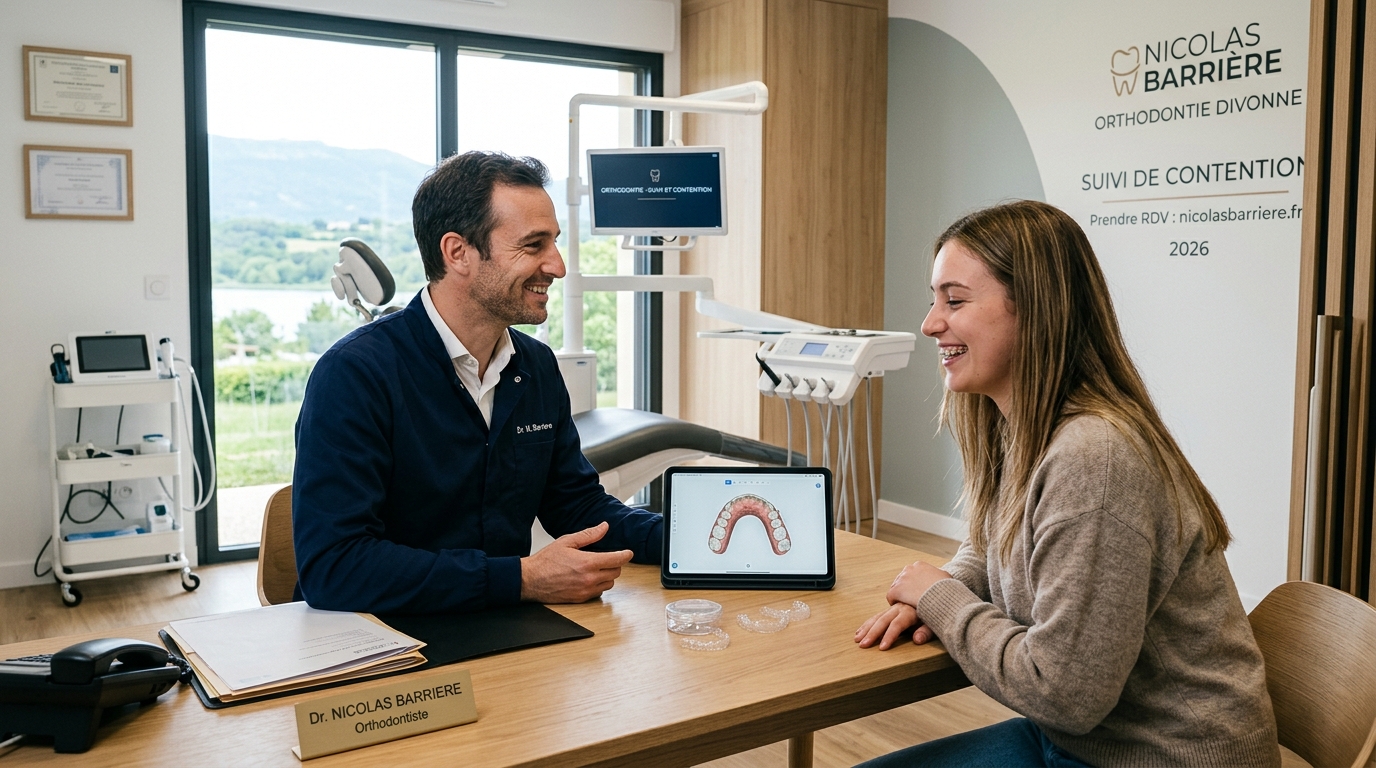
Changing orthodontists in Divonne-les-Bains to continue retention treatment started elsewhere is a common practice, governed by the Code of Ethics for Dental Surgeons. An initial clinical assessment, a transfer of records, and a personalized monitoring protocol help to maintain the results achieved.
- The resumption of restraint in Divonne-les-Bains is based on three pillars: transfer of the file, clinical assessment and follow-up plan.
- The Code of Ethics (articles R.4127-259 to R.4127-268) organizes the continuity of care between colleagues.
- The French Society of Dentofacial Orthopedics (SFODF) recommends in its 2023 work a retention that is often prolonged, sometimes for life.
- A detached lingual wire or a broken splint can be repaired or remade identically by the new practitioner.
To continue retention treatment begun elsewhere with an orthodontist in Divonne-les-Bains, the new practice first transfers your medical records from your previous practitioner. An initial clinical assessment then evaluates the integrity of the bonded lingual wire or night guards, the periodontal condition, and the stability of your bite. The practitioner then establishes a personalized monitoring protocol to maintain the orthodontic results over the long term.
After moving to the Pays de Gex, a professional life change between France and Switzerland, or simply a need for proximity, many patients seek to have their care monitored orthodontic retention near their homes. In 2026, this situation particularly concerns those wearing discreet (bonded lingual wire) or removable (nighttime retainers) appliances who wish to preserve years of active treatment. Understanding how this transition is organized, from the initial contact to long-term follow-up, allows for a smoother transition to changing practitioners.
⚠️ Health alert: Even if everything seems stable, a prolonged interruption in retention monitoring exposes you to a risk of relapse. Any sign of tooth movement, wire detachment, or a damaged retainer should prompt an immediate consultation.
How is the transfer of a case organized for a restraining order that has started elsewhere?
The transfer of the orthodontic file is based on a written request from the patient to their former practitioner, who then transmits the necessary information to their colleague. This approach is part of the continuity of care provided for by the Code of Ethics for Dental Surgeons.
In practice, the patient contacts their former practice to request a copy of their file: panoramic and cephalometric X-rays, initial and final photographs, digital impressions or casts, summary letters, and the type and date of splint application. These documents can be sent directly to the new practitioner or given to the patient. To better understand the organization and continuity of follow-up at the Divonne-les-Bains office, It is helpful to consult our guide dedicated to welcoming new patients.
Legal framework: Articles R.4127-259 to R.4127-268 of the Public Health Code govern the duties of professional conduct and the transmission of information useful for the continuity of care between dental surgeons. Source: Legifrance.
Orthodontic retention The final, passive phase of orthodontic treatment aims to maintain the teeth in their new position to prevent relapse. It follows the active phase (braces, aligners) and uses a wire bonded behind the teeth (fixed retention) or a retainer worn at night (removable retention).
What documents should I ask my former doctor for?
The submitted file ideally includes the following documents, which are essential for a secure resumption of monitoring.
- Panoramic radiograph at the end of active treatment.
- Lateral cephalometric radiography if available.
- Initial, intermediate and final clinical photographs.
- Study models (plaster or digital STL files).
- Summary letter describing the treatment carried out.
- Technical specifications of the retention device: type, date of installation, material.
- Dates and nature of the last inspection visits.
📝 The patient has a right of direct access to their medical file (law of March 4, 2002). The former practitioner must respond to the request within a maximum of eight days (two months if the file is more than five years old).
Why does collegiality facilitate the resumption of follow-up?
Collegiality, a cardinal principle of dental ethics, governs the relationships between practitioners in the patient's best interest. A new orthodontist in Divonne-les-Bains typically contacts their colleague to clarify a point in the patient's file, confirm a treatment plan, or obtain a missing X-ray. This seamless communication avoids redundant examinations and reduces waiting times.
«"In daily practice, we find that the transmission of a complete and annotated file between colleagues is the factor that most influences the quality of the revision of a retention. A wire placed eight years ago does not have the same significance as a recently placed wire."»
Need to organize the transfer of your file?
A preliminary phone call allows you to calmly prepare for your first consultation in Divonne-les-Bains.
What are the clinical steps involved in resuming your restraint treatment in Divonne-les-Bains?
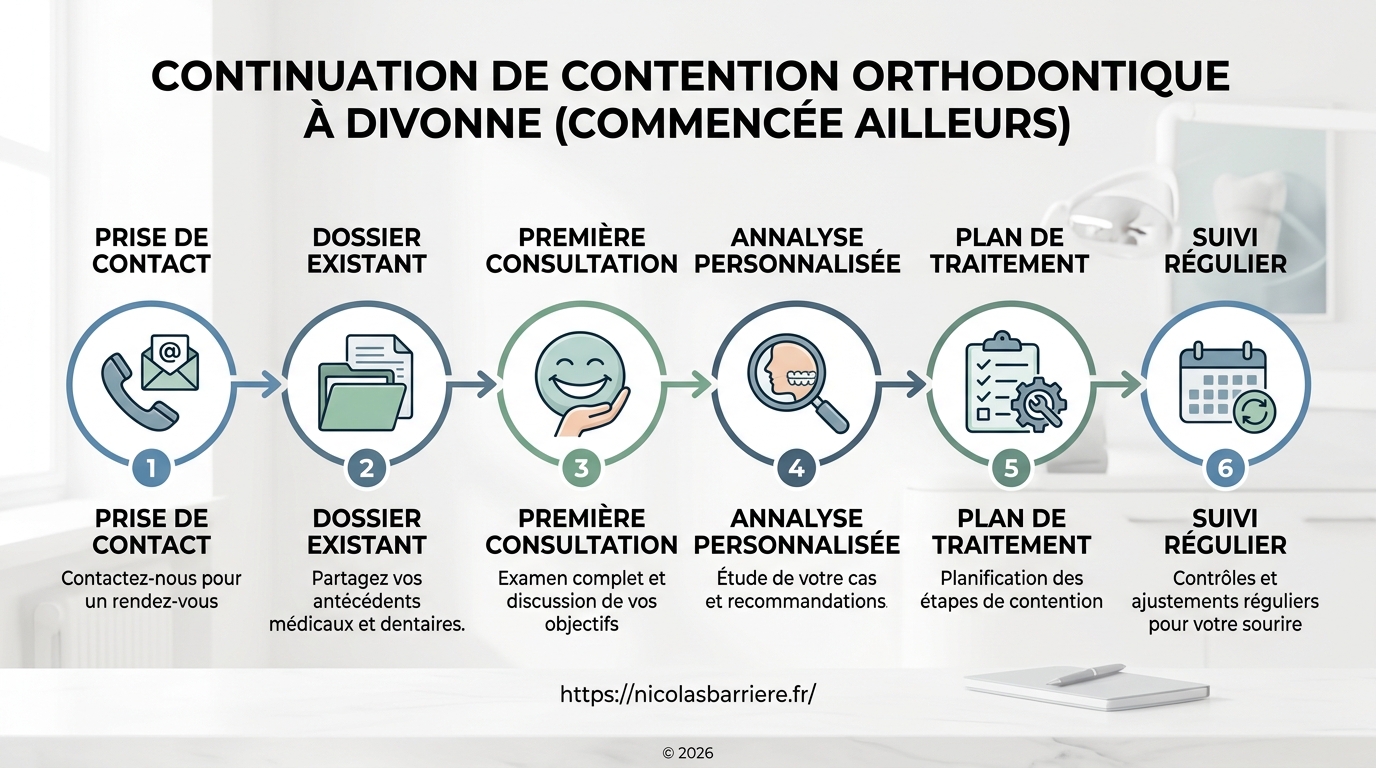
Clinical recovery takes place in five stages: administrative reception, periodontal assessment, evaluation of the existing device, therapeutic decision and follow-up planning. Each step addresses a specific objective of security and continuity.
-
Initial contact and transmission of the file
The patient calls the office, describes their situation (type of restraint, date of fitting, original office) and provides the relevant information from their file before the appointment.
-
Initial clinical assessment
Examination of occlusion, periodontal tissues, soft tissues and visual and tactile evaluation of the lingual wire or splints.
-
Analysis of the existing system
Checking the bonding points, the rigidity of the wire, the absence of corrosion, and the adaptation of the gutter.
-
Treatment decision
Preservation of the device, occasional adjustment, repair, or complete overhaul (new wire, new gutter).
-
Customized monitoring protocol
Planning of periodic check-ups (generally every 6 to 12 months) adapted to the duration of restraint.
Initial assessment: what does the orthodontist check during the first consultation?
The initial assessment evaluates four dimensions: tooth stability, gum health, occlusion, and the integrity of the retention device. Each dimension guides the recovery strategy.
The orthodontist first observes the alignment of the incisors and checks for the absence of early signs of orthodontic relapse (rotation, initial overlap). He then examines the gums and periodontal tissues: inflamed gum tissue around a bonded wire can complicate placement and must be treated beforehand. Occlusion is checked to detect any interference. Finally, the lingual wire is tested point by point: a detached adhesive pad may go unnoticed with the naked eye, but compromises the function of the device.
Orthodontic relapse Partial or total return of teeth to their initial position after the end of active treatment. This results from biological forces (periodontal memory), functional forces (swallowing, breathing) and the continuous physiological growth of the jaws throughout life.
🦷
Teeth
Alignment verification, early detection of rotations or overlaps.
🩸
Periodontium
Assessment of gingival health and absence of inflammation around the wire.
⚙️
Occlusion
Control of contact between arches and absence of functional interference.
🔗
Device
Integrity of the thread, glue points, condition of the removable gutters.
Adjustment or repair: what to do if your retainer is damaged?
A loose or broken wire or a cracked gutter can be repaired or remade identically during a dedicated consultation. The treatment is quick and preserves the orthodontic result.
If one or more adhesive points on the lingual wire have come loose, the practitioner cleans the tooth surface, reapplies a bonding composite, and checks the wire's fit. When the wire is deformed or corroded, it is replaced with a new wire, made of twisted steel or composite fiber, depending on the indications. For damaged night guards (cracks, perforations, wear), a new digital impression allows for the rapid fabrication of a replacement guard.
Damaged device
- partially detached thread
- Cracked or perforated gutter
- Missing glue dots
- Risk of short-term recurrence
After care
- Glue points restored
- New adapted gutter
- Wire replaced if necessary
- Scheduled follow-up
⚠️ Health alert: A retainer wire that pricks the tongue, moves when touched, or leaves a tooth loose is a situation that needs to be addressed quickly. Never attempt to reattach a wire yourself: contact your orthodontist.
Which restraint devices are affected by a resumption of monitoring?
Two main types of devices are involved: fixed retention (glued lingual wire) and removable retention (thermoformed night guard). The two can coexist in the same patient.
The bonded lingual wire is invisible and worn continuously, often lasting several years; its replacement involves checking the bond and the integrity of the wire, the main risk being the silent detachment of a stud. The night guard, visible only at night, requires daily cleaning and storage in a dedicated case; its replacement involves checking the fit or having a new one made, the main risks being forgetting to wear it or wear and tear on the plastic.
To delve deeper into the difference between these two approaches, you can consult our article dedicated to the fixed retention and night guard in orthodontics.
Why does the SFODF recommend prolonged restraint?
The French Society of Dentofacial Orthopedics (SFODF) recommends in its 2023 work a retention often prolonged beyond the initial stabilization phase. This recommendation is based on knowledge of continuous physiological growth.
Teeth are never static: throughout life, they are subjected to the forces of chewing, swallowing, breathing, and the residual growth of the jaws. Without a retainer, the lower incisors naturally tend to overlap with age, a phenomenon observed even in people who have never worn braces. Long-term retention limits this phenomenon and preserves the investment of several years of active treatment.
According to the SFODF 2023 recommendations, restraint should be considered as a long-term treatment rather than as a fixed-duration step.
Lingual thread
Thermoformed gutter
Fixed restraint
Removable restraint
SFODF 2023
Recidivism
Periodontium
Thermoformed gutter
Fixed restraint
Removable restraint
SFODF 2023
Recidivism
Periodontium
What are the deadlines and practical arrangements in Divonne-les-Bains?
For a restraint resumption, the waiting time for the first consultation in Divonne-les-Bains is organized according to the degree of urgency: rapid in case of a broken device, scheduled for a simple check-up.
A broken wire or a lost retainer are situations that should be addressed as a priority to prevent recurrence. For a simple check-up, scheduling an appointment in the following weeks is still appropriate. According to the Jean-Jaurès Foundation/Doctolib study on access to healthcare, appointment wait times vary considerably depending on the specialty and region: the Pays de Gex area, experiencing strong population growth according to INSEE (the French National Institute of Statistics and Economic Studies), sees significant demand from both the French and Swiss sides.
11 daysNational average waiting time for a dentist appointment (Dental Information)
28 daysaverage time according to other professional measures
2023year of the SFODF recommendations on restraint
What are the specific considerations for Franco-Swiss border patients?
Border patients benefit from the proximity of the practice to Nyon and the canton of Vaud, approximately 15 minutes away. Managing insurance files (LAMal, Swiss supplementary insurance, French social security) is part of the current organization.
Many patients who began their treatment in Switzerland wish to have their retention system continued in France, due to proximity to their home and workplace or administrative simplicity. The reverse is also common. In all cases, submitted documents (X-rays, casts, letters) are accepted and used regardless of their origin, provided they are legible and dated.
Good to know: The financial coverage for simple retention monitoring differs from that of active orthodontic treatment. A clear estimate is always provided before any procedure, in accordance with regulations.
How long does restraint last and how can follow-up be anticipated?
Retention begins as soon as active treatment is completed and often lasts for several years, or even a lifetime for its fixed component. The monitoring gradually becomes less intensive, but never stops completely for those with lingual wires.
Year 1
Intensive phase
Strict use of night guards, permanent wire, frequent check-ups (every 3 to 6 months).
Years 2-3
Consolidation phase
Gradual spacing of checkups, wearing of mouthguards several nights a week.
Years 4 and up
Maintenance phase
Annual check of the lingual wire, occasional use of the splint, monitoring of stability.
In the long term
Lifetime phase
Preservation of the lingual filament as a safeguard against natural age-related migration.
What are the best practices for maintaining your compression garment on a daily basis?
- Brush teeth carefully around the floss, using a suitable interdental brush.
- Avoid biting very hard foods directly with your incisors (nuts, ice cubes, crusts).
- Wear the mouthguard every night (or according to the protocol) and clean it daily.
- Store the gutter in its case, never in a paper towel.
- Consult immediately if you experience any unusual sensations, a pricking thread, or a damaged aligner.
- Keep your check-up appointments, even when everything seems fine.
«"A patient who moves and interrupts their follow-up for two or three years may notice, at the first resumption check-up, a slight overlap of the incisors that could have been avoided with annual monitoring. Retention is a silent but demanding discipline."»
A concrete example: redoing a lingual wire placed eight years ago
Let's take the example of a patient who recently moved to Divonne-les-Bains for a position in Geneva. Eight years ago, she received aligner treatment in another region, followed by a lingual wire bonded behind her lower incisors and an upper night guard. For the past three years, she hasn't seen an orthodontist. She's noticed that her wire seems to be shifting slightly and that her worn-out night guard appears too small.
-
Initial contact
She calls the office, describes her situation, and gets an evaluation appointment. She is asked to contact her former doctor to transfer her medical records.
-
Clinical assessment
The examination revealed a detached adhesive pad on a canine tooth, healthy periodontal tissues, and incisors that were still well aligned. The aligners were indeed deformed.
-
Decision
Targeted re-gluing of the block, taking digital impressions to manufacture new splints.
-
Follow up
A six-month check-up is planned, then an annual schedule will be adopted if everything is stable.
This common scenario illustrates how resuming restraint is a feasible approach without repeating a complete treatment, provided that action is taken before the appearance of a significant relapse.
Do you have a compression garment to be treated in Divonne-les-Bains?
A personalized opinion requires a clinical consultation and a thorough examination. Contact the office to arrange your initial visit.
Frequently Asked Questions: Essential Information on Orthodontic Retention
How long does orthodontic retention last?
Retention begins as soon as active treatment is completed. The first year requires strict adherence to the retainers and the presence of the bonded wire. Monitoring then continues for several years. According to the 2023 SFODF recommendations, the lingual wire is often kept in place long-term, sometimes for life, to compensate for the natural movement of teeth.
What is retention in orthodontics?
Retention is the final, passive phase of orthodontic treatment. Its aim is to maintain the teeth in their new position to prevent relapse. It uses either a thin wire bonded behind the teeth (fixed retention) or a thermoformed retainer worn at night (removable retention), sometimes both in combination.
Can a dentist remove a retainer wire?
A general dentist has the technical ability to remove a retainer wire, particularly in emergencies or to access cavity treatment. However, it is strongly recommended to consult an orthodontist before any permanent removal, in order to assess the risk of relapse and consider, if necessary, a replacement appliance.
Is it possible for teeth to move despite a retainer wire?
Yes, this can happen when one or more adhesive pads come loose without the patient noticing. The floss then no longer fully performs its function on the affected teeth. An annual check-up allows for the early detection of silent detachment and intervention before crowding becomes a permanent problem.
Is it recommended to keep a retention wire for life?
Yes, in many cases. The 2023 SFODF study highlights that prolonged, often lifelong, fixed retention compensates for the continuous physiological migration of teeth and the aging of the periodontium. This approach preserves the results of active treatment over the long term, provided that regular follow-up and rigorous oral hygiene are maintained.
Is it possible to change orthodontists during retention treatment without any problems?
Yes, continuity of care is governed by the Code of Ethics for Dental Surgeons. The patient requests their previous dentist to transfer their medical records (X-rays, photos, models). The new dentist in Divonne-les-Bains conducts an initial clinical assessment and then adapts the follow-up protocol to the existing system.
What should I do if my retainer wire breaks over a weekend?
A broken or loose wire is not a life-threatening emergency, but it should be repaired quickly to prevent a recurrence. Avoid handling the wire, protect your tongue with a small ball of orthodontic wax if the wire is pricking, and contact the office as soon as it opens. A follow-up appointment is usually offered promptly.
Are my old retainers reusable?
Not always. A deformed, cracked, or poorly fitting splint no longer provides adequate support. After clinical evaluation, the practitioner decides whether to keep the existing splint or fabricate new ones from recent digital impressions.
📌 Key points to remember
- The resumption of restraint in Divonne-les-Bains is governed by the Code of Ethics (articles R.4127-259 to R.4127-268) which organizes collegiality and continuity of care.
- The transfer of the file (x-rays, photos, models, letters) must be requested by the patient from their former practitioner.
- The initial clinical assessment evaluates the teeth, periodontium, occlusion, and existing retention device.
- A loose wire or a damaged aligner can be repaired or remade without having to redo the entire orthodontic treatment.
- The SFODF 2023 recommends retention that is often prolonged, sometimes lifelong, for lingual wire.
- The checks become less frequent over time but do not stop completely: an annual rhythm is common in the long term.
- A personalized opinion always requires a clinical consultation and a thorough examination.

About the author: Nicolas Barrière
Dr. Nicolas Barrière is an orthodontist, a qualified specialist in dentofacial orthopedics, a former hospital intern, and the founder of his practice in Divonne-les-Bains. He treats children, adolescents, and adults with orthodontic treatments (invisible aligners, lingual orthodontics), paying particular attention to the care of patients living near the French-Swiss border.
Areas of expertise: Orthodontics, Dentofacial orthopedics, Invisible aligners, Lingual orthodontics, Children's orthodontics, Adult orthodontics, Retention and relapse prevention.
📚 Sources and references
Official and legal:
- Public Health Code, articles R.4127-259 to R.4127-268: duties of collegiality (Legifrance)
- Code of ethics for dental surgeons (Legifrance)
- Treatment of dental malpositions (Health Insurance)
- Access to medical records (National Order of Dental Surgeons)
Academics and scientists:
- Orthodontic retention: SFODF 2023 best practice recommendations (PDF)
- Orthodontic retention: best practice recommendations (PubMed)
- Consequences of changing practitioners during orthodontic treatment (French Orthodontics)
Trade press:
- Waiting time for a dentist appointment (Dental Information)
- Ain: continued demographic growth (Insee)
📖 Also read:
- Making an orthodontic appointment in Divonne-les-Bains: practice organization
- Orthodontic practice in Divonne-les-Bains: what information should you consult before making contact?
- Fixed retention and night guard: how they work and indications
- What a patient file contains and how the information is transmitted
- Orthodontic emergencies in the office
- Assess your situation with our orthodontic quiz
 French
 English