
Plaster-free digital impressions are taken with a 3D intraoral scanner in less than 5 minutes per arch, without paste or gagging. By 2026, this technology will be in place in most orthodontic practices and will serve as the foundation for aligners and lingual braces. The model

Digital impressions in orthodontics: procedure and benefits in adult treatment planning
Written by Nicolas Barrière : Orthodontist, Qualified Specialist in Dentofacial Orthopedics, founder of the practice, at nicolasbarriere.fr. Updated on . Reading time: approximately 12 minutes.
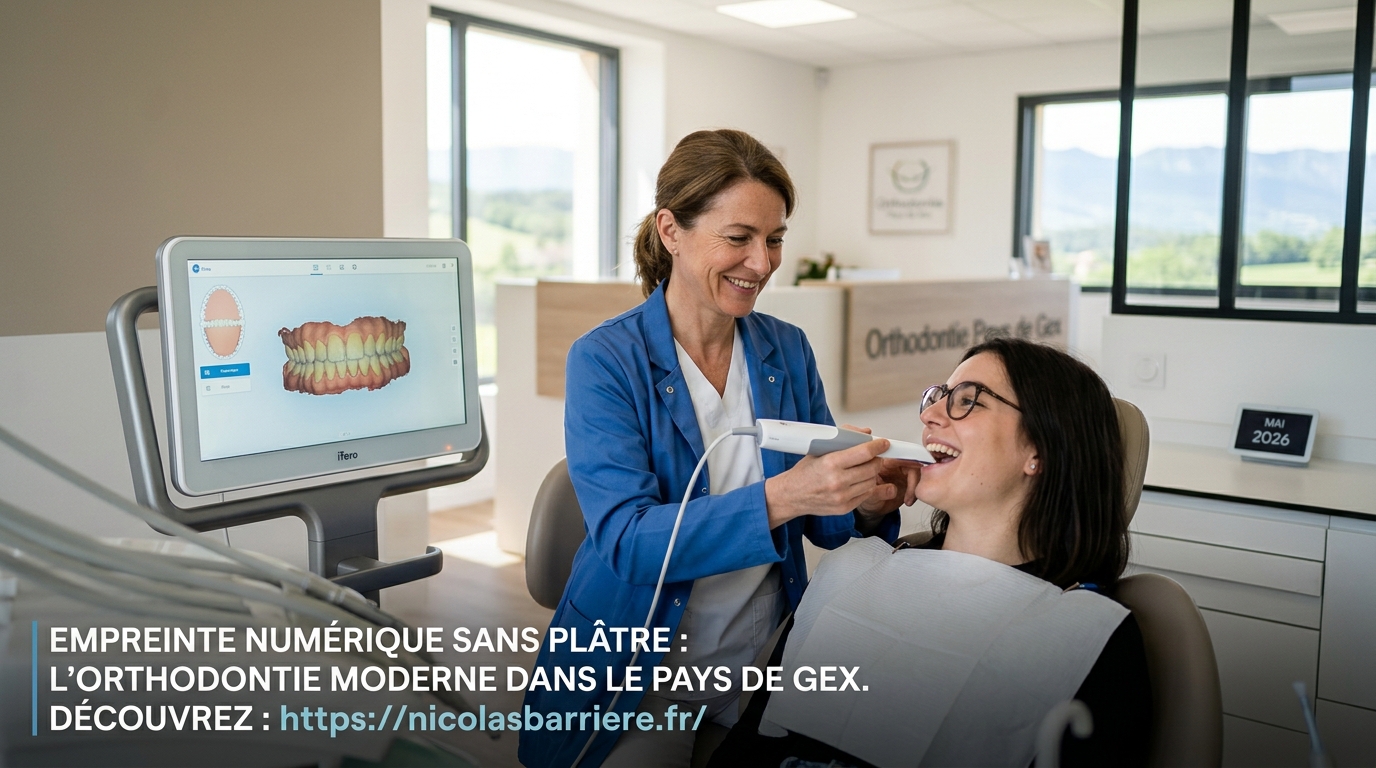
No more trays full of paste and the gag reflex: digital impressions have profoundly transformed the start of adult orthodontic treatment in Divonne-les-Bains. In just a few minutes, a 3D intraoral scanner replaces the traditional mold.
- Plaster-free digital impressions are taken with an intraoral 3D scanner in less than 5 minutes per arch, without paste or gag reflex.
- By 2026, this technology will be used in the majority of orthodontic practices and will serve as the foundation for aligners and lingual braces.
- The modeling offers an accuracy of around 20 to 50 micrometers, superior to that of alginate impressions.
Plaster-free digital impressions in orthodontics in Divonne-les-Bains involve creating a three-dimensional model of the teeth using a 3D intraoral scanner, without the use of traditional alginate paste. The procedure typically takes less than 5 minutes per arch, eliminates the gag reflex, and immediately provides a usable digital file for planning adult treatment with clear aligners or lingual braces.
As a follow-up to the guide on the’Discreet orthodontics for adults (lingual braces or clear aligners), This guide details a crucial link in the treatment process in 2026: taking optical impressions. You will discover its principle, how it is performed during a consultation, its precise contribution to the design of appliances, and why it has become essential in orthodontic practices. For any personal questions, an individualized opinion requires a clinical examination in the office: you can contact our team.
What is a plaster-free digital dental impression?
A plaster-free digital dental impression is a 3D model of the mouth obtained using an intraoral scanner, without any physical molding. The practitioner captures the geometry of the teeth and gums with a camera, and the digital file completely replaces the old plaster models.
Digital fingerprint Three-dimensional modeling of the dentition performed by a 3D intraoral scanner, without paste or plaster, which instantly produces a usable file for the diagnosis and manufacture of orthodontic appliances.
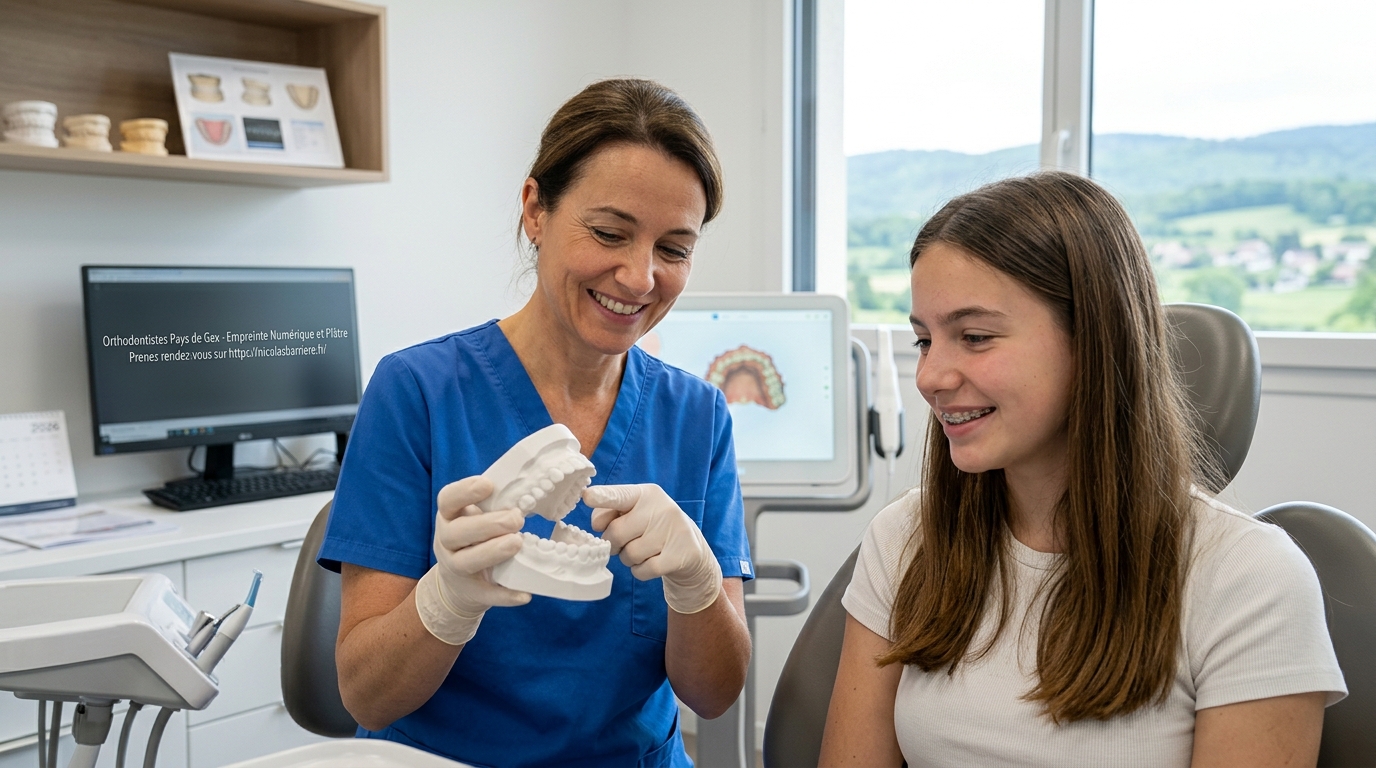
In practice, the orthodontist holds a small, thin-tipped camera in their hand. They move it over the occlusal, buccal, and lingual surfaces of the teeth, while the software reconstructs a 3D model in real time, displayed on the screen. No material is injected into the mouth, no impression trays need to be bitten into, and there is no waiting for the impression to set.
Before: alginate imprint
- Cold dough placed on a mold holder
- Wait 2 to 3 minutes motionless, mouth open
- The gag reflex is common in adults.
- Physical molding to be cast in plaster in the laboratory
- Bulky storage, risk of deformation
Next: 3D digital footprint
- Intraoral scanner the size of an electric toothbrush
- Progressive capture, free breathing
- No prolonged contact with the palate, nausea avoided.
- STL or PLY file transmitted electronically
- Long-term archiving, unlimited duplication
Reliability documented by scientific literature
The accuracy of modern intraoral scanners is now comparable to, or even superior to, that of conventional impressions for orthodontics. An in vivo study published on PubMed Central (PMC6981254) evaluates the accuracy and precision of intraoral scanners on the complete maxillary arch, demonstrating their reliability for everyday clinical use, including on the complete arches required in orthodontics.
Micrometer precision: Current intraoral scanners achieve an accuracy of around 20 to 50 micrometers over a complete arch, a level of detail sufficient to manufacture custom-made aligners and lingual brackets.
A digital file that can be used immediately
Unlike physical molding, which must be poured, shaped, and then shipped, the 3D file is transmitted to the laboratory or simulation software in just a few clicks. This digitalization accelerates planning, reduces manufacturing times, and allows for secure sharing between referring practitioners.
How is the optical impression taken during a consultation?
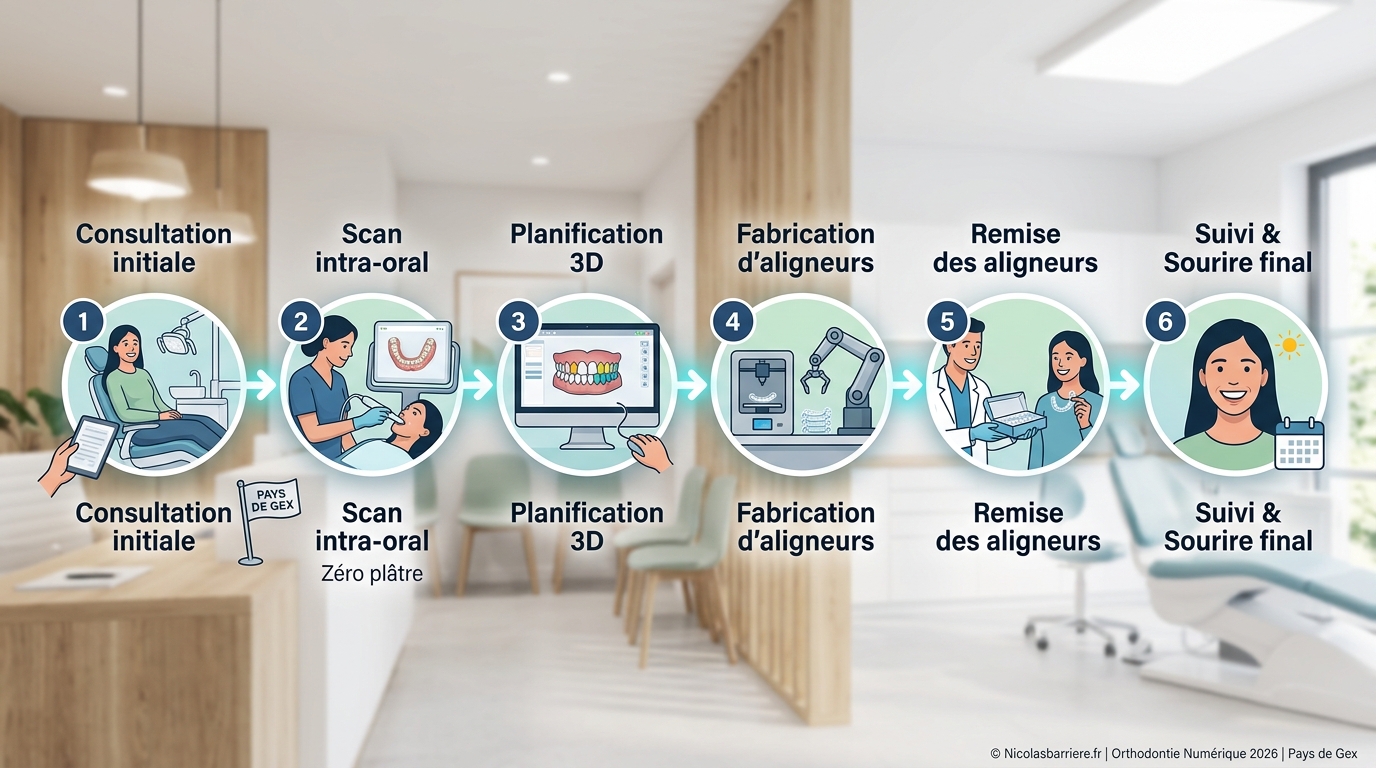
The optical impression takes place in 3 to 5 minutes per arch, without pain or injection, comfortably seated in the chair. The patient remains seated, breathes freely and can follow the live modeling on the office screen.
-
Mouth preparation
The dental surfaces are gently dried to ensure the camera captures images without unwanted reflections. No products are injected: neither powder, as with most modern scanners, nor paste.
-
Optical scan of the first arch
The practitioner moves the camera along the upper arch following a defined path (occlusal surface, then vestibular, then lingual). The software reconstructs the 3D model displayed on the screen in real time.
-
Scanning of the second arch and occlusion
The same procedure is used for the lower arch. The patient then closes their teeth for a recording of the occlusion (how the jaws fit together), captured in a few seconds.
-
File validation and transfer
The 3D model is checked on the screen, missing areas are completed by targeted scanning, then the file is validated and sent to the planning software or the laboratory.
Good to know: No anesthesia is required. Patients with old braces, bridges, or removable dentures can also benefit from a digital impression without any special adaptation.
Significantly improved comfort for sensitive patients
The elimination of the impression tray in the mouth radically changes the experience of the consultation. People with a strong gag reflex, those with a sensitive palate, or those who have difficulty breathing through their nose no longer have to dread this step. Claustrophobic or anxious patients also appreciate being able to see their mouth gradually take shape on the screen, thus demystifying the procedure.
«"In daily practice, we observe that adults who were apprehensive about traditional impressions readily accept scanning. Many are even surprised by the speed of the procedure and the accuracy of the result, which is immediately visible on the screen."»
How does this 3D technology optimize treatments for adults?
The digital impression serves as the foundation for the custom design of clear aligners and lingual braces: without it, there is no virtual simulation of the treatment. The 3D file directly feeds into the planning software which draws each planned dental movement, step by step.
For an adult seeking a discreet solution, the choice between discreet orthodontics (lingual braces or clear aligners) This approach is based on a thorough clinical analysis, of which 3D modeling is now an integral part. The practitioner remains responsible for choosing the appliance, whether it be visible braces, lingual braces, or aligners: the patient does not choose a technique alone. The digital impression is the common starting point for both techniques, each then processing the file in its own way.
Digital impressions and alginate impressions differ in several ways. A 3D digital impression takes 3 to 5 minutes per arch, is performed without paste or nausea, offers an accuracy of 20 to 50 micrometers, immediate visualization on the office screen, instant transmission to the laboratory, permanent and duplicable archiving, and allows for immediate treatment simulation. An alginate impression requires 5 to 8 minutes per arch with a setting time, often triggers a gag reflex, offers an accuracy of 80 to 150 micrometers, does not allow for visualization before pouring, requires physical shipment, a fragile and bulky model, and does not allow for simulation.
The contribution of digital technology to the design of clear aligners
Clear aligners are custom-made removable trays that gradually move teeth in successive stages. Each tray corresponds to a stage of treatment, a planned tooth movement of approximately 0.2 to 0.3 millimeters.
This level of precision is only achievable with a high-definition digital model. The planning software segments each tooth in the 3D file and then simulates the entire dental trajectory, from the initial position to the final goal. The practitioner adjusts the sequence, validates the intermediate steps, and then initiates manufacturing via 3D printing or thermoforming. Without digital impressions, this customized, serial production approach would be impossible to achieve industrially.
🎯
Visual simulation
The patient can see on screen the predicted position of their teeth at the end of treatment, from the first consultation.
📐
Encrypted transactions
Each tooth movement is planned in millimeters and degrees, tooth by tooth.
🖨️
Automated manufacturing
The file directly feeds into the 3D printing or thermoforming of successive gutters.
🔄
Adjustments made along the way
A new scan currently being processed allows for further refinement of the aligners if necessary.
The precision required for custom-made lingual braces
Lingual braces are brackets bonded to the inside surface of the teeth, invisible from the outside. Unlike standardized braces, each lingual bracket is individually manufactured to fit the shape of the tooth to which it will be bonded. This requirement makes a digital impression essential.
Using the 3D file, the laboratory manufactures brackets whose base precisely replicates the contours of the lingual surface of each tooth. A bonding tray, also created from the scan, allows the practitioner to position the brackets simultaneously and with micrometric precision in the mouth. A discrepancy of just a few tenths of a millimeter in the impression would result in incorrect positioning and less effective treatment.
⚠ Health alert: The choice between clear aligners and lingual braces is not based solely on aesthetics. It depends on the type of malocclusion, the periodontal condition, the bite, and lifestyle habits. A personalized assessment absolutely requires a clinical consultation and a thorough examination.
Facilitating dialogue with the adult patient
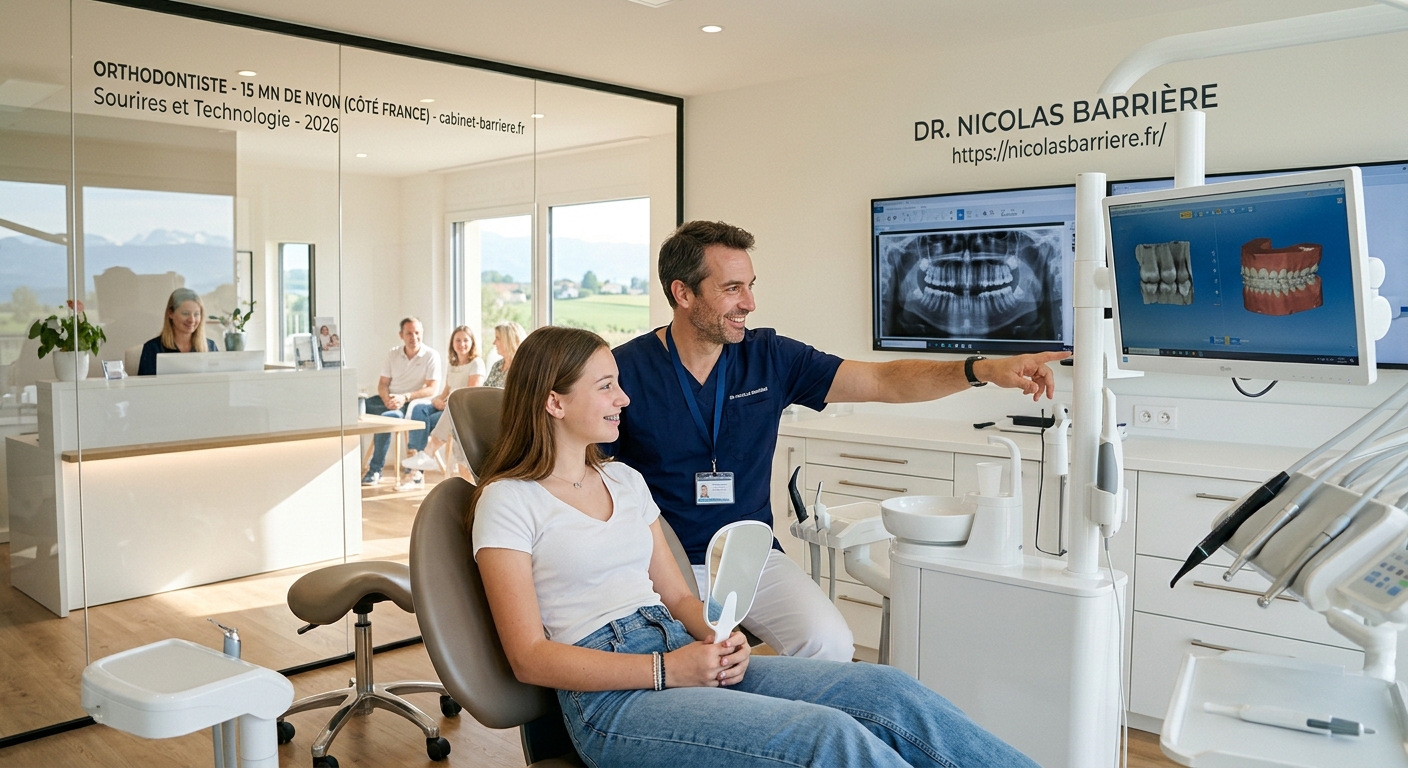
3D visualization also changes the practitioner-patient relationship. Even before starting, the adult sees the current position of their teeth on the screen, then the projection of the expected result. They clearly understand the necessary movements, any potential limitations of what is achievable, and can ask targeted questions. This educational transparency is particularly appreciated by a demanding adult clientele, often living near the border and accustomed to high standards of care.
Are you considering orthodontic treatment for adults?A clinical assessment will determine the technique best suited to your situation.
Equipment that has become essential in the Pays de Gex
The Pays de Gex is among the French territories where the digitalization of orthodontic practices is most advanced, driven by an active adult clientele from across the border accustomed to Swiss healthcare standards. Intraoral scanners are now used in the majority of specialized facilities.
According to the INSEE territorial data for the Pays de Gex Agglomeration Community, The territory has surpassed 100,000 inhabitants and is experiencing sustained population growth, driven by its proximity to the Geneva basin. This dynamic generates a strong demand for specialized care, a significant portion of which concerns adult orthodontics for aesthetic and functional purposes.
100 000+inhabitants in the Pays de Gex
15 minfrom Nyon and the Swiss border
3 to 5 minutesper arch for an intraoral scan
Why such rapid adoption in the region?
Several factors explain the rapid deployment of digital footprinting at the Divonne-les-Bains practice. The demands of an active adult patient base, often executives in the Geneva area, are driving practices to invest in tools that minimize the time spent in the dental chair. Furthermore, Franco-Swiss patients compare practices on both sides of the border and expect a level of equipment consistent with Swiss standards.
🌍
Demanding cross-border clientele
Adults who work in Geneva devote little time to consultations: the speed of a digital fingerprint naturally fits into this constraint.
Mixed insurance files
The management of LAMal and French supplementary insurance is facilitated by the electronic transmission of 3D files.
Population growth
The regular arrival of new residents creates a continuous demand for adult orthodontics.
Digital culture
The proximity of Geneva's technology hub promotes patient acceptance of digital tools.
What difference does a digital footprint make for a border-area adult?
For someone who crosses the border daily, every minute counts. A digital impression appointment fits perfectly into a lunch break, with no recovery time or lingering discomfort. The file is sent to the lab instantly, reducing the manufacturing time for aligners or lingual braces. And if the patient needs to consult a medical specialist in Switzerland (prosthetist, periodontist), the 3D file can be shared in seconds.
What are the indications for digital fingerprinting in adults?
Digital impressions are used in almost all adult orthodontic treatments, from simple aesthetic alignment to multidisciplinary cases combining orthodontics and surgery. Its use has become widespread in all planning procedures requiring an accurate model of the dentition.
Clear aligners. The scan is used both for predictive treatment simulation and for the fabrication of successive aligners. After the treatment plan is approved, the treatment includes an active phase with regular follow-up appointments and adjustments to the appliance. A new scan can be performed during treatment to refine the series if the predicted tooth movements have not progressed as expected.
Custom-made lingual braces. Each bracket is machined from the 3D file to fit the lingual surface of the tooth. A placement tray, also created from the scan, ensures simultaneous and precise bonding in the mouth.
Restraint devices. At the end of the treatment, a new scan allows the night retainer or bonded wire to be made perfectly adapted to the final position of the teeth.
Orthognathic surgery and multidisciplinary cases. The 3D file is integrated into surgical planning software, in addition to cone beam, to simulate bone displacements and prepare surgical guides.
Situations where further examination remains necessary
A digital impression captures the crown of the teeth and the free gum tissue, but does not assess the underlying bone, root position, or detailed periodontal health. For a complete adult orthodontic evaluation, it is combined with a panoramic radiograph, sometimes a 3D cone beam CT scan, and a clinical periodontal examination. These examinations remain essential for making a diagnosis and proposing an appropriate treatment plan.
⚡ Digital fingerprinting is a modeling tool, not a diagnostic tool. It complements the clinical examination, it never replaces it.
«"The 3D file has become the cornerstone of the modern orthodontic record. It circulates between the practitioner, the laboratory, and sometimes referring specialists, but the clinical decision remains human and is based on the entire assessment carried out in the office."»
What are the concrete benefits for adult treatment planning?
Digital impressions allow for faster, more precise and more visual planning of adult orthodontic treatment, while reducing appliance manufacturing times. It transforms dialogue into consultation and secures the laboratory stages.
Benefits for the patient
- Significantly improved comfort, no nausea
- Shorter examination time, 3 to 5 minutes per arch
- Immediate 3D visualization on the office screen
- Simulation of the expected result before commitment
- No re-scanning will be possible if an area is missing.
- Permanent archiving of the file
Points to be aware of
- Requires initial training by the healthcare team.
- Significant investment in equipment for the firm
- Does not replace X-rays or periodontal examination
- Quality depends on the thoroughness of the sweeping
- File interoperability needs to be verified between software programs
Saving time at every stage of the process
By combining the time savings at each stage (impression taking, transmission to the lab, manufacturing, adjustments), the treatment process for aligners can begin in a few weeks, compared to several months with the traditional approach. Once the plan is approved, the active phase of treatment unfolds with regular follow-up appointments and adjustments to the appliance before the retention device is fitted. For busy adults, this responsiveness is a decisive advantage.
D-DayIntraoral scan in the office
D-DayDigital transmission to the laboratory
Day 7 to Day 15Simulation received and validated
Day 21 to Day 30First device delivered
📌 Key points to remember
- Plaster-free digital impressions use a 3D intraoral scanner, without paste or gag reflex.
- It takes place in 3 to 5 minutes per arcade, comfortably, with immediate visualization on the screen.
- Its micrometric precision is confirmed by the scientific literature indexed on PubMed.
- It is essential for the custom manufacturing of clear aligners and lingual braces.
- Orthodontic practices have massively equipped themselves to meet the demands of a cross-border clientele.
- It complements the clinical examination and X-rays, it does not replace them.
- A personalized opinion on therapeutic approach requires a consultation in the office.
About the author: Nicolas Barrière
Dr. Nicolas Barrière is an orthodontist, a qualified specialist in dentofacial orthopedics, a former hospital intern, and the founder of his practice in Divonne-les-Bains. He treats children, adolescents, and adults with orthodontic treatments (invisible aligners, lingual orthodontics), paying particular attention to the care of patients living near the French-Swiss border.
Areas of expertise: Orthodontics, Dentofacial orthopedics, Invisible aligners, Lingual orthodontics, Children's orthodontics, Adult orthodontics, Associated orthognathic surgery.
LinkedIn profile of Dr. Nicolas Barrière · Meet the firm's team
Your frequently asked questions about 3D impressions in orthodontics
Is the intraoral scan painful?
No, taking a digital impression is completely painless. The intraoral camera does not touch the teeth and does not inject any product. It is a major advantage for patients with a strong gag reflex or a sensitive palate, as it eliminates prolonged contact with an impression tray filled with paste.
How long does it take to complete a full dental model?
A full arch scan typically takes between 3 and 5 minutes. Recording both arches and the occlusion takes less than 10 to 15 minutes in total. This speed is particularly appreciated by active adults, especially patients living near the border in the Pays de Gex region.
Do digital impressions cost the patient more?
The digital impression is integrated into the overall treatment plan or initial assessment defined by the practitioner. It is not billed as an additional procedure. The choice of technique is based primarily on the clinical diagnosis and the practitioner's expertise; the details are presented during the initial consultation as part of a detailed estimate that complies with regulations.
How accurate is an intraoral scanner compared to a traditional impression?
Studies published on PubMed Central show that a modern intraoral scanner achieves an accuracy of 20 to 50 micrometers across a full arch, which is greater than the precision of an alginate impression (80 to 150 micrometers). This accuracy is more than sufficient for all orthodontic procedures, including custom-made lingual braces.
Can a digital impression be taken if you already have crowns, bridges, or implants?
Yes, the intraoral scanner easily records fixed prostheses, crowns, bridges, and implant abutments. The 3D file can also be used to simultaneously plan orthodontic treatment and prosthetic care in coordination with referring dentists.
Is any special preparation required before an intraoral scan?
No specific preparation is required. Brushing your teeth just before the appointment is sufficient. At the office, the dentist will gently dry the tooth surfaces to optimize the scan quality, without any discomfort for the patient.
Is the 3D file of my mouth being kept safe?
Yes, the digital file is integrated into the patient's medical record and stored in accordance with medical confidentiality rules and the General Data Protection Regulation (GDPR). It is only shared with those necessary for processing (laboratory, referring physicians) and with the patient's consent.
Will we be able to see what my smile will look like at the end of the treatment?
Yes, most planning software allows you to visualize the final position of the teeth from the initial consultation. This simulation serves as a discussion tool, illustrating the intended therapeutic goal, but the actual result then depends on the smooth clinical progress and the patient's cooperation.
Want to learn more about your orthodontic situation?
A clinical examination in the office remains the only way to obtain a personalized opinion tailored to your teeth.
📚 Sources and references
Official and institutional sources:
- INSEE: Territorial comparator, Pays de Gex inter-municipal authority (240100750)
- French National Authority for Health: Indications for dentofacial and dentomaxillofacial orthopedics
- Health Insurance: Orthodontic diagnosis of dental malpositions
- National Order of Dental Surgeons: specialties in dentistry
Academic and scientific sources:
- Trueness and precision of intraoral scanners in the maxillary dental arch: an in vivo analysis (PMC6981254)
- CBCT and Intra-Oral Scanner: The Advantages of 3D Technologies in Orthodontic Treatment (PMC7765620)
- Computerized Casts for Orthodontic Purpose Using Powder-Free Intraoral Scanners (PMC5937598)
- A Comparison of Full Arch Trueness and Precision of Intra-Oral Digital Scanners (PMC8303663)
Professional references:
- French Society of Dentofacial Orthopedics (SFODF)
- Dental Information: Conditions for the success of intraoral optical impressions
📖 Also read
- Discreet orthodontics for adults: lingual braces and clear aligners, two techniques with different indications
- Clear aligners for adults: how they work, indications, and follow-up care
- Lingual braces in adults: principle, indications and daily wear
- Adult orthodontics: when veneers are considered and when orthodontics is indicated
- Contact Dr. Nicolas Barrière's office


 French
 English