
A small jaw at age 5 is characterized by a narrow palate, overlapping baby teeth, and sometimes mouth breathing. The French National Authority for Health (HAS) recommends orthodontic screening for transverse maxillary anomalies starting at age 6. Treatment is based on...’

Narrow jaw in young children: understanding this disorder and support options
Written by Nicolas Barrière : Orthodontist, Qualified Specialist in Dentofacial Orthopedics, founder of the practice at nicolasbarriere.fr. Updated on . Reading time: approximately 12 minutes.
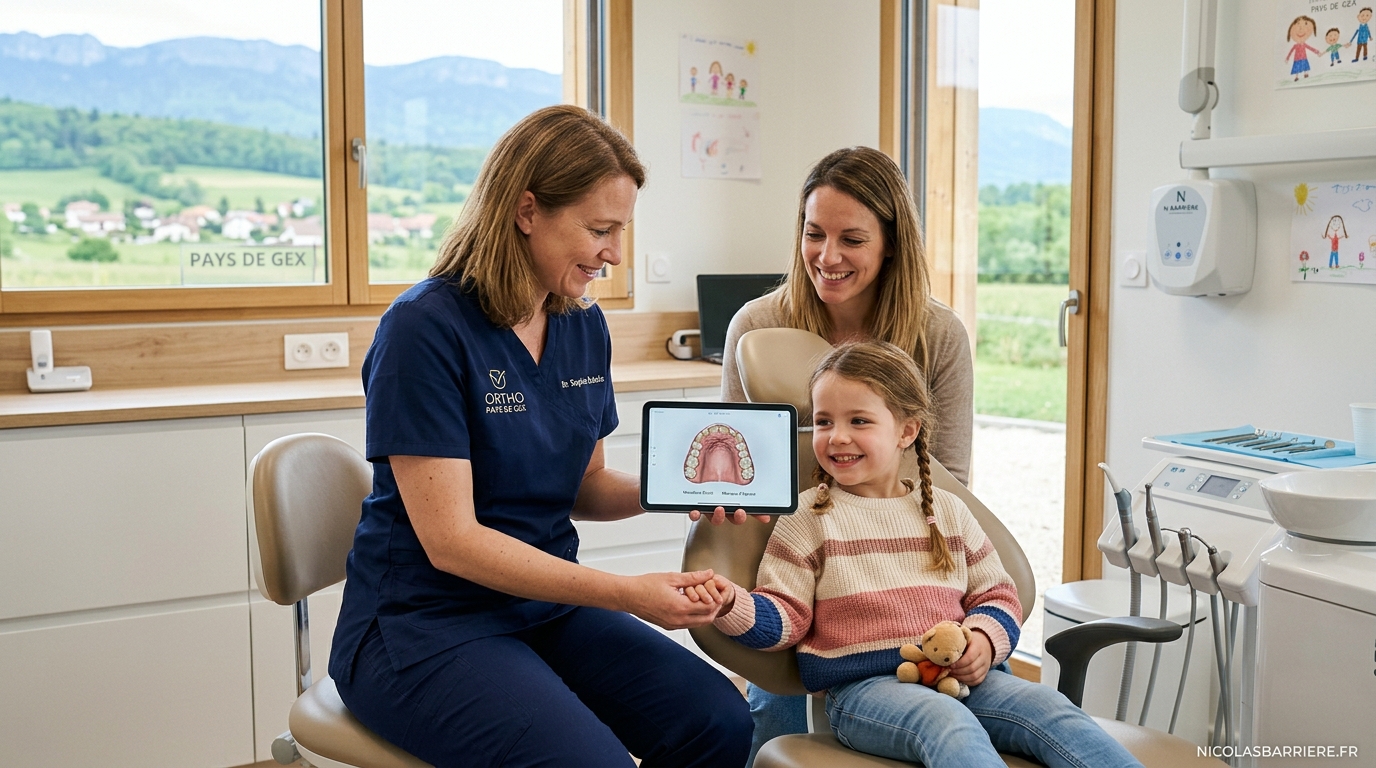
Have you noticed that your child's baby teeth are overlapping or that their palate seems abnormally narrow? At 5 years old, the jaw is still growing, which opens up a valuable therapeutic window.
- A jaw that is too small at age 5 can be identified by a narrow palate, overlapping baby teeth and sometimes mouth breathing.
- The French National Authority for Health (HAS) recommends orthodontic screening from age 6 for transverse maxillary anomalies.
- The treatment is based on interceptive orthodontics: palatal expander, removable appliances or functional trainers, without braces at this age.
In a 5-year-old, a small jaw is characterized by a narrow palate and insufficient space for future permanent teeth. Treatment relies on interceptive orthodontics, which uses small removable appliances or a palatal expander to stimulate the still-malleable bone growth. This early intervention, available at our practice in Divonne-les-Bains, allows for gentle jaw widening and avoids more extensive treatments during adolescence.
This article is part of a larger series: for a general overview of the signs that warrant an initial consultation in early orthodontics, you can consult our guide to early orthodontics in children. Here, we focus specifically on the case of narrow jaw in young children, at the practice in Divonne-les-Bains which receives families from the Pays de Gex and neighbouring Switzerland, and on how this disorder is identified in 2026.
What constitutes a small jaw in a 5-year-old child?
A jaw that is too small in a 5-year-old child, called endognathia or hypomaxilla, This condition refers to an upper jaw whose transverse width is insufficient to properly accommodate the teeth. This disorder manifests as a high-arched palate, very crowded baby teeth, and sometimes a cross occlusion.
At the age of 5, the child is in primary dentition or at the beginning of mixed dentition. The maxilla is not yet fused to the midline: the palatal suture remains open until the end of puberty, but its malleability is greatest before the age of 8. This is why this window is strategic for intervention.
Maxillary endognathia Transverse narrowing of the upper jaw which results in a narrow and deep palate, often associated with a lack of space for permanent teeth.
Interceptive orthodontics A therapeutic approach aimed at correcting an early growth anomaly of the jaws, generally between 4 and 8 years old, by using the bone malleability specific to this age.
How to identify a narrow palace or a lack of space?
Several visible signs at home should alert parents. Some can be observed without equipment, simply by watching your child smile, breathe, or sleep.
👄
Overlapping baby teeth
The incisors are crossing or overlapping when they should be slightly spaced apart at this age.
🏛️
Gothic palace
The palatine vault is high and narrow, V-shaped rather than rounded in a U-shape.
↔️
Cross occlusion
One or more of the upper teeth move inside the lower teeth when the child clenches their jaws.
😮💨
Mouth breathing
The child sleeps with their mouth open, snores slightly or breathes through their mouth during the day.
A normal spacing between baby teeth, called physiological diastema, This is actually a good sign: it indicates that the space provided for the larger permanent teeth will be sufficient. Conversely, overlapping or constricted baby teeth often indicate future crowding.
Important point to note: These signs are not sufficient to establish a diagnosis. Only a clinical examination by an orthodontist, possibly supplemented by impressions or an X-ray, can confirm endognathia and assess its severity. Schedule an appointment for a check-up.
What are the common causes of this jaw disorder?
The causes of a narrow jaw in young children are multifactorial. They often combine a genetic predisposition and functional factors acquired in the early years of life.
Genetic factor
The shape of the jaws is partly inherited. A parent with a narrow palate increases the likelihood for the child.
Mouth breathing
Chronic mouth breathing prevents the tongue from positioning itself correctly against the palate, depriving the latter of the stimulation necessary for its transverse growth.
Prolonged suction
Thumb or pacifier sucking beyond the age of 3 exerts deforming pressure on the palate and promotes its narrowing.
ENT obstruction
Large adenoids, enlarged tonsils or chronic rhinitis force the child to breathe through the mouth and disrupt maxillary development.
«"In young children, the tongue acts as a natural widening of the palate. When it no longer finds its place, for example due to mouth breathing or prolonged sucking, the upper jaw no longer receives the stimulation that guides its growth in width."»
The French Union for Oral Health regularly reminds us of the impact of sucking habits and mouth breathing on jaw development. According to the UFSBD, Acting early on these functional factors often helps to prevent the disorder from becoming permanently established.
Why consult an orthodontist in Divonne-les-Bains from the age of 5?
Consulting an orthodontist as early as age 5 in Divonne-les-Bains is justified by the exceptional malleability of the jawbone at this age and the geographical proximity necessary for close monitoring. The French National Authority for Health (HAS) recommends orthodontic screening during the primary or mixed dentition stage to identify transverse anomalies before they become fixed.
Between the ages of 4 and 8, the median palatine suture The jawbone remains open and cartilaginous. Gentle, progressive pressure is enough to separate the two hemimaxillae by a few millimeters, something that would be impossible to achieve without surgery in an adult. This physiological difference explains why early intervention is preferred.
6 years
Recommended age for a first assessment. The French National Authority for Health recommends a orthodontic screening in primary or mixed dentition before the age of 6 when suggestive signs are present.
Why does geographical proximity matter?
Interceptive treatment involves frequent appointments, often every 4 to 6 weeks. For a family residing in Divonne-les-Bains or coming from the Pays de Gex and neighbouring Switzerland, having a practice in Divonne-les-Bains avoids long journeys to Geneva or Lyon and facilitates regular follow-up.
6 weeks.Average interval between appointments
8 monthsTypical duration of an interceptive phase
15 minDistance from Divonne to the Swiss border
4 yearsMinimum age for first consultation
The Pays de Gex region has a unique characteristic: many cross-border families are covered by both the French national health insurance system and Swiss insurance (LAMal, supplementary insurance). A firm experienced in handling these dual cases significantly simplifies the administrative procedures.
What concrete benefits does an intervention at 5 years rather than at 10 years bring?
To find out if your child's situation corresponds to signs that justify an initial consultation in early orthodontics, A comprehensive assessment of their teeth is recommended. At age 5, the focus is on the growing bone; at age 10, it will shift more towards the teeth.
Without early intervention
- Dental crowding in adolescence
- Extractions are sometimes necessary to free up space
- Longer multi-bracket treatment
- Possible recourse to maxillary surgery in adulthood
With intervention at 5-7 years
- Gentle widening of the palate through orthopedic action
- Space created for permanent teeth
- Nasal breathing often shows improvement.
- Treatment for adolescents simplified or even avoided
Do you have any doubts about your child's jaw?
A clinical examination in our office in Divonne-les-Bains allows us to establish a personalized diagnosis and to assess the opportunity for interceptive treatment.
What type of dental appliance is used to widen the jaw?
Palatal expanders and functional training splints are the main appliances used to widen the jaw of a 5-year-old child. At this age, braces are not used: treatment relies on interceptive devices, fixed or removable, which act on bone growth rather than tooth position.
The role of the palatal expander and removable appliances
The palatal expander is a device fixed to the primary or permanent molars, featuring a central jack that parents activate daily with a quarter turn. This progressive activation separates the two halves of the maxilla at the level of the palatine suture, which is still flexible at this age.
Palatine circuit breaker Fixed orthopedic device used to widen the upper jaw by progressive opening of the median palatine suture, usually during 2 to 3 weeks of activation followed by a retention phase.
The treatment usually takes place in two phases: one active phase for about 2 to 3 weeks during which the parents turn the screw every day, then a containment phase for several months during which the device remains in place without being activated, while the newly formed bone consolidates in the suture.
Clinical assessment and impressions
Examination of the mouth, taking digital or classic impressions, possibly panoramic radiography depending on the indication.
Custom manufacturing
The expander is made in the laboratory from impressions, with bands that will fit precisely onto the child's molars.
Posing and learning
Placement in the chair, demonstration to parents of the daily activation maneuver, handing over of a monitoring booklet.
Daily activation
For 2 to 3 weeks, parents perform the activation at home, usually in the evening before bedtime.
Restraint and monitoring
The device remains in place for several months to stabilize the result, with regular check-ups in the office.
Post-treatment assessment and review
Removal of the device and evaluation of the transverse gain obtained, discussion of a possible removable retainer.
At age 5, orthodontists sometimes use gentler variations such as quad helix, A fixed wire appliance that exerts continuous, gentle pressure, without daily adjustment by the parents. The choice between a breaker and a quad helix depends on the degree of narrowing, the child's cooperation, and the condition of the primary teeth. In all cases, the practitioner is responsible for choosing the appliance best suited to the child's clinical case.
Each interceptive appliance addresses a specific indication. The fixed palatal expander, equipped with a screw, is used for significant transverse narrowing, with an active phase of 2 to 3 weeks followed by approximately 6 months of retention. The fixed quad helix appliance with a continuous wire is suitable for moderate widening in the primary dentition over 6 to 9 months. The removable screw-retained plate treats moderate cases over 8 to 12 months when cooperation is good. The pre-formed removable functional splint addresses the functional component (tongue, breathing) over 12 to 18 months.
Namely: None of these appliances involve brackets bonded to all the teeth as in adolescent treatment. The interceptive phase aims solely to prepare a favorable environment, not to align individual teeth.
Functional education to correct tongue posture
Functional education often complements the mechanical action of the device. Its aim is to restore a high tongue posture (tongue in contact with the palate at rest), nasal breathing, and correct swallowing. Without this work, the enlarged palate risks contracting again.
«"A successful jaw widening procedure is not judged at the time the appliance is removed, but two years later. The stability of the result depends closely on the reprogramming of orofacial functions: without nasal breathing or proper tongue posture, the palate tends to retract."»
How is a narrow jaw diagnosed?
The diagnosis of a narrow jaw in a 5-year-old child is based on a visual and manual clinical examination, supplemented if necessary by digital impressions and a panoramic radiograph. The orthodontist assesses the transverse width of the maxilla, the occlusion, the shape of the palate, and the resting position of the tongue.
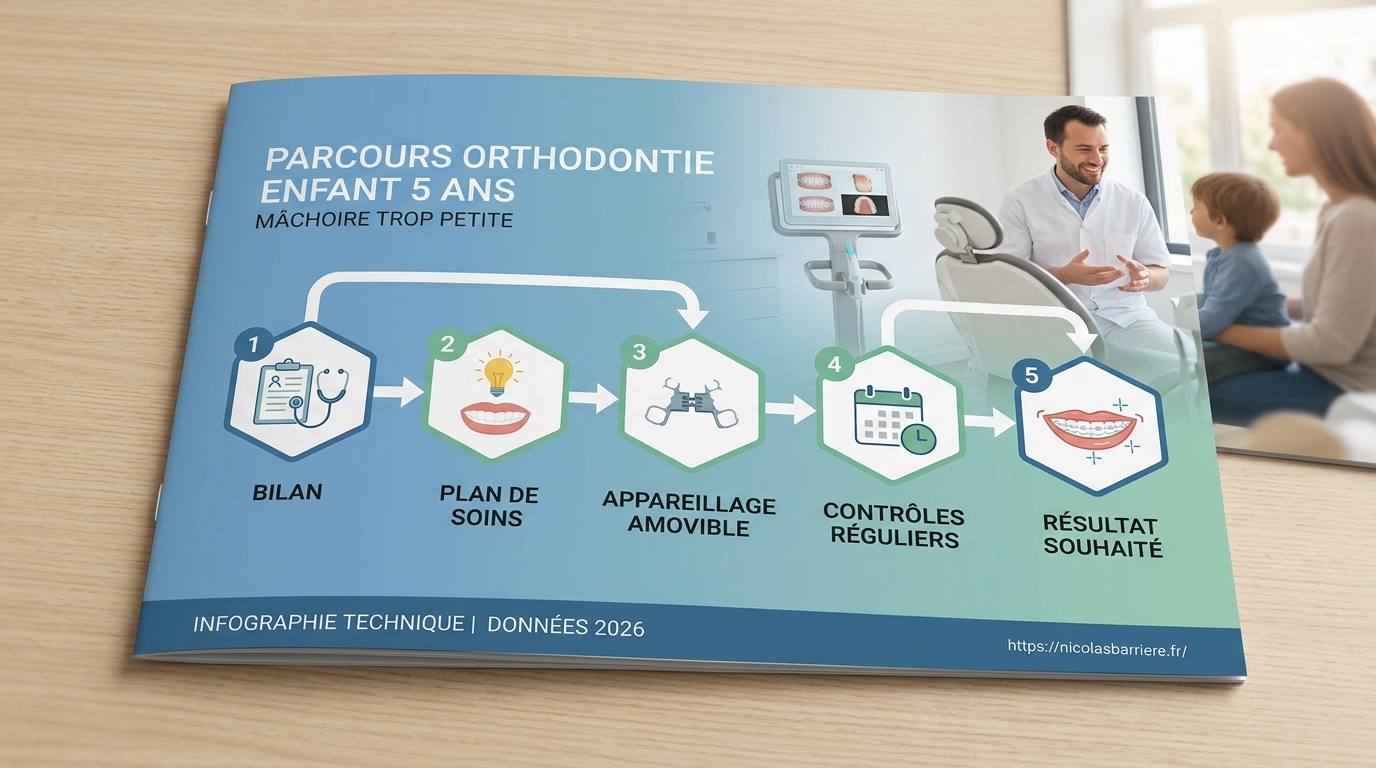
What happens on a first date?
The first meeting is primarily a time for observation and exchange, without any invasive gestures. It usually lasts 30 to 45 minutes and is intended to be reassuring for the child, who discovers the office, the chair and the team in a non-anxiety-inducing environment.
Interview with the parents
Medical history, sucking habits, breathing, snoring, possible ENT disorders.
Extraoral observation
Facial symmetry, position of the lips at rest, nasal or oral breathing.
Endoral examination
Shape of the palate, alignment of baby teeth, occlusion, possible presence of a reversed bite.
Functional assessment
Tongue posture at rest, swallowing, phonation.
Summary and proposals
Explanation in simple terms to the parents and child, discussion of the options: monitoring, exercises, or interceptive treatment.
Practical tip: There's no need to prepare your child with anxiety-inducing medical jargon. Simply present the visit as "an appointment to count teeth." Most 5-year-olds cooperate very well when they feel comfortable.
What additional tests can be offered?
Based on clinical findings, the orthodontist may suggest digital fingerprints (painless, with a small intraoral camera), a panoramic radiography to visualize the germs of permanent teeth, or more rarely a lateral cephalometric radiograph. These examinations are not routinely performed at age 5 and are prescribed only when they provide decisive information.
📝 The recommendations of the French Federation of Orthodontics emphasize the principle of radiological restraint in young children: each image must have a clear clinical justification.
How long does a 5-year interceptive treatment last?
An interceptive treatment at age 5 typically lasts between 6 and 18 months, depending on the device used and the severity of the problem. This initial phase can be followed, several years later during adolescence, by a second phase of dental alignment if necessary.
Month 0
Initial assessment
Diagnosis, impressions, treatment decision.
Month 1
Installation of the device
Adjustment, learning of activation.
Months 1-2
Active phase
Daily activation, close follow-up appointments with device adjustments.
Months 3-8
Restraint
The device remains in place, checks spaced out.
Month 9
Filing and bankruptcy
Withdrawal, evaluation of the result.
Years 6-11
Growth monitoring
Annual check-ups until the permanent teeth erupt.
Between the two phases, the child is seen once or twice a year to monitor the eruption of permanent teeth and check the stability of the widening achieved. This monitoring is essential: it allows the treatment plan to be adjusted as the child grows.
Is the treatment painful?
The palatal expander is not painful but it causes a feeling of pressure, especially in the first few days following each activation. Some children describe a slight tingling sensation in the nose, a sign that the palatal suture is separating as expected. This sensation disappears within a few hours.
This usually reassures children
- No needles were inserted.
- Rapid adaptation in 3 to 5 days
- Normal feeding possible from the first week
- No restrictions for school or sports activities
What to expect
- Speech altered for a few days
- Transiently increased salivation
- Oral hygiene needs improvement
- Avoid very sticky or hard foods
What role do lifestyle habits play in treatment?
Lifestyle habits play a central role in the success and stability of narrow jaw treatment. Nasal breathing, stopping thumb or pacifier sucking, and correct tongue posture are essential for maintaining the result in the long term.
How to support the cessation of thumb or pacifier use?
Prolonged thumb-sucking beyond the age of 3 is recognized as a factor in palate deformation. In 5-year-olds, stopping the habit is often necessary before or during interceptive treatment. Several non-punitive approaches can be offered: resin thumb guards, nighttime gloves, positive reinforcement, and support from a professional if the child is struggling with the deprivation.
Mechanical treatment without correction of the sucking habit exposes the patient to an almost certain recurrence of palatal narrowing.
Why is nasal breathing so important?
Nasal breathing positions the tongue against the palate, which stimulates its transverse growth and maintains its width. Conversely, mouth breathing lowers the tongue and deprives the palate of this natural stimulation. It's a vicious cycle: a narrow palate and mouth breathing perpetuate each other.
An ENT consultation is often recommended alongside the orthodontic assessment when the child breathes primarily through their mouth. Treating any adenoids or chronic rhinitis can facilitate a return to nasal breathing and significantly improve the prognosis of the treatment.
Do you live in Divonne-les-Bains or in the Pays de Gex and have questions?
An initial appointment allows us to answer your questions and calmly assess your child's situation.
What is the cost and coverage of a 5-year treatment?
Before any consideration of cost, it is the clinical diagnosis made by the practitioner that determines the indication and the technique best suited to the child's case. Interceptive orthodontic treatment begun before the age of 16 is covered by French National Health Insurance (Assurance Maladie) after prior approval, up to a fixed six-month period. Supplemental health insurance plans (mutuelles) cover the remaining costs at varying levels depending on the policy, often expressed as a percentage of the Social Security reimbursement base.
Orthodontic treatment falls under the category of covered care with direct agreement: the fee is freely set by the practitioner and communicated to the family before any treatment begins, in a detailed estimate submitted to the Health Insurance for prior approval. The practitioner's expertise and the clinical relevance of the treatment plan remain the determining factors.
Things to check before starting: according to Ameli.fr, Coverage requires prior agreement and treatment must begin before the child's 16th birthday. For cross-border families, the procedures vary depending on the social security system (French, Swiss, or dual).
How does the reimbursement process work for cross-border families?
In the Pays de Gex region, many families contribute to the Swiss health insurance system (LAMal) as a supplement to, or replacement for, the French system. Reimbursement procedures for orthodontics differ significantly between the two systems. A practice experienced in handling Franco-Swiss cases can prepare quotes compatible with both systems and direct patients to the most suitable provider based on their family's circumstances.
📌 Key points to remember
- A jaw that is too small at age 5 is characterized by a narrow palate and a lack of space for future permanent teeth.
- Warning signs at home: overlapping baby teeth, mouth breathing, snoring, prolonged sucking.
- The French National Authority for Health (HAS) recommends orthodontic screening from the age of 6, earlier in the event of suggestive signs.
- Interceptive treatment uses palatal expanders, quad helix or functional educators, without braces at this age.
- The typical duration of an interceptive phase is 6 to 18 months, followed by simple growth monitoring.
- Nasal breathing and stopping sucking are essential for the stability of the result.
- Treatment started before the age of 16 is covered by Health Insurance after prior agreement.

About the author: Dr. Nicolas Barrière
Dr. Nicolas Barrière is an orthodontist, a qualified specialist in dentofacial orthopedics, a former hospital intern, and the founder of his practice in Divonne-les-Bains. He treats children, adolescents, and adults with orthodontic treatments (clear aligners, lingual braces), paying particular attention to the care of patients living near the French-Swiss border.
Areas of expertise: dentofacial orthopedics, interceptive orthodontics for children, clear aligners, lingual orthodontics, management of complex malocclusions, sleep apnea, treatment of temporomandibular joint dysfunctions.
Frequently Asked Questions about Early Orthodontics
What should I do if my child has a jaw that is too small?
It is recommended to schedule an orthodontic assessment as early as age 4 or 5. Early intervention allows for the evaluation of bone growth and the implementation of interceptive treatment if necessary. This assessment is painless and primarily serves to observe the child and provide an opportunity for discussion with the parents.
What type of dental appliance is used to widen the jaw?
The palatal expander is the most commonly used appliance for widening a child's upper jaw. It is a fixed device with a central screw that parents activate daily to gradually separate the palatal suture. Alternatives exist, such as the quad helix or removable plates, depending on the specific needs.
Until what age can a child consult an orthodontist?
A child can see an orthodontist at any age. However, for a narrow jaw, the ideal time to intervene is between 5 and 8 years old, a period when palatal growth can still be easily stimulated. Beyond this age, widening remains possible but becomes more difficult as the palatal suture fuses.
Is orthodontic treatment for children covered by insurance?
Yes, orthodontic treatment for children is covered by French national health insurance (Assurance Maladie), provided that treatment begins before the child's sixteenth birthday and with prior approval. Reimbursement is made in the form of six-monthly allowances, supplemented in some cases by private health insurance.
Which health insurance plan offers the best reimbursement for children's orthodontics?
The best health insurance plans for children's orthodontics are those offering enhanced dental coverage with a fixed amount or a high percentage based on the national health insurance reimbursement rate (often expressed as a percentage, such as 300 or 400 %). It's advisable to compare annual coverage limits and check the waiting period before committing to any plan.
Do you need a prescription to go to the orthodontist?
No, no medical prescription is required. Parents can schedule an appointment directly with an orthodontist to have their child's teeth and jaw assessed. Consultations with a qualified specialist in dentofacial orthopedics are available through direct access within the coordinated care pathway.
Does the palatal expander hurt my child?
The palatal expander is not painful but causes a feeling of pressure in the hours following each activation. Most children adapt to it in 3 to 5 days and quickly resume a normal diet. Speech is slightly altered at first and then normalizes within one to two weeks.
Should mouth breathing be treated at the same time?
Yes, mouth breathing must be addressed alongside orthodontic treatment. An ENT consultation is often recommended to check for adenoids or nasal obstruction. Without a return to nasal breathing, the risk of relapse after palatal expansion is significant.
📚 Sources and references
Official and institutional sources:
- French National Authority for Health: Orthodontic screening in primary and/or mixed dentition
- HAS: Indications for dentofacial orthopedics in children and adolescents
- Ameli.fr: Reimbursement for orthodontic treatments
- Ameli.fr: Dental malpositions
Academic and scientific sources:
- Cochrane Library: Orthodontic treatment of dental crowding in children
- Epidemiological study on malocclusions and oral dysfunctions in children in France
- Recommendations of the French Federation of Orthodontics
Resources for the general public:
📖 Also read:
- Early orthodontics in children: at what age and for what signs should intervention be considered?
- Fixed or removable appliance for a 7-year-old child: how this choice is determined
- Misaligned teeth in the primary dentition: what you need to know in a 4-year-old child
- Jaw widening in 6-year-old children: alternatives to traditional braces
📝 Important : This article is strictly for informational and public health purposes. It is not a substitute for a clinical consultation. Each situation is unique, and a personalized opinion requires a thorough examination in the office. For any questions about your child's jaw, Make an appointment.
 French
 English