
Treatment with clear aligners in adults is based primarily on an accurate clinical diagnosis. The cost and technique used (aligners, ceramic braces, lingual orthodontics) depend on your anatomy and your goals, not the other way around.

Clear aligners for adults: the different options and how to choose the treatment
Written by Nicolas Barrière : Orthodontist, Qualified Specialist in Dentofacial Orthopedics, founder of the practice at nicolasbarriere.fr. Updated on . Reading time: approximately 12 minutes.
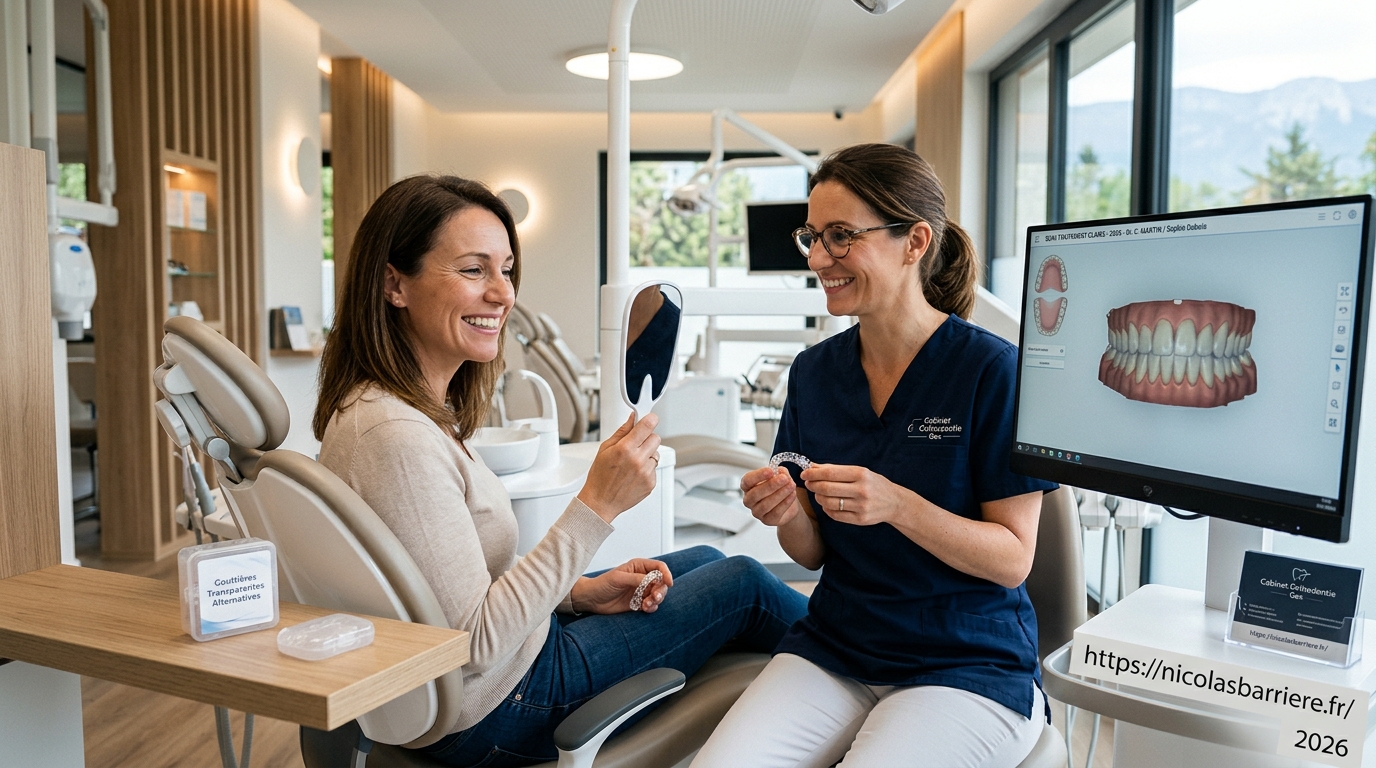
Many adults wish to straighten their teeth discreetly and wonder about the most suitable solution for their situation. The answer depends primarily on specific clinical criteria, assessed by the orthodontist, who is responsible for choosing the appropriate technique.
- The choice of treatment with clear aligners in adults is based primarily on the clinical diagnosis of the practitioner.
- The orthodontist determines the appropriate technique (visible braces, lingual braces or aligners) according to your anatomy and malocclusion.
- Health insurance does not reimburse adult orthodontics: only supplementary health insurance with a dental package can reduce the out-of-pocket expenses.
For an adult, the choice of clear aligner treatment depends on the clinical complexity of the case and not simply on price. The orthodontist is responsible for selecting the most suitable appliance, whether it be visible braces, lingual braces, or aligners. Any solution requires a precise diagnosis and regular follow-up appointments with a qualified orthodontist, particularly in Divonne-les-Bains, to avoid the risks associated with online 100% free offers.
Health alert point: All adult orthodontic treatment requires a prior clinical examination (X-rays, periodontal assessment, 3D impressions). Offers for aligners sold remotely, without an in-office consultation, expose patients to real risks (gum recession, occlusion problems, treatment failure). A personalized assessment always requires a consultation.
What clinical criteria determine the choice of a mouthguard system?
The choice of a clear aligner system in adults is based on the practitioner's clinical diagnosis: complexity of tooth movements, periodontal condition, nature of malocclusion and estimated duration of treatment. Technology is only a tool at the service of a medical decision, never the other way around.
Before discussing the treatment process, it is essential to understanding the different orthodontic techniques for adults to understand why each case requires a tailored approach. Two patients with "overlapping" teeth may receive two very different treatment plans depending on their underlying anatomy.
Clear aligner A clear aligner is a removable tray made of thermoplastic resin, custom-made from a 3D scan, worn 20 to 22 hours a day to gradually move teeth according to an orthodontic treatment plan validated in the office.
The complexity of the dental movements to be performed
Some movements are simple (frontal tilts, small overlaps), others are complex (molar rotations, extrusions, closing of spaces after extraction). The more technical the movements, the more efficient and feature-rich the solution will need to be. cleats (small resin reliefs glued onto the teeth to improve the anchoring of the aligners).
🦷
Simple cases
Frontal relapse, slight incisor overlap: compatible with a short protocol.
⚙️
Intermediate cases
Moderate bulk, axis correction: compatible with complete treatment with aligners.
🔬
Complex cases
Extractions, associated surgery, skeletal malocclusions: require advanced expertise.
The estimated duration of orthodontic treatment
The longer the treatment, the greater the number of aligners manufactured, which influences the course of the treatment. A 6-month treatment (light correction) uses 15 to 25 aligners, while a complete 18- to 24-month treatment may require 40 to 60 successive aligners, plus any necessary refinements at the end of the course.
Periodontal condition and prior oral health
An adult with gingivitis, periodontitis, or active cavities must first clean their mouth before any tooth movement. According to the recommendations of the French Federation of Orthodontics, A prior periodontal assessment is essential in adults: as supporting tissues are less tolerant than in adolescence, poorly controlled movement can aggravate pre-existing damage.
Note: Adult orthodontics often involves collaboration with other disciplines (periodontology, prosthodontics, surgery) depending on the complexity of the case. This is called a multidisciplinary approach, essential to guarantee the stability of the result.
How does the practitioner determine the appropriate technique for an adult?
The choice of technique is based entirely on the clinical evaluation of the practitioner, who guarantees the solution best suited to your case. It is the diagnosis, and not a price criterion, that guides us towards a full range or a short protocol when the situation allows.
The practitioner, responsible for choosing the technique
The orthodontist is the only one who can determine the most appropriate technique: visible braces, lingual braces or clear aligners. This choice stems from a comprehensive examination (X-rays, periodontal assessment, 3D scan) and a precise analysis of the necessary tooth movements. The patient does not select a solution independently; they benefit from the practitioner's expertise, who assumes clinical responsibility for the outcome.
Short protocols for minor corrections
When an adult presents with only a small post-adolescent recurrence or a slight frontal aesthetic defect, the practitioner may, if the clinical indication justifies it, refer to a short protocol. This decision is based on the limited nature of the required tooth movements, not on budgetary considerations. These treatments are limited to a small number of aligners and a duration of 6 to 9 months, strictly reserved for clinically compatible cases.
What a short protocol allows
- Correcting frontal recurrence after initial adolescent treatment
- Realigning the upper incisors for a controlled aesthetic result
- To manage limited and well-defined tooth movements
- To respond to a specific clinical indication assessed by the practitioner
This is something that a short protocol does not allow
- Correcting a skeletal malocclusion
- Close off extraction areas
- Treating significant molar rotations
- Resolving a posterior occlusion problem
Are there any low-cost aligner offers online?
Yes, but they present significant clinical risks. Some companies sell mouthguards by mail order, based solely on a mold sent by the patient.’Health Insurance and professional bodies regularly warn about the lack of prior radiography, periodontal examination and clinical follow-up in these circuits.
«"The clear aligner is a medical device whose effectiveness relies on a prior clinical diagnosis and regular follow-up. Without X-rays or examination of the supporting tissues, there is a risk of moving teeth on a weakened surface, with consequences that are sometimes irreversible."»
How is a treatment quote for an adult calculated?
The quote for treatment with clear aligners includes the initial assessment, 3D planning, manufacturing of the aligners, follow-up consultations and the final retention phase. Each station corresponds to a clinical time and an identifiable stage of the journey.
-
Initial assessment and diagnosis
Clinical examination, panoramic and cephalometric radiographs, photographs, intraoral 3D scan. This step determines everything that follows.
-
Treatment plan and virtual setup
Digital simulation of dental movements, validated with the patient before manufacturing.
-
Custom-made aligner manufacturing
Laboratory production, according to the technique chosen and the number of trays.
-
Follow-up consultations (every 6 to 8 weeks)
Control of movements, verification of cleats, delivery of the next series of aligners.
-
Final restraint phase
Adhesive wire or night guard, essential to stabilize the result in the long term.
The quote is prepared after the initial consultation, based on the diagnosis and the chosen treatment plan. It depends on the complexity of the case, the estimated duration, and the number of appointments required.
A precise diagnosis for a quote tailored to your situation
Every situation is unique. A consultation at the office allows us to establish a personalized treatment plan and a detailed quote, tailored to your anatomy and your objectives.
Why choose an orthodontist in Divonne-les-Bains?
Geographical proximity conditions the quality of clinical follow-up: regular consultations, real-time adjustments and management of unforeseen events (broken aligner, detached attachment, unusual discomfort). A treatment with aligners is not a product delivered to your home, it is a treatment journey.
The danger of 100 % online alignment offers
Platforms selling clear aligners without in-office consultation expose patients to real clinical risks: receding gums, temporomandibular joint dysfunction, and tooth loss in the most serious cases. The absence of prior radiography makes it impossible to detect periodontal disease, a short root, or underlying caries.
Health vigilance: Any tooth movement triggers localized bone resorption, which is reversible under normal conditions but potentially pathological if the supporting tissues are weakened. No scan or X-ray can be replaced by a simple photo taken at home. A personalized opinion always requires a clinical consultation and a thorough examination.
The importance of diagnosis and close monitoring
Consulting a specialist in Divonne-les-Bains allows you to benefit from a professional 3D scan, a complete periodontal check and a readjustment of the treatment at each stage. Personalized medical care, with an accessible practitioner, remains the most reliable guarantee of a lasting result. In case of doubt or discomfort, a quick appointment is possible, something no online platform can offer.
📍
Local roots
A practice located in Divonne-les-Bains, 15 minutes from Nyon and the Swiss border, allows for accessible follow-up for French and border patients.
3D Scanner
Precise digital impressions, without molding material.
Insurance files
Management of reimbursements from Swiss LAMal and supplementary insurance.
Regular monitoring
Follow-up appointments every 6 to 8 weeks to adjust the treatment.
What refunds are possible for an adult?
Health insurance does not cover orthodontics for adults: only treatment started before the 16th birthday entitles you to basic reimbursement. For adults, coverage is based exclusively on the supplementary health insurance policy taken out.
Restraint Retention is the stabilization phase that follows active orthodontic treatment. It uses a wire bonded behind the teeth or a retainer worn at night, and aims to prevent relapse, that is, the gradual return of the teeth to their original position.
What the Health Insurance says for adults
According to the Health insurance coverage rules, Orthodontic treatment is only covered by health insurance if it is requested before the patient's 16th birthday. After this age, no reimbursement from Social Security is possible, except in the specific case of orthognathic surgery associated with a recognized medical condition.
The role of supplementary health insurance
Reimbursement depends entirely on the guarantees taken out, often expressed as an annual lump sum or as a percentage of the agreed rate. Some health insurance companies offer dedicated "adult orthodontics" packages. It is essential to send the orthodontist's detailed quote to the insurance company before starting treatment to know the exact out-of-pocket expenses.
- Request a detailed quote from the orthodontist before making any commitments.
- Send this quote to the health insurance company to obtain written approval for coverage.
- Check if the contract includes an "adult orthodontics" package.
- Anticipate the payment schedule in agreement with the firm
- Keep the receipts for any potentially deductible expenses.
Comparison of discreet alignment options in adults
Beyond clear aligners, two other options offer high discretion in adults: ceramic braces and lingual orthodontics. Each one responds to specific requirements and different comfort preferences.
| Criteria | Clear aligners | Ceramic rings | Lingual orthodontics |
|---|---|---|---|
| Visual discretion | ✓ | ~ | ✓ |
| Removable | ✓ | ✗ | ✗ |
| Adaptable to all cases | ~ | ✓ | ✓ |
| Number of appointments | ✓ | ~ | ~ |
| rapid initial adaptation | ✓ | ~ | ~ |
What exactly does an adult orthodontic treatment process look like?
The process for an adult wishing to align their teeth follows a structured progression: consultation, 3D diagnosis, presentation of the chosen technique, validation of the treatment plan, active follow-up phase, then retention. Each step has a specific clinical role.
-
Initial consultation at the office
Listening to expectations, a complete clinical examination, and an assessment of gum and dental health. This is the moment when the practitioner identifies the main features of the case.
-
3D diagnostic and scan
Panoramic and cephalometric radiographs, photographs and digital impressions. This data allows for the construction of an accurate simulation of possible movements.
-
Presentation of the chosen technique and quote
The practitioner, who guarantees the choice of appliance, presents the clinically appropriate technique (aligners, visible or lingual braces, short or complete protocol) with the corresponding quote.
-
Validation of the treatment plan
After consideration and possible feedback from the health insurance company, the patient confirms the chosen option. The laboratory then manufactures the complete set of aligners.
-
Active phase of treatment
The aligners are worn for 20 to 22 hours a day, with follow-up appointments every 6 to 8 weeks. The practitioner monitors the progress of the teeth, checks the attachments, makes any necessary adjustments, and dispenses the next set of aligners. Final adjustments may be made at the end of the treatment to perfect the result.
-
Restraint
Once alignment is achieved, a retainer (bonded wire or night guard) is fitted to stabilize the result and prevent recurrence in the long term.
Good to know: For an adult in the midst of their professional career, the initial consultation is a crucial time to ask all questions related to daily life (meals, sports, meetings, photos). A clear understanding of the protocol from the outset promotes adherence and therefore the success of the treatment.
What trends are observed in adult orthodontics?
The demand for orthodontics among adults has been steadily increasing for the past ten years, driven by aesthetic expectations and the democratization of discreet solutions. According to data published by the French Federation of Orthodontics, the proportion of adult treatments continues to increase in specialist practices.
«"Adult orthodontics is booming, with requests focused on the aesthetics of the smile but also on function (chewing, articulation, breathing). The diagnosis must integrate these dimensions."»
In practice, we regularly observe that adults seeking help today are better informed than they were ten years ago: they arrive with a clear idea of clear aligners, but also expect personalized support that no digital platform can replace.
«"The question of budget is legitimate, but it should never take precedence over the clinical question. The best treatment is the one that corresponds to your anatomy, respects your supporting tissues, and that you can wear diligently for several months. The quote stems from this reasoning, not the other way around."»
📌 Key points to remember
- The cost estimate for treatment with clear aligners in adults is established after diagnosis, depending on the complexity of the case and the expected duration.
- The practitioner is responsible for choosing the technique (visible braces, lingual braces or aligners), based on the clinical diagnosis.
- A short protocol may be indicated when the case is limited to a frontal correction, at the clinical decision of the practitioner.
- Health insurance does not reimburse adult orthodontics: only supplementary health insurance can cover part of the costs.
- The choice of solution always depends on the clinical diagnosis: complexity, duration, periodontal health.
- Offers of 100 % aligners online, without prior examination, expose patients to real clinical risks.
- Close monitoring in Divonne-les-Bains remains the best guarantee of a stable and lasting result.

About the author: Dr. Nicolas Barrière
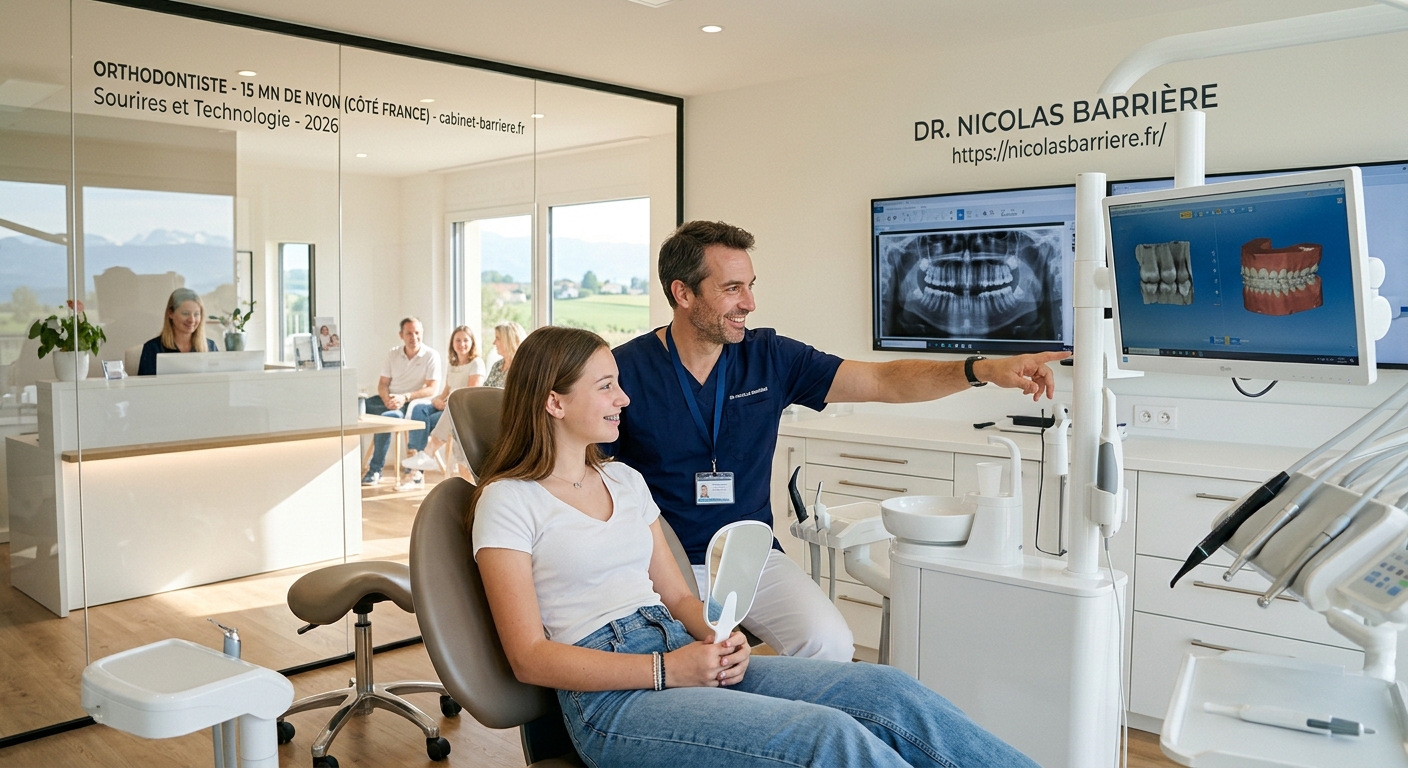
Dr. Nicolas Barrière is an orthodontist, a qualified specialist in dentofacial orthopedics, a former hospital intern, and the founder of his practice in Divonne-les-Bains. He treats children, adolescents, and adults with orthodontic treatments (invisible aligners, lingual orthodontics), paying particular attention to the care of patients living near the French-Swiss border.
Areas of expertise: Dentofacial orthopedics, adult orthodontics, invisible aligners, lingual orthodontics, multi-bracket orthodontics (ceramic and aesthetic brackets), orthognathic surgery associated with orthodontics, sleep apnea, retention and relapse management.
LinkedIn profile of Dr. Nicolas Barrière · Meet the firm's team
FAQ: Costs, reimbursements, and alternatives for your smile
How to choose the right orthodontic treatment in adulthood?
The choice of treatment is based on the practitioner's clinical diagnosis, which ensures the most suitable technique for your case (visible braces, lingual braces, or clear aligners). A comprehensive examination (X-rays, periodontal assessment, 3D scan) will determine the appropriate solution. Avoid online platforms lacking medical supervision, as these expose you to clinical risks.
How is the quote for invisible orthodontics for adults calculated?
The quote is prepared after the initial consultation, based on the diagnosis and the chosen treatment plan. It includes the initial assessment, 3D planning, custom-made aligners, follow-up appointments, and the final retention phase. Clinical complexity, the estimated duration of treatment, and the number of appointments are the main factors influencing the quote.
Does health insurance cover invisible orthodontics for adults?
Some health insurance plans offer a dedicated "adult orthodontics" package. It is essential to send the orthodontist's detailed estimate to your supplemental health insurance provider before starting treatment to obtain written approval and know the exact out-of-pocket cost.
Who decides which orthodontic technique to use?
The orthodontist is responsible for choosing the appliance, based on a thorough clinical diagnosis. They will determine the most suitable technique for your case (visible braces, lingual braces, or aligners) according to the complexity of the tooth movements, the periodontal condition, and your goals. The patient benefits from this expertise rather than having to select a solution themselves. Payment plans are also available.
Does the CPAM (French National Health Insurance Fund) reimburse adult orthodontics?
No. Health insurance only covers orthodontics if treatment begins before the patient's 16th birthday. Adults are not eligible for basic reimbursement from social security, except in specific cases related to medically recognized orthognathic surgery.
Which health insurance plan offers the best reimbursement for adult orthodontics?
Reimbursement depends on the coverage chosen, often expressed as an annual allowance. High-end plans that include coverage for adult orthodontics are the most advantageous. It is essential to compare plans and send the quote to your supplemental health insurance provider before beginning any treatment.
How long does aligner treatment last in adults?
The duration varies depending on the clinical complexity. A short protocol (minor frontal correction) lasts 6 to 9 months. An average treatment takes 12 to 15 months. A complete treatment, including complex movements, may require 18 to 24 months, followed by a retention phase essential for stabilizing the result.
Can clear aligners be combined with other techniques?
Yes. Depending on the clinical assessment, the practitioner may combine aligners and braces on certain teeth, combine an aligner protocol with periodontal or prosthetic treatment, or even orthognathic surgery. These multidisciplinary approaches are common in adults to ensure a stable functional and aesthetic result.
Ready to have your case assessed at the firm?
A complete clinical examination and a 3D scan allow us to establish the treatment plan best suited to your anatomy, with a detailed and transparent quote.
📚 Sources and references
Official and institutional sources:
- Ameli: Reimbursement for orthodontic treatments
- Ameli: Treatment of dental malpositions
- Ameli: Orthodontic diagnosis of dental malpositions
- French Federation of Orthodontics: Updated recommendations 2020
- CNP ODF-ODMF: Patient Information Sheets
- SFODF: Recommendations for good practice on restraint
- Economie.gouv: How to choose your dental practitioner
Encyclopedic and academic sources:
- Wikipedia: Orthodontics
- Wikipedia: Clear aligners
- Wikipedia: Align Technology (Invisalign)
- PubMed: Orthodontic treatment in adults, compliance and satisfaction
- Faculty of Dental Surgery of Strasbourg: Dentofacial Orthopedics
📖 Also read:
- Braces or clear aligners: understanding the different orthodontic techniques for teens and adults
- Misaligned teeth in adults: orthodontics or veneers, two different approaches
- Lingual braces and clear aligners: comfort, adaptation and everyday experience
- Invisible aligners for teenagers: from what age is this technique recommended?
- Make an appointment at the office


 French
 English